
One of the strategies that people use to avoid feeling anxious is simply to avoid the source of their anxiety. Children might run indoors if they see a bee outside, refuse to talk in social interactions out of fear that they will be judged for what they say, or beg their caregiver to stay home because they fear the caregiver will get in a car accident and never come back.
Sally, for example, is afraid of germs, and refuses to play with her siblings in the backyard. She also misses out on family walks and trips to the neighborhood park.
When Sally avoids her fears, those fears only get bigger and bigger. When children avoid their fears, they may never learn that they can overcome them, and they trick their brains into thinking that something safe is really dangerous. If children never face their fears, they never learn that their feared outcome is unlikely to happen, or that if it does happen, it is not actually as bad as they think it will be. Avoiding a fear actually makes the fear stick around for longer. Avoidance can trick your brain into thinking something is more dangerous than it actually is.
This is why it’s important that we help our kids face their fears gradually. This is what psychologists call “exposure,” which means exposing yourself to feared situations. In essence, exposure is the opposite of avoidance. While anxiety serves an important purpose by helping us recognize and avoid danger, too much anxiety is not only upsetting, but it can also keep children from engaging in fun and important experiences, make it harder to develop important life skills, and add stress to the family unit.
When we are in an anxiety-inducing situation, fear can increase quickly, making us believe that it will continue to increase the longer we remain in the situation. However, when someone stays in a feared situation, feelings of anxiety eventually peak and then decrease. The longer someone stays in the situation, the more anxiety levels drop. This graph shows you what happens to anxiety levels during most exposure situations. (The graph shows anxiety level increases during the time spent in a feared situation, then decreases as time spent progresses).
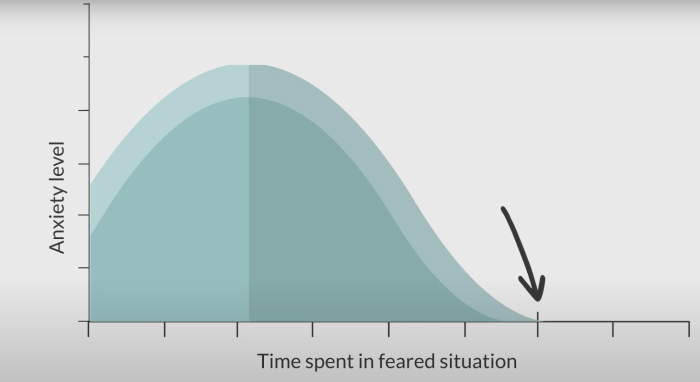
During that process, children learn that anxiety does not last forever, and also
- That their feared outcome might not happen
- That even if it does, they can usually handle it
- That they GOT THIS!
In the next part of LUNA – you are going to learn how to help your child slowly face up to situations that they fear so that they can learn to cope with their anxiety. Don’t worry, though, your child will not be facing their biggest fear right away. You would not expect an astronaut to know how to fly a spaceship on their first day; they need to train and hone their skills. People must do the same when overcoming their anxiety!
“Exposure therapy” helps people gradually face their fears in a practical way. An “exposure hierarchy” involves a series of steps, with each step including a specific feared situation that a person faces. In LUNA, we call exposure hierarchies “mission plans.” The first step is the easiest, and each subsequent step becomes harder and harder, until the last, most difficult step. The steps may involve different, related tasks that target the same fear, or they may involve the same task, with modifications added in each step that make it more difficult. Your child can repeat a step until they feel ready to move on the following step.
Because it is hard work to face your fears, your child will earn a reward each time they complete a step. With each step, you will see your child’s confidence grow, and over time, their anxiety will decrease.
Now that you have watched the videos on mission plans or exposure therapy, we wanted to present Neil and Sally’s first mission plans as a preview. Neil's first mission plan gives ideas for what you might do with a younger child and Sally's first mission plan might be closer to what an older child or teen would use.
This week, you will work together with your child to make your child's first mission plan.
Download a PDF version.
| Step | Anxiety Rating 0-10 OR Easy - Medium - Hard | Reward / Brave Bucks |
|---|---|---|
| Neil is in a dark room with his mom for 2 minutes (during the day). | 1 | 10 extra minutes of screen time |
| Neil is in a dark room with his mom for 2 minutes (at night). | 2 | Choosing breakfast |
| Neil is by himself in a room with his nightlight on for 2-3 minutes (during the day). | 3 | Choosing a board game for family game night |
| Neil is by himself in a room with his nightlight on for 2-3 minutes (at night). | 5 | Choosing a toy to bring in the car on the way to school |
| Neil will stay in bed for 10 minutes with his mom sitting in a chair outside his room that he can see from his bed. If he does not fall asleep in that time, his mom will return to his bedside (like usual). His nightlight is on. | 7 | Screen time on the drive to school |
| Neil will stay in bed for 10 minutes with his mom sitting in a chair outside his room that he cannot see. If he does not fall asleep in that time, his mom will move the chair where it is visible. His nightlight is on. | 8 | Neil can bring his dog on the drive to and from school |
| Neil will stay in bed for 10 minutes with his mom in a different part of the house. If he does not fall asleep in that time, his mom will move closer to his room. His nightlight is on. | 9 |
Day trip to NASA and a souvenier |
Download a PDF version.
| Step | Anxiety Rating 0-10 OR Easy - Medium - Hard | Reward / Brave Bucks |
|---|---|---|
| Sally asks her good friend Joana to borrow a pencil | 2 | 1 brave buck |
| Sally asks her classmate, Rita, who she does not know well, to borrow a pencil | 3 | 2 brave buck |
| Sally sits next to Rita during lunch | 4 | 3 brave buck |
| Sally texts Rita a funny meme | 5 | 4 brave buck |
| Sally makes friendly chat with Rita during breaks | 6 | 6 brave buck |
| Sally asks Rita if she wants to meet at the mall to hang out | 7 | 7 brave buck |
| Sally asks Rita if she wants to come over to her house to watch a movie together | 7 | 7 brave buck |
| Sally invites Rita for a sleepover | 8 | 8 brave buck |
| Sally joins the rest of Rita's friends during lunch and makes conversation with the group | 10 | 10 brave buck |