Home
  • Healthcare
    • Specialties
      • Cardiovascular Care
      • Oncology
      • Neurosurgery
      • Primary Care
      • View All Specialties >
    • For Health Professionals
      • Refer a Patient
      • Clinical Trials
      • Professional Development
      • View All >
    • For Patients & Visitors
      • MyChart Login
      • Accepted Insurance
      • Pay My Bill
      • Patient Information
      • View All >
    • Clinical Trials
      • Autism
      • Cancer
      • Obesity
      • Substance Abuse
      • View All Clinical Trials >
    • Find a Doctor
    • Make an Appointment

    General Inquiries

    Call today to schedule an appointment or fill out an online request form. If requested before 2 p.m. you will receive a response today.

    CALL

    713-798-1000

    Monday – Friday 8 a.m. – 5 p.m.


    ONLINE

    Request Now

    Request non-urgent appointments

    Request an appointment, learn about your rights as a patient, read about what to expect from your appointment, and more.

    As Houston's premier academic medical practice, Baylor Medicine delivers compassionate, innovative, evidence-based care.
    Find a Doctor

  • Education
    • Degree Programs & Admissions
      • M.D. Program
      • Ph.D. Programs
      • DNP Program (Nurse Anesthesia)
      • Genetic Counseling Program
      • P.A. Program
      • Orthotics & Prosthetics Program
      • Baccalaureate/M.D. Programs
      • Dual Degree Programs
      • View All Programs >
    • Financing Your Education
      • Tuition & Fees
      • Financial Aid
      • CARES ACT
    • Schools
      • School of Medicine
      • Graduate School of Biomedical Sciences
      • National School of Tropical Medicine
      • School of Health Professions
    • Advanced Training Programs
      • Residency Programs
      • Clinical Fellowships
      • Postdoctoral Research Positions
      • Continuing Professional Development
      • Diploma in Tropical Medicine
      • View All >
    • Resources
      • Departments
      • Academic Centers
      • Academic Calendars
      • Education Cores
      • View All >
    • Information For...
      • Students
      • Postdoctoral Researchers
      • Faculty
      • Alumni
    get-to-know-houston

    America's fourth-largest city is a great place to live, work, and play. Find out why.
    Get to Know Houston

  • Research
    • Research Offices
      • Advanced Technology Cores
      • Clinical Research
      • Institute for Clinical & Translational Research
      • Office of Research Leadership
      • Research IT
      • Sponsored Programs
    • Research at Baylor
      • Academic Centers
      • Departments
      • Faculty Labs
      • From the Labs
      • News
      • Our Research
      • Research Centers
      • Strategic Research Center
    • Additional Research Services
      • BCM Innovation Institute
      • Service Labs
      • VIICTR
    get-to-know-houston

    America's fourth-largest city is a great place to live, work, and play. Find out why.
    Get to Know Houston

  • Community
    • Healthcare Outreach
      • Community Programs
      • More >
    • Global Outreach
      • Global Health
      • Global Programs >
    • Educational Outreach
      • SMART Program
      • BioEd Online
      • More >
    • General Resources
      • Community Events
      • News
      • Blogs
      • Baylor in the Community
    get-to-know-houston

    America's fourth-largest city is a great place to live, work, and play. Find out why.
    Get to Know Houston

  • About
    • About Us
      • Academic Centers
      • Alumni
      • Careers
      • Departments
      • Giving
      • Leadership
      • Mission, Vision, Values
      • News
      • Our Affiliates
      • Fast Facts
      • Accreditation
    • Offices
      • President's Office
      • Office of Research
      • Ombuds Office
      • BCM Innovation Institute
      • View All >
    • Our Campus
      • Compliance
      • Safety and Security
      • Resource Stewardship & Sustainability
      • Team Shop
      • Find a Person
    get-to-know-houston

    America's fourth-largest city is a great place to live, work, and play. Find out why.
    Get to Know Houston

  • GIVE
  • CAREERS
  • INTRANET
  • Careers
  • Contact Us
  • News
LUNA (Learning to Understand and Navigate Anxiety)
  • Caregiver Modules
  • Child Modules
  • Teen Modules
  • Teen Caregiver Modules
  • ASTRO Teen Modules
  • ASTRO Teen Caregiver Modules
  • Caregiver Modules
  • Child Modules
  • Teen Modules
  • Teen Caregiver Modules
  • ASTRO Teen Modules
  • ASTRO Teen Caregiver Modules
  1. Baylor College of Medicine
  2. Research
  3. Faculty Labs
  4. LUNA (Learning to Understand and Navigate Anxiety)
  5. Caregiver Modules
  6. Module 10: Parenting Strategies for Managing Challenging Behavior
  7. Managing Challenging Behaviors by Focusing on Antecedents
  • Caregiver Modules
    • Module 1: About LUNA, Anxiety and Your Child's Goals
      • Design of LUNA
      • Structure of our Treatment Program
      • What is Anxiety?
      • Supplemental Information for Autism: Understanding Anxiety in Autistic Children
      • When Does Anxiety Become a Problem?
      • Anxiety or Something Else
      • My Child's Anxiety
      • Setting Goals
      • Summary
    • Module 2: Learning How to Identify Anxiety and Motivate your Child
      • What is Anxiety is Made of?
      • Measuring How Anxious You Are
      • LUNA Rewards System
      • Brave Bucks with a Rewards Menu
      • Direct Rewards
      • Direct Rewards, Brave Bucks, or both?
      • Summary
    • Module 3: The Avoidance Cycle and Fix-Its
      • What Are Quick Fixes?
      • Accommodation of Anxiety Behaviors
      • Congratulations!
    • Module 4: Facing our Fears - Preparing for Mission Plans
      • Avoidance versus Exposure
      • Creating Mission Plans
      • Select a Target Fear
      • Supplemental Information for Autism: Choosing mission plans
      • Specific Mission Plan Goal
      • Mission Plan Steps
      • Assign Anxiety Ratings
      • Make a Rewards Plan
      • Summary
    • Module 5: Executing Mission Plans
      • Plan Your Practice
      • Monitor Progress
      • Repeat Steps of your Mission Plan while also Mixing it Up
      • Debrief After Mission Plan Practice
      • Forms to use When Completing Mission Plans
      • Troubleshooting Mission Plans
      • Summary
    • Module 6: Learning Coping Skills to Manage Anxiety
      • What are Coping Skills? 
      • Relaxation and Mindfulness Skills
      • Other Mindfulness Exercises
      • Choosing your Coping Tools
      • Supplemental Information for Autism: Self-Stimulating Behaviors or "Stimming" as Coping
      • How to Approach Coping Practice
      • A Note on Coping Skills and Exposure Therapy (Facing Fears)
      • Summary
    • Module 7: Testing Expectations during Mission Plans
      • Changing expectations through mission plans
      • Experiencing Feared Consequences
      • Reflecting after doing mission plan activities
      • Summary
    • Module 8: Social Coaching
      • Social Skills
      • Supplemental Information for Autism: Social Coaching
      • Handling Bullying
      • Social Coaching Instructions
      • Social Coaching Example
      • Planning a Social Coaching Mission Plan Step
      • Summary
    • Module 9: Mission Plans for Autism-Related Anxiety
      • Targeting Anxiety Related to Sensory Sensitivity
      • Example of a mission plan with sensory components
      • Making Mission Plans Gradual for Anxiety Related to Features of Autism
      • Example of a mission plan with insistence on sameness and wanting to stick to routines
      • Your Turn to Practice
      • Caregivers Module 9 Summary
    • Module 10: Parenting Strategies for Managing Challenging Behavior
      • How Behaviors are Learned: The ABC Model
      • Supplemental Information for Autism: How Behaviors are Learned
      • Managing Challenging Behaviors by Focusing on Antecedents
      • How to use prevention strategies
      • Caregivers Module 10 Summary
    • Module 11: Managing Multiple Mission Plans
      • When to work on multiple mission plans? - Neil's example
      • When to work on multiple mission plans? - Sally's example
      • Managing multiple mission plans
      • Challenging feared expectations during mission plans
      • Caregivers Module 11 Summary
    • Module 12: Reviewing Your Progress and Planning for the Future
      • Planning for the Future
      • Planning for Anxiety Flares
      • Escalations in Anxiety
      • Finding Future Treatment
      • Supplemental Information for Autism and Special Education: Other Helpful Resources
      • Checking in with YOU
      • Caregivers Module 12 Summary
  • Child Modules
    • Module 1: About LUNA
      • Meet Sally and Neil!
      • What will I do in LUNA?
      • Knowing My Anxiety
      • LUNA Goals
      • Congratulations!
    • Module 2: How do I know when I’m anxious? How do I get my rewards?
      • Knowing how anxious you are using the anxiety scale
      • LUNA Rewards
      • Becoming an Astronaut
      • Congratulations!
    • Module 3: The Avoidance Cycle and Fix-Its
      • Fix-Its
      • ASTRO: The OCD Cycle
      • Congratulations!
    • Module 4: Learning About Mission Plans
      • What is Exposure?
      • Making a Mission Plan
      • Congratulations!
    • Module 5: Doing Mission Plans
      • Planning Practice
      • Practicing Mission Plan Steps
      • Congratulations!
    • Module 6: Coping with Anxiety
      • Deep Breathing
      • Mindfulness
      • Coping Skills Cards
      • Choosing your Coping Tools
      • Congratulations!
    • Module 7: Testing Expectations during Mission Plans
      • Challenging “stinking thinking” during mission plans
      • Congratulations!
    • Modules 8-10: Making Mission Plans Work Better
    • Module 11: Working on More Than One Mission Plan
      • Mission Plan Steps
      • Congratulations!
    • Module 12: Reviewing Your Progress and Planning for the Future
      • When You Start to Feel More Anxious or Afraid
      • Congratulations!
  • Teen Modules
    • Module 1: About LUNA
      • Knowing My Anxiety
      • Setting Goals
      • Congratulations!
    • Module 2: Identifying Anxiety and Staying Motivated
      • Introducing the Anxiety Intensity Scale
      • Getting Motivated
      • Congratulations!
    • Module 3: The Avoidance Cycle and Quick Fixes
      • Congratulations!
    • Module 4: Your Plan of Action
      • Making a Plan of Action
      • Congratulations!
    • Module 5: Completing Your Plan of Action
      • Practicing Your Exposure Activities
      • Congratulations!
    • Module 6: Coping with Anxiety
      • Example Coping Skills
      • Choosing Your Coping Tools
      • Congratulations!
    • Module 7: Challenging Our Expectations
      • Challenging Anxious Thoughts
      • Congratulations!
    • Module 8: Social Barriers and Social Skills
      • Social Skills
      • Handling Bullying and Rejection
      • Practicing Social Skills
      • Congratulations!
    • Module 9: When Anxiety Overlaps with Autism
      • Autism and Anxiety
      • Example Plans of Action
      • Congratulations!
    • Module 10: Managing More Than One Plan of Action
      • Are You Ready for a New Plan of Action?
      • Tips for Managing Multiple Plans of Action
      • Congratulations!
    • Module 11: Maintaining Progress
      • Congratulations!
    • Module 12: Planning for the Future
      • When You Start to Feel Anxious
      • Congratulations!
  • Teen Caregiver Modules
    • Module 1: About LUNA
      • More About Anxiety
      • Is My Child’s Behavior Due to Anxiety?
      • Your Child’s Anxiety
      • Congratulations!
    • Module 2: Identifying Anxiety and Staying Motivated
      • Different Aspects of Anxiety
      • Introducing the Anxiety Intensity Scale
      • Pros and Cons of Making a Change – Getting Motivated!
      • Congratulations!
    • Module 3: The Avoidance Cycle and Quick Fixes
      • What Are Quick Fixes?
      • Accommodation of Anxiety Behaviors
      • Congratulations!
    • Module 4: Your Plan of Action
      • Steps for Making a Plan of Action
      • Congratulations!
    • Module 5: Completing Your Plan of Action
      • Practicing Exposure Activities
      • During Exposure Activity Practice
      • After Practices
      • Troubleshooting
      • Congratulations!
    • Module 6: Coping with Anxiety
      • Example Coping Skills
      • Choosing Coping Tools
      • Congratulations!
    • Module 7: Challenging Our Expectations
      • Challenging Anxious Thoughts
      • Experiencing Feared Consequences & Accepting Uncertainty
      • Congratulations!
    • Module 8: Social Barriers and Social Skills
      • Social Skills
      • Social Coaching
      • Congratulations!
    • Module 9: When Anxiety Overlaps with Autism
      • Anxiety Related to Autism
      • Example Plans of Action
      • Congratulations!
    • Module 10: Managing More Than One Plan of Action
      • Is Your Child Ready for a New Plan of Action?
      • Tips for Managing Multiple Plans of Action
      • Notes About Oppositional Behavior
      • Congratulations!
    • Module 11: Maintaining Progress
      • Congratulations!
    • Module 12: Planning for the Future
      • Thinking About the Future
      • Anxiety Flares and Escalations
      • Finding Future Treatment and Resources
      • Congratulations!
  • ASTRO Teen Modules
    • ASTRO Module 1: About LUNA
      • ASTRO: Knowing My Anxiety
      • ASTRO: Setting Goals
      • Congratulations!
    • ASTRO Module 2: Identifying Anxiety and Staying Motivated
      • ASTRO: Introducing the Anxiety Intensity Scale
      • ASTRO: Getting Motivated
      • Congratulations!
    • ASTRO Module 3: The Avoidance Cycle and Quick Fixes
      • Congratulations!
    • ASTRO Module 4: Your Plan of Action
      • ASTRO Making a Plan of Action
      • Congratulations!
    • ASTRO Module 5: Completing Your Plan of Action
      • ASTRO: Practicing Your Exposure Activities
      • Congratulations!
    • ASTRO Module 6: Coping with Anxiety
      • ASTRO: Example Coping Skills
      • ASTRO: Choosing Your Coping Tools
      • Congratulations!
    • ASTRO Module 7: Challenging Our Expectations
      • ASTRO: Challenging Anxious Thoughts
      • Congratulations!
    • ASTRO Module 8: Social Barriers and Social Skills
      • ASTRO: Social Skills
      • ASTRO: Handling Bullying and Rejection
      • ASTRO: Practicing Social Skills
      • Congratulations!
    • ASTRO Module 9: When Anxiety Overlaps with Autism
      • ASTRO: Autism and Anxiety
      • ASTRO: Example Plans of Action
      • Congratulations!
    • ASTRO Module 10: Managing More Than One Plan of Action
      • ASTRO: Are You Ready for a New Plan of Action?
      • ASTRO: Tips for Managing Multiple Plans of Action
      • Congratulations!
    • ASTRO: Module 11: Maintaining Progress
      • Congratulations!
    • ASTRO: Module 12: Planning for the Future
      • ASTRO: When You Start to Feel Anxious
      • Congratulations!
  • ASTRO Teen Caregiver Modules
    • ASTRO Module 1: About LUNA
      • ASTRO: More About Anxiety
      • ASTRO: Is My Child’s Behavior Due to Anxiety?
      • ASTRO: Your Child’s Anxiety
      • Congratulations!
    • ASTRO Module 2: Identifying Anxiety and Staying Motivated
      • ASTRO: Different Aspects of Anxiety
      • ASTRO: Introducing the Anxiety Intensity Scale
      • ASTRO: Pros and Cons of Making a Change – Getting Motivated!
      • Congratulations!
    • ASTRO Module 3: The Avoidance Cycle and Quick Fixes
      • ASTRO: What Are Quick Fixes?
      • ASTRO: Accommodation of Anxiety Behaviors
      • Congratulations!
    • ASTRO Module 4: Your Plan of Action
      • ASTRO: Steps for Making a Plan of Action
      • Congratulations!
    • ASTRO Module 5: Completing Your Plan of Action
      • ASTRO: Practicing Exposure Activities
      • ASTRO: During Exposure Activity Practice
      • ASTRO: After Practices
      • ASTRO: Troubleshooting
      • Congratulations!
    • ASTRO Module 6: Coping with Anxiety
      • ASTRO: Example Coping Skills
      • ASTRO: Choosing Coping Tools
      • Congratulations!
    • ASTRO Module 7: Challenging Our Expectations
      • ASTRO: Challenging Anxious Thoughts
      • ASTRO: Experiencing Feared Consequences & Accepting Uncertainty
      • Congratulations!
    • ASTRO Module 8: Social Barriers and Social Skills
      • ASTRO: Social Skills
      • ASTRO: Social Coaching
      • Congratulations!
    • ASTRO Module 9: When Anxiety Overlaps with Autism
      • ASTRO: Anxiety Related to Autism
      • ASTRO: Example Plans of Action
      • Congratulations!
    • ASTRO Module 10: Managing More Than One Plan of Action
      • ASTRO: Is Your Child Ready for a New Plan of Action?
      • ASTRO: Tips for Managing Multiple Plans of Action
      • ASTRO: Notes About Oppositional Behavior
      • Congratulations!
    • ASTRO Module 11: Maintaining Progress
      • Congratulations!
    • ASTRO Module 12: Planning for the Future
      • ASTRO: Thinking About the Future
      • ASTRO: Anxiety Flares and Escalations
      • ASTRO: Finding Future Treatment and Resources
      • Congratulations!

Managing Challenging Behaviors by Focusing on Antecedents

Though there are many different types of strategies to help with challenging behaviors, the focus of this week will be on prevention strategies, or how you can change the antecedents. Most caregivers already use many prevention strategies without even realizing it. For example, when you go to the grocery store, you may avoid going down the toy aisle to prevent your child from asking for a toy. Can you think of ways that you already prevent challenging behaviors from happening? By using the ABC model and focusing on the antecedents that trigger certain challenging behaviors, we can create a plan that involves prevention strategies.

Using prevention strategies

We are going to provide you with a list of different prevention strategies that you might find helpful. As you watch the video below, think about how you are already using each strategy or how you can start to use it.

In this video, several “prevention strategies” will be reviewed, which you can use to help prevent your child or teen from engaging in “challenging behaviors.”

End on a high note. Families can reduce the likelihood of challenging behaviors by limiting the child’s time in a specific situation when those behaviors might happen instead of avoiding situations or people. Think about a mission plan for social anxiety for a young child where the mission plan goal is your child going to a birthday party. Rather than staying at a birthday party for 2 hours, perhaps your child only stays for 30 minutes. Before any challenging behaviors occur, end on a high note, and let them leave the party or play in a quieter space for the remainder of the party.

Take control of the environment. Though it is not always possible, some families prevent challenging behaviors by controlling the environment. For instance, if you have a younger child who always tries to leave the room when you begin practicing mission plans, you might add a lock to the door that is out of reach to the child. Or, if you have a teen who is always trying to get their phone while you are practicing steps in your mission plan, you might limit their phone usage to certain times in the day.

Respond to your child’s cues. Some children show warning signs that signal that more serious challenging behavior is about to occur. Families may benefit from paying close attention to their child’s warning signs and respond accordingly in order to avoid more serious challenging behavior. For instance, if you notice your child pacing around the room or becoming more irritated at a restaurant, you may go outside briefly where it is less noisy to help your child calm down. If your child appears more irritated while doing homework and starts sighing heavily or being very critical of themselves, you might offer more help with homework that night.

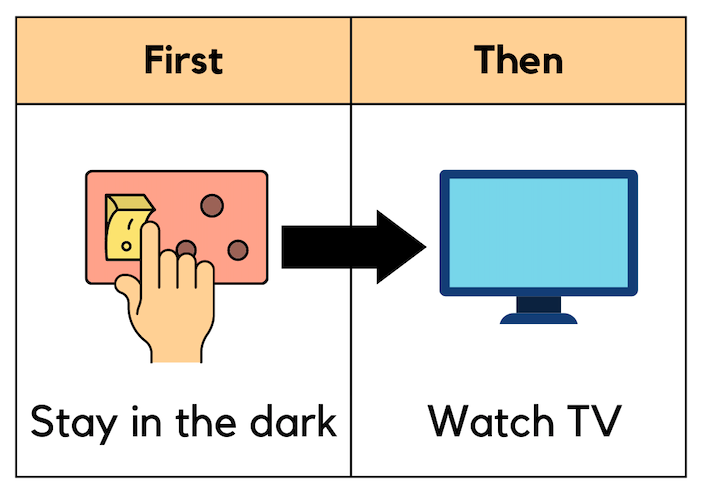
First-Then. Most children become upset or annoyed when you tell them to stop doing something they enjoy, such as playing on their tablet, and start doing something they do not enjoy, such as doing LUNA activities. It can be helpful to change the order by doing the less preferred activity (for example, doing a mission plan step) before they get to do something they enjoy (for example, playing on their tablet). For instance, you might say, “First you need to practice being in the dark by yourself, then you can play on your tablet.” 

Offer choices. It is common for children to engage in challenging behaviors when they are told “no”. Instead of immediately saying “no” when your child asks for something they cannot have, try offering choices. You might try this strategy when practicing mission plans. For example, Sally’s mom might offer Sally the choice of working on a mission plan either for her fear of germs or for her social fears. In some cases, caregivers may also use a choice board, which we will talk more about later.

Change how you give instructions. When you see your child doing something you don’t like, it’s quite natural for you to immediately say “stop” or “don’t”. Saying “stop” or “don’t” does not tell your child what they should be doing. Instead of telling a child to stop what they are doing, try giving instructions in a positive manner. For instance, instead of saying, “Neil, stop jumping on the couch, we need to work on mission plans!”, you could say, “Neil, please put your feet on the ground so you can get brave bucks after you practice hanging out alone in the dark.” 

Use visual or auditory supports. Visual and auditory supports help show your child exactly what to do and what will happen next. Examples we review this week include: visual schedules, “first-then” boards, and choice boards. These supports can prevent challenging behaviors for children who have trouble changing from one activity to another, changing their routine, or understanding their schedule. 

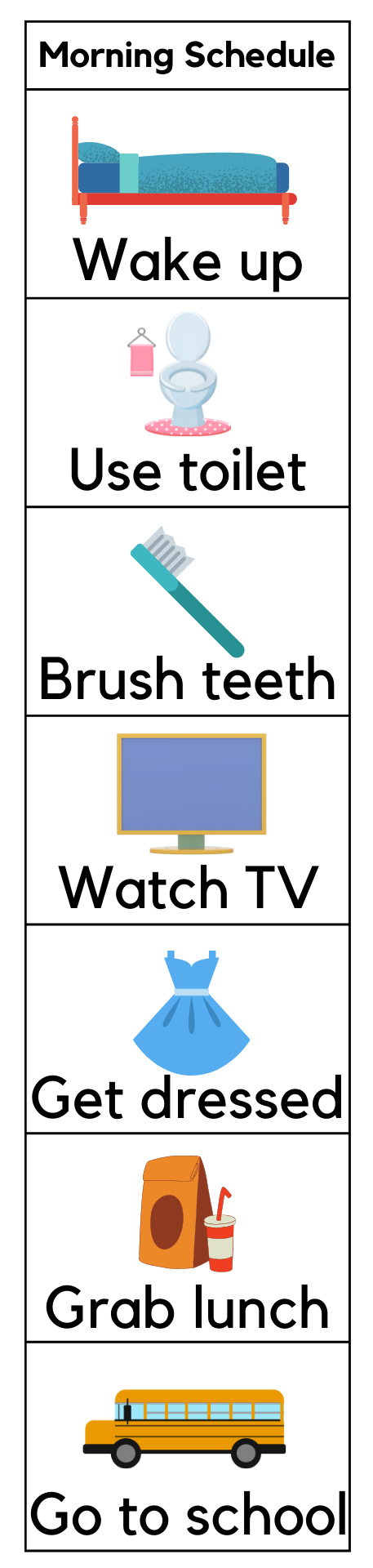
  • Visual Schedule. You may create a visual schedule that shows the activities for the day or a visual schedule for a certain period of time that tends to be more challenging. We have created an example below of a visual schedule for the morning routine before school. We recommend using either pictures of your child doing the activities, pictures of other children doing the activities, or small pictures of the activities. These individual pictures can then be attached to a laminated piece of paper, cardboard or other stable surface using Velcro.
    • Download this PDF or make your own using pictures to match these phrases:
    • Morning Schedule: Wake up; Use toilet; Brush teeth; Watch tv; Get dressed; Grab lunch; Go to school
  • “First-Then” Board. You may also use a “first-then” board that shows what is expected. This can also be used with visual schedules or instead of them. We have created an example of a “first-then” board below. When it is time to complete a task, like a step of a mission plan, we recommend saying, “First practice staying in the dark for five minutes, then you can watch TV for an extra 10 minutes.” You can say this while also showing your child their “first-then” board.
    • Download this PDF or make your own using pictures to match these phrases:
    • First - Stay in the dark
    • Then - Watch TV
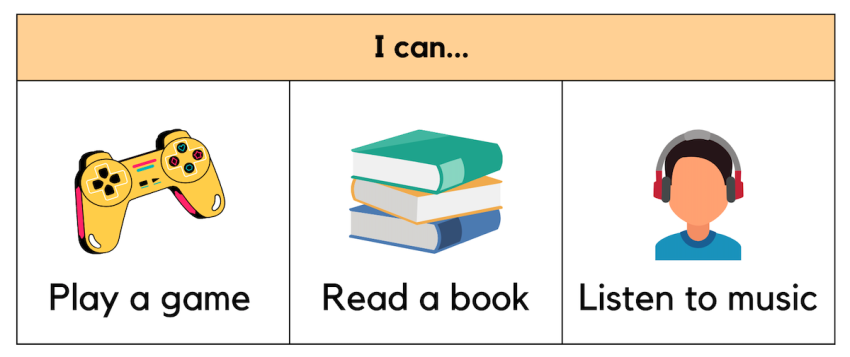
  • Choice Board. When you offer your child choices, you may use a choice board. This can be used in addition to other visual and auditory supports. You may say, “Playing on your tablet is not an option, but you can do art, you can read a book, or you can listen to music.” You can make this statement while showing your child the options through a choice board. Depending on your child, they may benefit from having fewer choices or more choices.
    • Download this PDF or make your own using pictures to match this phrase:
    • I can... Play a game | Read a book | Listen to music
Go easy on challenging days. Both children and their caregivers can become frustrated more easily when the schedule changes, when someone is feeling sick, or when they don’t get enough sleep. On days that are more challenging for you or your family, think about ways to make the day easier, like asking to have fewer chores done, or even skipping mission plan practice. 

Managing challenging behaviors using prevention strategies ahead of time:

Catch your child being good. One of the best prevention strategies is to notice and praise when your child is good. For example, when you see your child doing “positive opposites,” meaning the positive or good behavior that is the opposite of the behavior you do not want to see, you will want to provide them with positive attention. For example, if a child with fears of bugs screams when they see a spider, but then you see them walking near spiders without screaming, you could say “Wow, you are so brave for staying quiet and calm near that spider!”

Use your anxiety reward system for challenging behavior.  As noted in previous modules, rewards can be used to help increase positive behaviors and reduce challenging behaviors. Think about behaviors that you would like to continue to see or see more of and reward your child for doing that specific behavior. For instance, each time your child follows instructions the first time, you will want to reward them.

< Back to Week 10 Main Page

Next Page: How to use prevention strategies
LUNA (Learning to Understand and Navigate Anxiety)
  • Caregiver Modules
    • Module 1: About LUNA, Anxiety and Your Child's Goals
      • Design of LUNA
      • Structure of our Treatment Program
      • What is Anxiety?
      • Supplemental Information for Autism: Understanding Anxiety in Autistic Children
      • When Does Anxiety Become a Problem?
      • Anxiety or Something Else
      • My Child's Anxiety
      • Setting Goals
      • Summary
    • Module 2: Learning How to Identify Anxiety and Motivate your Child
      • What is Anxiety is Made of?
      • Measuring How Anxious You Are
      • LUNA Rewards System
      • Brave Bucks with a Rewards Menu
      • Direct Rewards
      • Direct Rewards, Brave Bucks, or both?
      • Summary
    • Module 3: The Avoidance Cycle and Fix-Its
      • What Are Quick Fixes?
      • Accommodation of Anxiety Behaviors
      • Congratulations!
    • Module 4: Facing our Fears - Preparing for Mission Plans
      • Avoidance versus Exposure
      • Creating Mission Plans
      • Select a Target Fear
      • Supplemental Information for Autism: Choosing mission plans
      • Specific Mission Plan Goal
      • Mission Plan Steps
      • Assign Anxiety Ratings
      • Make a Rewards Plan
      • Summary
    • Module 5: Executing Mission Plans
      • Plan Your Practice
      • Monitor Progress
      • Repeat Steps of your Mission Plan while also Mixing it Up
      • Debrief After Mission Plan Practice
      • Forms to use When Completing Mission Plans
      • Troubleshooting Mission Plans
      • Summary
    • Module 6: Learning Coping Skills to Manage Anxiety
      • What are Coping Skills? 
      • Relaxation and Mindfulness Skills
      • Other Mindfulness Exercises
      • Choosing your Coping Tools
      • Supplemental Information for Autism: Self-Stimulating Behaviors or "Stimming" as Coping
      • How to Approach Coping Practice
      • A Note on Coping Skills and Exposure Therapy (Facing Fears)
      • Summary
    • Module 7: Testing Expectations during Mission Plans
      • Changing expectations through mission plans
      • Experiencing Feared Consequences
      • Reflecting after doing mission plan activities
      • Summary
    • Module 8: Social Coaching
      • Social Skills
      • Supplemental Information for Autism: Social Coaching
      • Handling Bullying
      • Social Coaching Instructions
      • Social Coaching Example
      • Planning a Social Coaching Mission Plan Step
      • Summary
    • Module 9: Mission Plans for Autism-Related Anxiety
      • Targeting Anxiety Related to Sensory Sensitivity
      • Example of a mission plan with sensory components
      • Making Mission Plans Gradual for Anxiety Related to Features of Autism
      • Example of a mission plan with insistence on sameness and wanting to stick to routines
      • Your Turn to Practice
      • Caregivers Module 9 Summary
    • Module 10: Parenting Strategies for Managing Challenging Behavior
      • How Behaviors are Learned: The ABC Model
      • Supplemental Information for Autism: How Behaviors are Learned
      • Managing Challenging Behaviors by Focusing on Antecedents
      • How to use prevention strategies
      • Caregivers Module 10 Summary
    • Module 11: Managing Multiple Mission Plans
      • When to work on multiple mission plans? - Neil's example
      • When to work on multiple mission plans? - Sally's example
      • Managing multiple mission plans
      • Challenging feared expectations during mission plans
      • Caregivers Module 11 Summary
    • Module 12: Reviewing Your Progress and Planning for the Future
      • Planning for the Future
      • Planning for Anxiety Flares
      • Escalations in Anxiety
      • Finding Future Treatment
      • Supplemental Information for Autism and Special Education: Other Helpful Resources
      • Checking in with YOU
      • Caregivers Module 12 Summary
  • Child Modules
    • Module 1: About LUNA
      • Meet Sally and Neil!
      • What will I do in LUNA?
      • Knowing My Anxiety
      • LUNA Goals
      • Congratulations!
    • Module 2: How do I know when I’m anxious? How do I get my rewards?
      • Knowing how anxious you are using the anxiety scale
      • LUNA Rewards
      • Becoming an Astronaut
      • Congratulations!
    • Module 3: The Avoidance Cycle and Fix-Its
      • Fix-Its
      • ASTRO: The OCD Cycle
      • Congratulations!
    • Module 4: Learning About Mission Plans
      • What is Exposure?
      • Making a Mission Plan
      • Congratulations!
    • Module 5: Doing Mission Plans
      • Planning Practice
      • Practicing Mission Plan Steps
      • Congratulations!
    • Module 6: Coping with Anxiety
      • Deep Breathing
      • Mindfulness
      • Coping Skills Cards
      • Choosing your Coping Tools
      • Congratulations!
    • Module 7: Testing Expectations during Mission Plans
      • Challenging “stinking thinking” during mission plans
      • Congratulations!
    • Modules 8-10: Making Mission Plans Work Better
    • Module 11: Working on More Than One Mission Plan
      • Mission Plan Steps
      • Congratulations!
    • Module 12: Reviewing Your Progress and Planning for the Future
      • When You Start to Feel More Anxious or Afraid
      • Congratulations!
  • Teen Modules
    • Module 1: About LUNA
      • Knowing My Anxiety
      • Setting Goals
      • Congratulations!
    • Module 2: Identifying Anxiety and Staying Motivated
      • Introducing the Anxiety Intensity Scale
      • Getting Motivated
      • Congratulations!
    • Module 3: The Avoidance Cycle and Quick Fixes
      • Congratulations!
    • Module 4: Your Plan of Action
      • Making a Plan of Action
      • Congratulations!
    • Module 5: Completing Your Plan of Action
      • Practicing Your Exposure Activities
      • Congratulations!
    • Module 6: Coping with Anxiety
      • Example Coping Skills
      • Choosing Your Coping Tools
      • Congratulations!
    • Module 7: Challenging Our Expectations
      • Challenging Anxious Thoughts
      • Congratulations!
    • Module 8: Social Barriers and Social Skills
      • Social Skills
      • Handling Bullying and Rejection
      • Practicing Social Skills
      • Congratulations!
    • Module 9: When Anxiety Overlaps with Autism
      • Autism and Anxiety
      • Example Plans of Action
      • Congratulations!
    • Module 10: Managing More Than One Plan of Action
      • Are You Ready for a New Plan of Action?
      • Tips for Managing Multiple Plans of Action
      • Congratulations!
    • Module 11: Maintaining Progress
      • Congratulations!
    • Module 12: Planning for the Future
      • When You Start to Feel Anxious
      • Congratulations!
  • Teen Caregiver Modules
    • Module 1: About LUNA
      • More About Anxiety
      • Is My Child’s Behavior Due to Anxiety?
      • Your Child’s Anxiety
      • Congratulations!
    • Module 2: Identifying Anxiety and Staying Motivated
      • Different Aspects of Anxiety
      • Introducing the Anxiety Intensity Scale
      • Pros and Cons of Making a Change – Getting Motivated!
      • Congratulations!
    • Module 3: The Avoidance Cycle and Quick Fixes
      • What Are Quick Fixes?
      • Accommodation of Anxiety Behaviors
      • Congratulations!
    • Module 4: Your Plan of Action
      • Steps for Making a Plan of Action
      • Congratulations!
    • Module 5: Completing Your Plan of Action
      • Practicing Exposure Activities
      • During Exposure Activity Practice
      • After Practices
      • Troubleshooting
      • Congratulations!
    • Module 6: Coping with Anxiety
      • Example Coping Skills
      • Choosing Coping Tools
      • Congratulations!
    • Module 7: Challenging Our Expectations
      • Challenging Anxious Thoughts
      • Experiencing Feared Consequences & Accepting Uncertainty
      • Congratulations!
    • Module 8: Social Barriers and Social Skills
      • Social Skills
      • Social Coaching
      • Congratulations!
    • Module 9: When Anxiety Overlaps with Autism
      • Anxiety Related to Autism
      • Example Plans of Action
      • Congratulations!
    • Module 10: Managing More Than One Plan of Action
      • Is Your Child Ready for a New Plan of Action?
      • Tips for Managing Multiple Plans of Action
      • Notes About Oppositional Behavior
      • Congratulations!
    • Module 11: Maintaining Progress
      • Congratulations!
    • Module 12: Planning for the Future
      • Thinking About the Future
      • Anxiety Flares and Escalations
      • Finding Future Treatment and Resources
      • Congratulations!
  • ASTRO Teen Modules
    • ASTRO Module 1: About LUNA
      • ASTRO: Knowing My Anxiety
      • ASTRO: Setting Goals
      • Congratulations!
    • ASTRO Module 2: Identifying Anxiety and Staying Motivated
      • ASTRO: Introducing the Anxiety Intensity Scale
      • ASTRO: Getting Motivated
      • Congratulations!
    • ASTRO Module 3: The Avoidance Cycle and Quick Fixes
      • Congratulations!
    • ASTRO Module 4: Your Plan of Action
      • ASTRO Making a Plan of Action
      • Congratulations!
    • ASTRO Module 5: Completing Your Plan of Action
      • ASTRO: Practicing Your Exposure Activities
      • Congratulations!
    • ASTRO Module 6: Coping with Anxiety
      • ASTRO: Example Coping Skills
      • ASTRO: Choosing Your Coping Tools
      • Congratulations!
    • ASTRO Module 7: Challenging Our Expectations
      • ASTRO: Challenging Anxious Thoughts
      • Congratulations!
    • ASTRO Module 8: Social Barriers and Social Skills
      • ASTRO: Social Skills
      • ASTRO: Handling Bullying and Rejection
      • ASTRO: Practicing Social Skills
      • Congratulations!
    • ASTRO Module 9: When Anxiety Overlaps with Autism
      • ASTRO: Autism and Anxiety
      • ASTRO: Example Plans of Action
      • Congratulations!
    • ASTRO Module 10: Managing More Than One Plan of Action
      • ASTRO: Are You Ready for a New Plan of Action?
      • ASTRO: Tips for Managing Multiple Plans of Action
      • Congratulations!
    • ASTRO: Module 11: Maintaining Progress
      • Congratulations!
    • ASTRO: Module 12: Planning for the Future
      • ASTRO: When You Start to Feel Anxious
      • Congratulations!
  • ASTRO Teen Caregiver Modules
    • ASTRO Module 1: About LUNA
      • ASTRO: More About Anxiety
      • ASTRO: Is My Child’s Behavior Due to Anxiety?
      • ASTRO: Your Child’s Anxiety
      • Congratulations!
    • ASTRO Module 2: Identifying Anxiety and Staying Motivated
      • ASTRO: Different Aspects of Anxiety
      • ASTRO: Introducing the Anxiety Intensity Scale
      • ASTRO: Pros and Cons of Making a Change – Getting Motivated!
      • Congratulations!
    • ASTRO Module 3: The Avoidance Cycle and Quick Fixes
      • ASTRO: What Are Quick Fixes?
      • ASTRO: Accommodation of Anxiety Behaviors
      • Congratulations!
    • ASTRO Module 4: Your Plan of Action
      • ASTRO: Steps for Making a Plan of Action
      • Congratulations!
    • ASTRO Module 5: Completing Your Plan of Action
      • ASTRO: Practicing Exposure Activities
      • ASTRO: During Exposure Activity Practice
      • ASTRO: After Practices
      • ASTRO: Troubleshooting
      • Congratulations!
    • ASTRO Module 6: Coping with Anxiety
      • ASTRO: Example Coping Skills
      • ASTRO: Choosing Coping Tools
      • Congratulations!
    • ASTRO Module 7: Challenging Our Expectations
      • ASTRO: Challenging Anxious Thoughts
      • ASTRO: Experiencing Feared Consequences & Accepting Uncertainty
      • Congratulations!
    • ASTRO Module 8: Social Barriers and Social Skills
      • ASTRO: Social Skills
      • ASTRO: Social Coaching
      • Congratulations!
    • ASTRO Module 9: When Anxiety Overlaps with Autism
      • ASTRO: Anxiety Related to Autism
      • ASTRO: Example Plans of Action
      • Congratulations!
    • ASTRO Module 10: Managing More Than One Plan of Action
      • ASTRO: Is Your Child Ready for a New Plan of Action?
      • ASTRO: Tips for Managing Multiple Plans of Action
      • ASTRO: Notes About Oppositional Behavior
      • Congratulations!
    • ASTRO Module 11: Maintaining Progress
      • Congratulations!
    • ASTRO Module 12: Planning for the Future
      • ASTRO: Thinking About the Future
      • ASTRO: Anxiety Flares and Escalations
      • ASTRO: Finding Future Treatment and Resources
      • Congratulations!

Follow Us facebook twitter youtube linkedin instagram rss 

Footer Menu Healthcare

  • Healthcare
    • Specialties
    • MyChart Login
    • For Patients & Visitors
    • For Health Professionals
    • Clinical Trials
    • Find a Physician

Footer Menu Education

  • Education
    • Programs & Admissions
    • Student & Trainee Resources
    • Faculty Resources
    • School of Medicine
    • Graduate School of Biomedical Sciences
    • National School of Tropical Medicine
    • School of Health Professions
    • Tuition & Fees
    • Financial Aid

Footer Menu Research

  • Research
    • Our Research
    • Core Labs
    • Faculty Labs
    • Research Centers
    • Research Offices

Footer Menu Community

  • Community
    • Healthcare Outreach
    • Education Outreach
    • Global Programs
    • Community Events

Footer Menu About

  • About
    • Our Campus
    • Departments
    • Academic Centers
    • Administrative Offices
    • Affiliates
    • Leadership
    • Giving
    • Alumni

Footer Menu Resource Links

  • Resource Links
    • Contact Us
    • Find a Person
    • Careers
    • BCM Team Shop
    • News
    • Title IX Office
    • Compliance
    • Covid Response Site

©1998-2026 Baylor College of Medicine® | 1 Baylor Plaza, Houston, Texas 77030 | 713-798-4951
Have an edit or suggestion for this page?

  • Compliance
  • Privacy
  • Intranet