
Point of Care Ultrasound (POCUS) has been part of the undergraduate medical education (UME) curriculum for many years. Physicians in emergency medicine (EM), internal medicine (IM), obstetrics and gynecology (OB/GYN) and pediatric emergency medicine (PEM) championed workshops, lectures and other activities as part of the legacy curriculum. During the curriculum renewal process, Dr. Ismail designed a POCUS thread leadership team, comprised of a Pediatric cardiologist, PEM physician, and a registered diagnostic medical sonographer. Under this leadership, a multi-disciplinary team was established recruiting faculty from anesthesiology, cardiology, IM, rheumatology, and EM across both campuses to collaborate on the development and implementation of the POCUS curriculum and content. Since its inception, the POCUS thread has continued to evolve and now has complimentary faculty at both campuses, and foundational POCUS experiences throughout the four years of medical school.
How do we define POCUS
“A diagnostic or procedural guidance ultrasound that is performed by a clinician during a patient encounter to help guide the evaluation and management of the patient”
Alternative names include:
- Emergency ultrasound (EUS)
- Focused ultrasound
- Clinician-performed ultrasound
- Bedside ultrasound
- Clinical ultrasound
Some specialties have incorporated POCUS milestones into graduate medical education (GME), and many clinicians are finding that utilizing POCUS in their practice increases patient satisfaction, provides faster management, and improves the physical examination. Technological advances and AI assistance are providing a more user-friendly experience, reducing some of the apprehension that may have previously contributed to the slow adoption of POCUS in clinical practice. As the interest and demand for POCUS increases, so does the need for earlier education and training in UME.
At BCM, we considered what foundational POCUS knowledge and skills could be highly generalizable and relevant to the UME graduate regardless of their chosen GME training. This POCUS curriculum was developed to consolidate foundational POCUS principles during the preclinical years so that more time can be spent in clerkship on acquisition, interpretation, and case management.
At the end of the longitudinal point-of-care ultrasound (POCUS) curriculum, medical students should be able to use POCUS to enhance their clinical reasoning, medical decision making, and procedural skills.
Students will:
- Operate an ultrasound machine
- Generate images of selected organs
- Explain which views are required for an Extended Focused Assessment with Sonography in Trauma (E-FAST) examination and what windows they are accessed from
- Interpret specified pathology related to the identification of free fluid
- Identify indications for use of POCUS in emergency situations
- Perform ultrasound guided procedures on a task trainer
- Develop management strategies
- Perform E-FAST
Foundational Sciences
- Transitions in Medicine
- The Evolution of Clinical Ultrasound
- Introduction to POCUS
- Cardiac, Respiratory, Renal
- Pulmonary and Cardiac modules
- Practice of Medicine
- Introduction to POCUS Workshop
- Pulmonary and Cardiac Workshop
- Subcostal View Hands-on Assessment
- Endocrine, Gastrointestinal, and Genitourinary System Course
- Abdomen and Pelvis modules
- Practice of Medicine 2
- Abdomen and Pelvis Workshop
- Pelvis Hands-on Assessment
- Integrated Systems
- Reconstructing EFAST
- Transitions to Clerkship
- Ultrasound Guided Vascular access module and Workshop
Clerkship
- Internal Medicine
- Abdomen and Pelvis Workshop
- Emergency Medicine
- E-FAST workshop
- E-FAST ultrasound assessment
Post Clerkship
- Critical Care
- IV guided access
- Lung imaging
- PAT/UAT
- Transitions to Residency
- POCUS Bootcamp
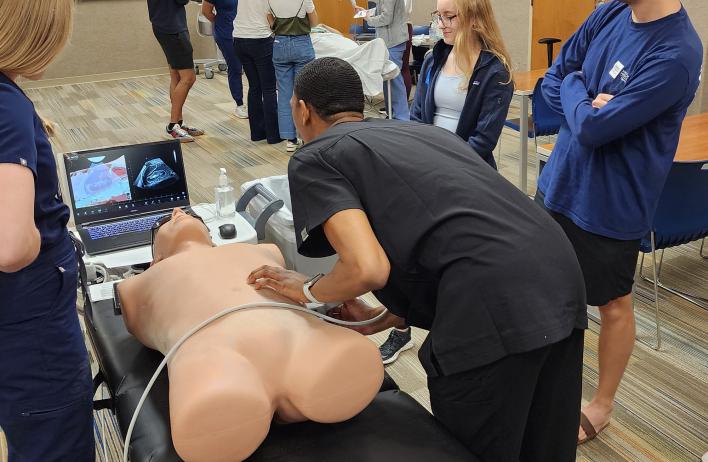
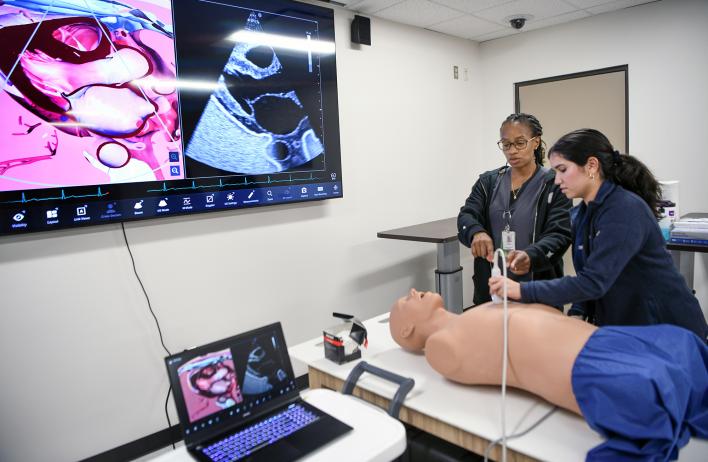
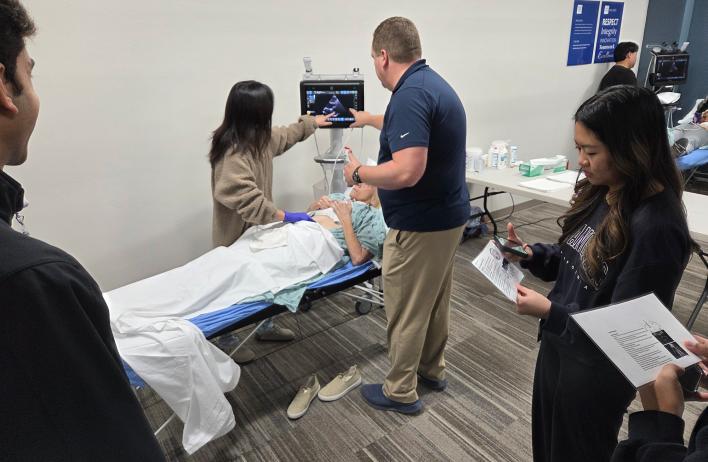
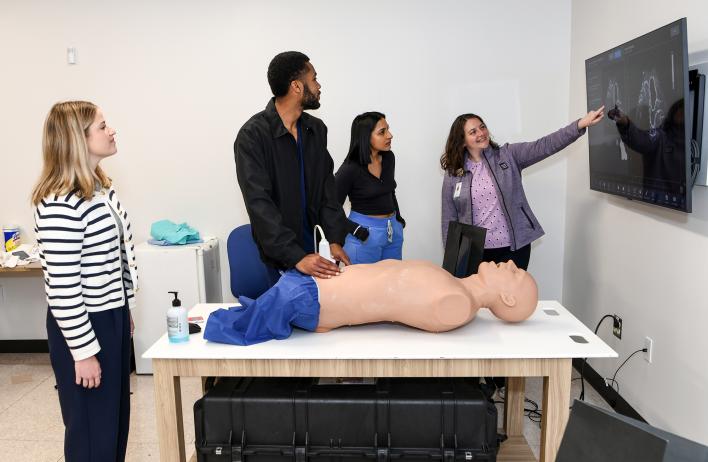
The POCUS thread faculty and sonographer educators dedicate a portion of their time each fall and spring to small group practice sessions with the MS1 students. These are scheduled sessions which allow students time to recall what they learned in the workshop and scan independently, followed by direct feedback, verbal guidance, hands on assistance, demonstration, or visual guidance from our high-fidelity simulator if needed. This additional practice is provided as part of their preparation for hands-on assessments.
The foundational science POCUS elective is a unique opportunity for students interested in specialties where POCUS is commonly utilized. Our elective objectives expand upon the first year POCUS thread with carefully chosen topics and skills to advance on foundational elements that all students would benefit from, regardless of future specialty. We target learning objectives which foster continued image acquisition and optimization while integrating clinical decision-making and evidence-based research. Our aim for this elective is to benefit students who have taken a strong interest in the POCUS thread materials, and who are seriously considering specialties that utilize POCUS.
We collaborate with the Anatomy Education Core and Advanced Surgical Anatomy elective to create POCUS correlates. These projects connect dissection with sonographic imaging to demonstrate anatomy in motion on ultrasound and showcase how integral knowledge of anatomy is for image acquisition, interpretation, and case management.
Meet our Team - Houston




Meet our Team - Temple




Publications
- Point-of-Care Ultrasound Foundations in Physics and Image Acquisition: An Innovative Hands-on Active Learning Workshop
- Deconstructing the Extended Focused Assessment with Sonography in Trauma (E-FAST) as a Roadmap for Longitudinal Integration of Point of Care Ultrasound Education Within Undergraduate Medical Education