Home
  • Healthcare
    • Specialties
      • Cardiovascular Care
      • Oncology
      • Neurosurgery
      • Primary Care
      • View All Specialties >
    • For Health Professionals
      • Refer a Patient
      • Clinical Trials
      • Professional Development
      • View All >
    • For Patients & Visitors
      • MyChart Login
      • Accepted Insurance
      • Pay My Bill
      • Patient Information
      • View All >
    • Clinical Trials
      • Autism
      • Cancer
      • Obesity
      • Substance Abuse
      • View All Clinical Trials >
    • Find a Doctor
    • Make an Appointment

    General Inquiries

    Call today to schedule an appointment or fill out an online request form. If requested before 2 p.m. you will receive a response today.

    CALL

    713-798-1000

    Monday – Friday 8 a.m. – 5 p.m.


    ONLINE

    Request Now

    Request non-urgent appointments

    Request an appointment, learn about your rights as a patient, read about what to expect from your appointment, and more.

    As Houston's premier academic medical practice, Baylor Medicine delivers compassionate, innovative, evidence-based care.
    Find a Doctor

  • Education
    • Degree Programs & Admissions
      • M.D. Program
      • Ph.D. Programs
      • DNP Program (Nurse Anesthesia)
      • Genetic Counseling Program
      • P.A. Program
      • Orthotics & Prosthetics Program
      • Baccalaureate/M.D. Programs
      • Dual Degree Programs
      • View All Programs >
    • Financing Your Education
      • Tuition & Fees
      • Financial Aid
      • CARES ACT
    • Schools
      • School of Medicine
      • Graduate School of Biomedical Sciences
      • National School of Tropical Medicine
      • School of Health Professions
    • Advanced Training Programs
      • Residency Programs
      • Clinical Fellowships
      • Postdoctoral Research Positions
      • Continuing Professional Development
      • Diploma in Tropical Medicine
      • View All >
    • Resources
      • Departments
      • Academic Centers
      • Academic Calendars
      • Education Cores
      • View All >
    • Information For...
      • Students
      • Postdoctoral Researchers
      • Faculty
      • Alumni
    get-to-know-houston

    America's fourth-largest city is a great place to live, work, and play. Find out why.
    Get to Know Houston

  • Research
    • Research Offices
      • Advanced Technology Cores
      • Clinical Research
      • Institute for Clinical & Translational Research
      • Office of Research Leadership
      • Research IT
      • Sponsored Programs
    • Research at Baylor
      • Academic Centers
      • Departments
      • Faculty Labs
      • From the Labs
      • News
      • Our Research
      • Research Centers
      • Strategic Research Center
    • Additional Research Services
      • BCM Innovation Institute
      • Service Labs
      • VIICTR
    get-to-know-houston

    America's fourth-largest city is a great place to live, work, and play. Find out why.
    Get to Know Houston

  • Community
    • Healthcare Outreach
      • Community Programs
      • More >
    • Global Outreach
      • Global Health
      • Global Programs >
    • Educational Outreach
      • SMART Program
      • BioEd Online
      • More >
    • General Resources
      • Community Events
      • News
      • Blogs
      • Baylor in the Community
    get-to-know-houston

    America's fourth-largest city is a great place to live, work, and play. Find out why.
    Get to Know Houston

  • About
    • About Us
      • Academic Centers
      • Alumni
      • Careers
      • Departments
      • Giving
      • Leadership
      • Mission, Vision, Values
      • News
      • Our Affiliates
      • Fast Facts
      • Accreditation
    • Offices
      • President's Office
      • Office of Research
      • Ombuds Office
      • BCM Innovation Institute
      • View All >
    • Our Campus
      • Compliance
      • Safety and Security
      • Resource Stewardship & Sustainability
      • Team Shop
      • Find a Person
    get-to-know-houston

    America's fourth-largest city is a great place to live, work, and play. Find out why.
    Get to Know Houston

  • GIVE
  • CAREERS
  • INTRANET
  • Careers
  • Contact Us
  • News
Healthcare: Cardiovascular Medicine
  • Specialties
  • Find a Physician
  • For Patients
  • For Physicians
  • Clinical Trials
  • Request an Appointment
  • MyChart
  • News
  • Specialties
  • Find a Physician
  • For Patients
  • For Physicians
  • Clinical Trials
  • Request an Appointment
  • MyChart
  • News
  1. Baylor College of Medicine
  2. Healthcare
  3. Specialties
  4. Cardiovascular Medicine
  5. Cardiothoracic Surgery
  6. Ascending Aneurysm
  • You and Your Heart
    • About the Heart
    • General Cardiology
    • Interventional Cardiology
    • Cardiac Electrophysiology
      • Cardiac Electrophysiology and Arrhythmias
      • Meet Our Team
    • Women and Heart Disease
    • Meet our Team
  • Services and Diagnostic Procedures
  • Specialty Centers and Programs
    • Advanced Heart Failure Clinic
      • Heart Failure FAQs
      • Hypertrophic Cardiomyopathy
      • Pulmonary Hypertension
      • Meet Our Team
    • Center for Aortic Surgery
      • Meet Our Team
    • Inherited Arrhythmia and Cardiomyopathy Clinic
      • Meet Our Team
    • Structural Heart Disease Center
      • Atrial Septal Defect (ASD) Repair
      • Patent Foramen Ovale
      • Structural Heart Disease FAQs
      • Meet Our Team
    • Texas Adult Congenital Heart Center
      • Meet Our Team
    • Lipid Metabolism and Atherosclerosis Clinic
      • Meet Our Team
  • Cardiothoracic Surgery
    • Abdominal Aortic Aneurysm
    • Aortic Graft and Stent-Graft Infections
    • Ascending Aneurysm
    • Ascending and Arch Aortic Aneurysms and Dissection
    • Bentall Procedure
    • Beveled Aortic Hemiarch Replacement
    • Cabrol Procedure
    • Cardiopulmonary Bypass
    • Carotid Artery Stent Procedure
    • Carotid-Carotid Bypass
    • Carotid-Subclavian Bypass
    • Coronary Artery Disease Coronary Bypass
    • Descending Aneurysm
    • Elephant Trunk Repair
    • Hybrid Arch Repair
    • Heart Valve Repair
    • Minivalve Repair
      • Request Appointment Minivalve
    • Pacemaker
    • Pericardiectomy
    • Prolapse
    • Pulmonary Endarterectomy
    • Robotic Heart Surgery
    • TAVR
    • Total Aortic Arch Replacement
    • Meet Our Team
  • Invasive & Non-Invasive Tests
  • Vascular Health
    • Angioplasty and Stent Placement
    • Carotid Artery Disease
    • Deep Vein Thrombosis
    • Diabetic Foot Limb Salvage
    • Hemodialysis
    • Mesenteric Artery Disease
    • Peripheral Artery Disease
    • Peripheral Artery Bypass
    • Varicose Veins
      • Noninvasive Treatments for Varicose Veins
      • Varicose Vein Stripping (Phlebectomy )
    • Vascular Problems in Athletes
    • Venous Insufficiency and Venous Ulcers
    • Frequently Asked Questions
    • Meet Our Team
  • For Patients
  • Meet Our Team

Ascending and Arch Aortic Aneurysms and Dissection

Scott Weldon
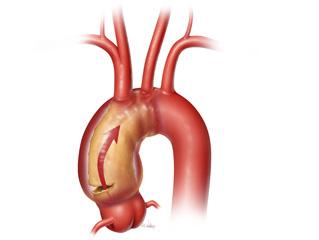
A tear or dissection of the ascending aorta (credit: Scott Weldon)

Your aorta is a tube-like structure that resembles a candy cane. The ascending aorta forms the beginning or handle of the cane and originates at the aortic valve. The ascending aorta includes the aortic root and sinuses of Valsalva where the blood supply to your heart, via the coronary arteries, originates. The ascending aorta continues upward to form the aortic arch, where the oxygenated blood supply to your head originates. The aorta continues on down to the descending aorta that further supplies blood to the rest of your body.

What Is an Ascending or Aortic Arch Aneurysm?

An ascending or aortic arch aneurysm refers to ballooning out of the aorta which causes aortic wall weakening. The aortic wall may continue to expand or may remain unchanged, but close surveillance is necessary. As the aortic wall weakens, there is a risk of the wall tearing or dissecting.

What Contributes to the Formation of an Ascending or Aortic Arch Aneurysm?

  • Age/degenerative disease of the aortic wall
  • Uncontrolled high blood pressure
  • Long-term use of tobacco
  • Inflammation or swelling of the aorta
  • Infection
  • History of connective tissue disorders, such as Marfan syndrome, Ehlers-Danlos syndrome, or Loeys-Dietz syndrome
  • Trauma

How Can You Tell if You Have an Aneurysm?

Individuals with ascending or aortic arch aneurysms usually do not have symptoms. Ascending and aortic arch aneurysms are commonly found incidentally. It is possible that, as the aneurysm enlarges and compresses surrounding nerves or organs, an individual may experience chest pain, hoarseness or difficulty swallowing.

Patients that experience sudden symptoms such as chest pain, characterized as a tearing sensation, or back pain, nausea, vomiting, a fast heart beat and possibly the feeling of impending doom, may be experiencing a tear or dissection of the aorta. Left untreated this can lead to rupture and is considered an emergent condition that requires immediate intervention.

Diagnostic Evaluation of an Aneurysm or Dissection

Computed tomography (CT) with or without contrast is the most common imaging study used to evaluate your condition. A CT provides valuable information about your aorta, such as the location and size of an aneurysm or dissection. Magnetic resonance imaging (MRI), or magnetic resonance angiography (MRA), is another imaging modality to visualize your aortic aneurysm and vessels. Similar to a CT with contrast, an MRI or MRA provides detailed information about your aorta. Your surgeon will choose the best method for imaging your aorta.

Surgical Repair of Your Aorta

During this operation, the surgeon will make an incision, called a median sternotomy, in your chest and through the breastbone.

In order to perform surgery on your aorta, it is necessary to connect you to a heart-lung bypass machine. This machine takes over the work of the heart circulating oxygenated blood throughout the body. During your surgery, the diseased portion of your aorta will be replaced with a Dacron® graft. If you have an arch aneurysm, it is possible that you may also require bypass grafts to replace vessels that supply blood to your head.

While repairing your aorta, your surgeon will inspect your aortic valve to determine whether it can be spared or may need replacement, which is done at the same time as your aneurysm surgery. Please, see the separate insert about valve replacement for more information.

Recovery

It will take you approximately two to three months to fully recover from undergoing ascending aortic aneurysm/dissection or arch surgery. You should plan to be away from work, getting your full strength back, for six to eight weeks. Your surgeon will advise you on post-operative restrictions and when it’s safe to drive again. Participating in a cardiac rehabilitation program will be beneficial in your recovery. Make sure to ask about this before you are discharged from the hospital and make arrangements close to your home in advance.

  • You and Your Heart
    • About the Heart
    • General Cardiology
    • Interventional Cardiology
    • Cardiac Electrophysiology
      • Cardiac Electrophysiology and Arrhythmias
      • Meet Our Team
    • Women and Heart Disease
    • Meet our Team
  • Services and Diagnostic Procedures
  • Specialty Centers and Programs
    • Advanced Heart Failure Clinic
      • Heart Failure FAQs
      • Hypertrophic Cardiomyopathy
      • Pulmonary Hypertension
      • Meet Our Team
    • Center for Aortic Surgery
      • Meet Our Team
    • Inherited Arrhythmia and Cardiomyopathy Clinic
      • Meet Our Team
    • Structural Heart Disease Center
      • Atrial Septal Defect (ASD) Repair
      • Patent Foramen Ovale
      • Structural Heart Disease FAQs
      • Meet Our Team
    • Texas Adult Congenital Heart Center
      • Meet Our Team
    • Lipid Metabolism and Atherosclerosis Clinic
      • Meet Our Team
  • Cardiothoracic Surgery
    • Abdominal Aortic Aneurysm
    • Aortic Graft and Stent-Graft Infections
    • Ascending Aneurysm
    • Ascending and Arch Aortic Aneurysms and Dissection
    • Bentall Procedure
    • Beveled Aortic Hemiarch Replacement
    • Cabrol Procedure
    • Cardiopulmonary Bypass
    • Carotid Artery Stent Procedure
    • Carotid-Carotid Bypass
    • Carotid-Subclavian Bypass
    • Coronary Artery Disease Coronary Bypass
    • Descending Aneurysm
    • Elephant Trunk Repair
    • Hybrid Arch Repair
    • Heart Valve Repair
    • Minivalve Repair
      • Request Appointment Minivalve
    • Pacemaker
    • Pericardiectomy
    • Prolapse
    • Pulmonary Endarterectomy
    • Robotic Heart Surgery
    • TAVR
    • Total Aortic Arch Replacement
    • Meet Our Team
  • Invasive & Non-Invasive Tests
  • Vascular Health
    • Angioplasty and Stent Placement
    • Carotid Artery Disease
    • Deep Vein Thrombosis
    • Diabetic Foot Limb Salvage
    • Hemodialysis
    • Mesenteric Artery Disease
    • Peripheral Artery Disease
    • Peripheral Artery Bypass
    • Varicose Veins
      • Noninvasive Treatments for Varicose Veins
      • Varicose Vein Stripping (Phlebectomy )
    • Vascular Problems in Athletes
    • Venous Insufficiency and Venous Ulcers
    • Frequently Asked Questions
    • Meet Our Team
  • For Patients
  • Meet Our Team

Make an Appointment

CALL 832–355–9910 Monday-Friday 7 a.m.-5 p.m.

ONLINE

Request Now

Request non-urgent appointments

Find a Physician

Surgeons Who Repair Aortic Aneurysms

  • Joseph S. Coselli, M.D.
  • Lauren Barron, M.D.
  • Marc Moon, M.D.
  • Vicente Orozco-Sevilla, M.D.
  • Anna Xue, M.D.
mychart

MyChart is a patient-accessible website that enables you to interact with your Baylor Medicine healthcare team.

Login

mobile-phone-image
Baylor College of Medicine

Aortic Surgery – Pre-Existing Conditions and What to Expect

Follow Us facebook twitter youtube linkedin instagram rss 

Footer Menu Healthcare

  • Healthcare
    • Specialties
    • MyChart Login
    • For Patients & Visitors
    • For Health Professionals
    • Clinical Trials
    • Find a Physician

Footer Menu Education

  • Education
    • Programs & Admissions
    • Student & Trainee Resources
    • Faculty Resources
    • School of Medicine
    • Graduate School of Biomedical Sciences
    • National School of Tropical Medicine
    • School of Health Professions
    • Tuition & Fees
    • Financial Aid

Footer Menu Research

  • Research
    • Our Research
    • Core Labs
    • Faculty Labs
    • Research Centers
    • Research Offices

Footer Menu Community

  • Community
    • Healthcare Outreach
    • Education Outreach
    • Global Programs
    • Community Events

Footer Menu About

  • About
    • Our Campus
    • Departments
    • Academic Centers
    • Administrative Offices
    • Affiliates
    • Leadership
    • Giving
    • Alumni

Footer Menu Resource Links

  • Resource Links
    • Contact Us
    • Find a Person
    • Careers
    • BCM Team Shop
    • News
    • Title IX Office
    • Compliance
    • Covid Response Site

©1998-2026 Baylor College of Medicine® | 1 Baylor Plaza, Houston, Texas 77030 | 713-798-4951
Have an edit or suggestion for this page?

  • Compliance
  • Privacy
  • Intranet