Home
  • Healthcare
    • Specialties
      • Cardiovascular Care
      • Oncology
      • Neurosurgery
      • Primary Care
      • View All Specialties >
    • For Health Professionals
      • Refer a Patient
      • Clinical Trials
      • Professional Development
      • View All >
    • For Patients & Visitors
      • MyChart Login
      • Accepted Insurance
      • Pay My Bill
      • Patient Information
      • View All >
    • Clinical Trials
      • Autism
      • Cancer
      • Obesity
      • Substance Abuse
      • View All Clinical Trials >
    • Find a Doctor
    • Make an Appointment

    General Inquiries

    Call today to schedule an appointment or fill out an online request form. If requested before 2 p.m. you will receive a response today.

    CALL

    713-798-1000

    Monday – Friday 8 a.m. – 5 p.m.


    ONLINE

    Request Now

    Request non-urgent appointments

    Request an appointment, learn about your rights as a patient, read about what to expect from your appointment, and more.

    As Houston's premier academic medical practice, Baylor Medicine delivers compassionate, innovative, evidence-based care.
    Find a Doctor

  • Education
    • Degree Programs & Admissions
      • M.D. Program
      • Ph.D. Programs
      • DNP Program (Nurse Anesthesia)
      • Genetic Counseling Program
      • P.A. Program
      • Orthotics & Prosthetics Program
      • Baccalaureate/M.D. Programs
      • Dual Degree Programs
      • View All Programs >
    • Financing Your Education
      • Tuition & Fees
      • Financial Aid
      • CARES ACT
    • Schools
      • School of Medicine
      • Graduate School of Biomedical Sciences
      • National School of Tropical Medicine
      • School of Health Professions
    • Advanced Training Programs
      • Residency Programs
      • Clinical Fellowships
      • Postdoctoral Research Positions
      • Continuing Professional Development
      • Diploma in Tropical Medicine
      • View All >
    • Resources
      • Departments
      • Academic Centers
      • Academic Calendars
      • Education Cores
      • View All >
    • Information For...
      • Students
      • Postdoctoral Researchers
      • Faculty
      • Alumni
    get-to-know-houston

    America's fourth-largest city is a great place to live, work, and play. Find out why.
    Get to Know Houston

  • Research
    • Research Offices
      • Advanced Technology Cores
      • Clinical Research
      • Institute for Clinical & Translational Research
      • Office of Research Leadership
      • Research IT
      • Sponsored Programs
    • Research at Baylor
      • Academic Centers
      • Departments
      • Faculty Labs
      • From the Labs
      • News
      • Our Research
      • Research Centers
      • Strategic Research Center
    • Additional Research Services
      • BCM Innovation Institute
      • Service Labs
      • VIICTR
    get-to-know-houston

    America's fourth-largest city is a great place to live, work, and play. Find out why.
    Get to Know Houston

  • Community
    • Healthcare Outreach
      • Community Programs
      • More >
    • Global Outreach
      • Global Health
      • Global Programs >
    • Educational Outreach
      • SMART Program
      • BioEd Online
      • More >
    • General Resources
      • Community Events
      • News
      • Blogs
      • Baylor in the Community
    get-to-know-houston

    America's fourth-largest city is a great place to live, work, and play. Find out why.
    Get to Know Houston

  • About
    • About Us
      • Academic Centers
      • Alumni
      • Careers
      • Departments
      • Giving
      • Leadership
      • Mission, Vision, Values
      • News
      • Our Affiliates
      • Fast Facts
      • Accreditation
    • Offices
      • President's Office
      • Office of Research
      • Ombuds Office
      • BCM Innovation Institute
      • View All >
    • Our Campus
      • Compliance
      • Safety and Security
      • Resource Stewardship & Sustainability
      • Team Shop
      • Find a Person
    get-to-know-houston

    America's fourth-largest city is a great place to live, work, and play. Find out why.
    Get to Know Houston

  • GIVE
  • CAREERS
  • INTRANET
  • Careers
  • Contact Us
  • News
Healthcare: Cardiovascular Medicine
  • Specialties
  • Find a Physician
  • For Patients
  • For Physicians
  • Clinical Trials
  • Request an Appointment
  • MyChart
  • News
  • Specialties
  • Find a Physician
  • For Patients
  • For Physicians
  • Clinical Trials
  • Request an Appointment
  • MyChart
  • News
  1. Baylor College of Medicine
  2. Healthcare
  3. Specialties
  4. Cardiovascular Medicine
  5. Vascular Health
  6. Hemodialysis
  • You and Your Heart
    • About the Heart
    • General Cardiology
    • Interventional Cardiology
    • Cardiac Electrophysiology
      • Cardiac Electrophysiology and Arrhythmias
      • Meet Our Team
    • Women and Heart Disease
    • Meet our Team
  • Services and Diagnostic Procedures
  • Specialty Centers and Programs
    • Advanced Heart Failure Clinic
      • Heart Failure FAQs
      • Hypertrophic Cardiomyopathy
      • Pulmonary Hypertension
      • Meet Our Team
    • Center for Aortic Surgery
      • Meet Our Team
    • Inherited Arrhythmia and Cardiomyopathy Clinic
      • Meet Our Team
    • Structural Heart Disease Center
      • Atrial Septal Defect (ASD) Repair
      • Patent Foramen Ovale
      • Structural Heart Disease FAQs
      • Meet Our Team
    • Texas Adult Congenital Heart Center
      • Meet Our Team
    • Lipid Metabolism and Atherosclerosis Clinic
      • Meet Our Team
  • Cardiothoracic Surgery
    • Abdominal Aortic Aneurysm
    • Aortic Graft and Stent-Graft Infections
    • Ascending Aneurysm
    • Ascending and Arch Aortic Aneurysms and Dissection
    • Bentall Procedure
    • Beveled Aortic Hemiarch Replacement
    • Cabrol Procedure
    • Cardiopulmonary Bypass
    • Carotid Artery Stent Procedure
    • Carotid-Carotid Bypass
    • Carotid-Subclavian Bypass
    • Coronary Artery Disease Coronary Bypass
    • Descending Aneurysm
    • Elephant Trunk Repair
    • Hybrid Arch Repair
    • Heart Valve Repair
    • Minivalve Repair
      • Request Appointment Minivalve
    • Pacemaker
    • Pericardiectomy
    • Prolapse
    • Pulmonary Endarterectomy
    • Robotic Heart Surgery
    • TAVR
    • Total Aortic Arch Replacement
    • Meet Our Team
  • Invasive & Non-Invasive Tests
  • Vascular Health
    • Angioplasty and Stent Placement
    • Carotid Artery Disease
    • Deep Vein Thrombosis
    • Diabetic Foot Limb Salvage
    • Hemodialysis
    • Mesenteric Artery Disease
    • Peripheral Artery Disease
    • Peripheral Artery Bypass
    • Varicose Veins
      • Noninvasive Treatments for Varicose Veins
      • Varicose Vein Stripping (Phlebectomy )
    • Vascular Problems in Athletes
    • Venous Insufficiency and Venous Ulcers
    • Frequently Asked Questions
    • Meet Our Team
  • For Patients
  • Meet Our Team

Hemodialysis

Overview

© 2016-2019 Healthwise, Incorporated
Dialysis

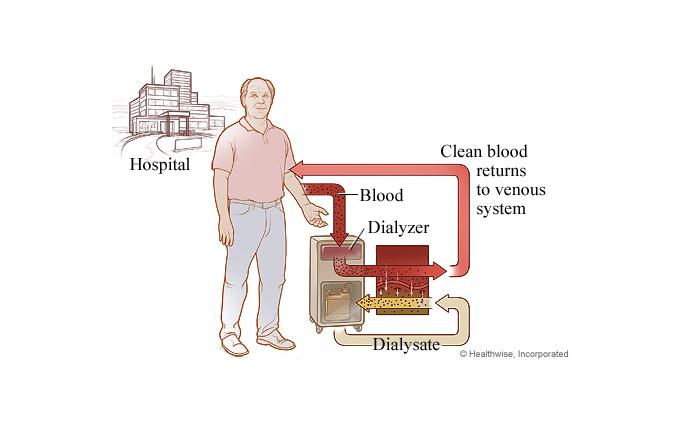
Chronic kidney disease and acute kidney injury (also known as acute renal failure) cause the kidneys to lose their ability to filter and remove waste and extra fluid from the body. Hemodialysis is a process that uses a man-made membrane (dialyzer) to:

Remove wastes, such as urea, from the blood.Restore the proper balance of electrolytes in the blood.Eliminate extra fluid from the body.

For hemodialysis, you are connected to a filter (dialyzer) by tubes attached to your blood vessels. Your blood is slowly pumped from your body into the dialyzer, where waste products and extra fluid are removed. The filtered blood is then pumped back into your body.

There are different types of hemodialysis. Talk about these with your doctor to decide which one might be best for you.

In-center hemodialysis

You go to a hospital or a dialysis center. Hemodialysis usually is done 3 days a week and takes 3 to 5 hours a day.

Home hemodialysis

After you are trained, you do your dialysis treatments at home. Hemodialysis is usually done 3 days a week (or every other day). Discuss with your doctor how long each session needs to be. A session could be as long as 6 hours, which may help you feel better.

Daily home hemodialysis

After you are trained, you do your dialysis treatments at home. Hemodialysis is done 5 to 7 days a week. Each session takes about 3 hours.

Nocturnal home hemodialysis

After you are trained, you do your dialysis treatments at home. Hemodialysis is done 3 to 7 nights a week. Each session is done overnight (about 6 to 8 hours).

Before treatments can begin, your doctor will need to create a site where the blood can flow in and out of your body during the dialysis sessions. This is called the dialysis access. The type of dialysis access you have will depend in part on how quickly you need to begin hemodialysis.

There are different types of access for hemodialysis

Fistula

A fistula is created by connecting an artery to a vein in your lower arm. A fistula allows repeated access for each dialysis session. It may take several months for the fistula to form. A fistula may not clot as easily as other dialysis access methods. A fistula is the most effective dialysis access and the most durable. Complications include infection at the site of access and clot formation (thrombosis).

Graft

A vascular access that uses a synthetic tube implanted under the skin in your arm (graft) may be used if you have very small veins. The tube becomes an artificial vein that can be used repeatedly for needle placement and blood access during hemodialysis. A graft does not need to develop as a fistula does, so a graft can sometimes be used as soon as 1 week after placement. Compared with fistulas, grafts tend to have more problems with clotting or infection and need to be replaced sooner. A polytetrafluoroethylene (PTFE or Gore-Tex) graft is the most common type used for hemodialysis.

Venous catheter

A tube, or catheter, may be used temporarily if you have not had time to get a permanent access. The catheter is usually placed in a vein in the neck, chest, or groin. Because it can clog and become infected, this type of catheter is not routinely used for permanent access. But if you need to start hemodialysis right away, a catheter may be used until your permanent access is ready.

Hemodialysis for acute kidney injury may be done daily until kidney function returns.

Choosing between treatment with hemodialysis or peritoneal dialysis is based on your lifestyle, other medical conditions, and body size and shape. Talk to your doctor about which type would be best for you.

© 2016-2019 Healthwise, Incorporated.

What Is a Hemodialysis Access?

Hemodialysis is a treatment that removes wastes and extra fluid from your blood when your own kidneys have failed. Before hemodialysis can be done, a connection must be made to the blood inside your blood vessels. Your hemodialysis access, or vascular access, is a way to reach your blood for hemodialysis. The access allows your blood to travel through soft tubes to the dialysis machine where it is cleaned as it passes through a special filter, called a dialyzer.

Are Different Types of Vascular Access Available?

There are three different types of access can be placed for hemodialysis. They are called a fistula, a graft and a catheter. Your doctor should teach you about the advantages and disadvantages of each one. Your doctor should refer you to a special surgeon with hemodialysis access experience at least six months before you need to start treatment. This surgeon will evaluate you and help you choose the type of access that is best for you. Once your doctor tells you that you will need dialysis, you should protect the arm where the surgery will be done. Don't allow anyone to draw blood or give you an injection in this arm. Also, never let anyone use a cuff to take your blood pressure from this arm. You should wear a medical alert bracelet to inform hospital staff about your arm.

Fistula. A fistula is the best choice for hemodialysis. It is preferred because it usually lasts longer and has fewer problems like clotting and infections. A fistula should be placed several months before you need to start dialysis. This allows the fistula enough time to be ready when you need treatment. Minor surgery is needed to create a fistula. It is made by connecting a vein to a nearby artery, usually in your arm. This creates a large blood vessel that has a fast flow of blood. Your wrist or elbow is the preferred location for your fistula. A fistula will usually last for many years. A fistula usually takes one to four months to "mature" or enlarge before it can be used. If you are already receiving hemodialysis using a graft or catheter, ask your doctor about the benefits of a fistula.

Graft. A graft is the second choice for an access. Minor surgery is done using an artificial tube between a vein and a nearby artery. A graft is usually put inside the bend of your arm or in your upper arm. Sometimes, grafts may be placed in your leg or chest wall. Grafts generally need to be in place at least two weeks after surgery before they can be used.

Catheter. Catheters are most often used for a temporary access. For example, they are sometimes used for a short time in people who get a fistula and need to start dialysis before the fistula is ready. Once the fistula is "mature," the catheter will be removed. Sometimes a catheter is used over a long period of time because a fistula or graft is not possible. Catheters are made of soft plastic tubing. There are two parts, one for removing your blood and the other for returning the cleaned blood to your body. Catheters are placed only when you need to start dialysis. They are put in a large vein, usually in your neck but sometimes in your upper chest. Catheters have more problems (like clotting and infections) than fistulas or grafts. They may not have enough blood flow for good dialysis treatment.

Scott Holmes
Dialysis Access Types

Illustration of types of vascular access for dialysis which include fistula, graft and catheter

What Kind of Anesthesia Is Used for a Dialysis Operation Performed and What Is the Recovery Time?

A dialysis access operation, either an AV fistula or AV graft, can be performed under either local or general anesthesia. The operation typically takes about two hours.

After recovering in the recovery room, the patient can go home. There will be a sterile, transparent dressing on the incision. The dressing can be taken off at home after 72 hours and the incision left uncovered. It is okay to shower normally with the uncovered incision.

The stitches are absorbable and will not need to be removed. You will be seen in the clinic approximately two weeks following surgery. Generally it takes at least four to six weeks to allow an AV fistula or graft to be ready for dialysis access.

What Happens During a Dialysis Procedure?

If a patient has a working dialysis access as either a fistula or graft, dialysis can be initiated. In this process, two needles are inserted into dialysis access at the beginning of each dialysis. These needles are connected to soft plastic tubes that go to the dialysis machine. The patient's blood travels to the machine through one of these tubes. The blood passes through the dialyzer, or artificial kidney, where it is cleaned. It is returned back to the patient through the other tube. If a patient has a catheter, it can be connected directly to the dialysis tubes, and no needles are used.

What Happens During a Dialysis Procedure?

If a patient has a working dialysis access as either a fistula or graft, dialysis can be initiated. In this process, two needles are inserted into dialysis access at the beginning of each dialysis. These needles are connected to soft plastic tubes that go to the dialysis machine. The patient's blood travels to the machine through one of these tubes. The blood passes through the dialyzer, or artificial kidney, where it is cleaned. It is returned back to the patient through the other tube. If a patient has a catheter, it can be connected directly to the dialysis tubes, and no needles are used.

What Are the Potential Risks for a Dialysis Access Operation?

As with any intervention or operation, one has to be aware of the risks of the operation. The risks of anesthesia are minimized, due to the fact that this is under local anesthesia with sedation; but the risk is not zero. There is always a possibility of the fistula or graft clotting, but the risk is lower with a fistula than a graft.

Sometimes, particularly in diabetic patients, the fistula can "steal" blood away from the hand. If this happens, one has to watch for hand or finger pain, numbness and tingling, and in the worst situations, a reduction in the strength and/or sensation in the hand. If these symptoms occur, it is important for you to let the surgeon know about it. It may occasionally require additional surgery to prevent the symptoms from worsening, and in the extreme circumstance, it may require tying off the fistula or the graft.

The other potential risk is that one can develop an infection in the skin, which is most times easily treated with antibiotics. Rarely, months or years later the graft can get infected, in which case it has to be removed. The risk of this is much lower with a fistula than with a graft.

It is important to realize that the term "permanent dialysis access" is not accurate because many times patients with renal failure will require an additional operation or operations. However, if one has a functioning fistula, the chance of this is much lower than with a graft. With advanced planning, however, a good functional access can be obtained in the majority of patients.

Baylor Medicine at McNair Campus - Tower One
7200 Cambridge Street Houston, TX 77030
View Location
  • You and Your Heart
    • About the Heart
    • General Cardiology
    • Interventional Cardiology
    • Cardiac Electrophysiology
      • Cardiac Electrophysiology and Arrhythmias
      • Meet Our Team
    • Women and Heart Disease
    • Meet our Team
  • Services and Diagnostic Procedures
  • Specialty Centers and Programs
    • Advanced Heart Failure Clinic
      • Heart Failure FAQs
      • Hypertrophic Cardiomyopathy
      • Pulmonary Hypertension
      • Meet Our Team
    • Center for Aortic Surgery
      • Meet Our Team
    • Inherited Arrhythmia and Cardiomyopathy Clinic
      • Meet Our Team
    • Structural Heart Disease Center
      • Atrial Septal Defect (ASD) Repair
      • Patent Foramen Ovale
      • Structural Heart Disease FAQs
      • Meet Our Team
    • Texas Adult Congenital Heart Center
      • Meet Our Team
    • Lipid Metabolism and Atherosclerosis Clinic
      • Meet Our Team
  • Cardiothoracic Surgery
    • Abdominal Aortic Aneurysm
    • Aortic Graft and Stent-Graft Infections
    • Ascending Aneurysm
    • Ascending and Arch Aortic Aneurysms and Dissection
    • Bentall Procedure
    • Beveled Aortic Hemiarch Replacement
    • Cabrol Procedure
    • Cardiopulmonary Bypass
    • Carotid Artery Stent Procedure
    • Carotid-Carotid Bypass
    • Carotid-Subclavian Bypass
    • Coronary Artery Disease Coronary Bypass
    • Descending Aneurysm
    • Elephant Trunk Repair
    • Hybrid Arch Repair
    • Heart Valve Repair
    • Minivalve Repair
      • Request Appointment Minivalve
    • Pacemaker
    • Pericardiectomy
    • Prolapse
    • Pulmonary Endarterectomy
    • Robotic Heart Surgery
    • TAVR
    • Total Aortic Arch Replacement
    • Meet Our Team
  • Invasive & Non-Invasive Tests
  • Vascular Health
    • Angioplasty and Stent Placement
    • Carotid Artery Disease
    • Deep Vein Thrombosis
    • Diabetic Foot Limb Salvage
    • Hemodialysis
    • Mesenteric Artery Disease
    • Peripheral Artery Disease
    • Peripheral Artery Bypass
    • Varicose Veins
      • Noninvasive Treatments for Varicose Veins
      • Varicose Vein Stripping (Phlebectomy )
    • Vascular Problems in Athletes
    • Venous Insufficiency and Venous Ulcers
    • Frequently Asked Questions
    • Meet Our Team
  • For Patients
  • Meet Our Team

Make an Appointment

Call today to schedule an appointment or fill out an online request form. If requested before 2 p.m. you will receive a response today.

Call 713–798–5700 Monday - Friday 8 a.m. - 5 p.m.

ONLINE

Request Now

Request non-urgent appointments

Find a Physician
mychart

MyChart is a patient-accessible website that enables you to interact with your Baylor Medicine healthcare team.

Login

mobile-phone-image

Follow Us facebook twitter youtube linkedin instagram rss 

Footer Menu Healthcare

  • Healthcare
    • Specialties
    • MyChart Login
    • For Patients & Visitors
    • For Health Professionals
    • Clinical Trials
    • Find a Physician

Footer Menu Education

  • Education
    • Programs & Admissions
    • Student & Trainee Resources
    • Faculty Resources
    • School of Medicine
    • Graduate School of Biomedical Sciences
    • National School of Tropical Medicine
    • School of Health Professions
    • Tuition & Fees
    • Financial Aid

Footer Menu Research

  • Research
    • Our Research
    • Core Labs
    • Faculty Labs
    • Research Centers
    • Research Offices

Footer Menu Community

  • Community
    • Healthcare Outreach
    • Education Outreach
    • Global Programs
    • Community Events

Footer Menu About

  • About
    • Our Campus
    • Departments
    • Academic Centers
    • Administrative Offices
    • Affiliates
    • Leadership
    • Giving
    • Alumni

Footer Menu Resource Links

  • Resource Links
    • Contact Us
    • Find a Person
    • Careers
    • BCM Team Shop
    • News
    • Title IX Office
    • Compliance
    • Covid Response Site

©1998-2026 Baylor College of Medicine® | 1 Baylor Plaza, Houston, Texas 77030 | 713-798-4951
Have an edit or suggestion for this page?

  • Compliance
  • Privacy
  • Intranet