Home
  • Healthcare
    • Specialties
      • Cardiovascular Care
      • Oncology
      • Neurosurgery
      • Primary Care
      • View All Specialties >
    • For Health Professionals
      • Refer a Patient
      • Clinical Trials
      • Professional Development
      • View All >
    • For Patients & Visitors
      • MyChart Login
      • Accepted Insurance
      • Pay My Bill
      • Patient Information
      • View All >
    • Clinical Trials
      • Autism
      • Cancer
      • Obesity
      • Substance Abuse
      • View All Clinical Trials >
    • Find a Doctor
    • Make an Appointment

    General Inquiries

    Call today to schedule an appointment or fill out an online request form. If requested before 2 p.m. you will receive a response today.

    CALL

    713-798-1000

    Monday – Friday 8 a.m. – 5 p.m.


    ONLINE

    Request Now

    Request non-urgent appointments

    Request an appointment, learn about your rights as a patient, read about what to expect from your appointment, and more.

    As Houston's premier academic medical practice, Baylor Medicine delivers compassionate, innovative, evidence-based care.
    Find a Doctor

  • Education
    • Degree Programs & Admissions
      • M.D. Program
      • Ph.D. Programs
      • DNP Program (Nurse Anesthesia)
      • Genetic Counseling Program
      • P.A. Program
      • Orthotics & Prosthetics Program
      • Baccalaureate/M.D. Programs
      • Dual Degree Programs
      • View All Programs >
    • Financing Your Education
      • Tuition & Fees
      • Financial Aid
      • CARES ACT
    • Schools
      • School of Medicine
      • Graduate School of Biomedical Sciences
      • National School of Tropical Medicine
      • School of Health Professions
    • Advanced Training Programs
      • Residency Programs
      • Clinical Fellowships
      • Postdoctoral Research Positions
      • Continuing Professional Development
      • Diploma in Tropical Medicine
      • View All >
    • Resources
      • Departments
      • Academic Centers
      • Academic Calendars
      • Education Cores
      • View All >
    • Information For...
      • Students
      • Postdoctoral Researchers
      • Faculty
      • Alumni
    get-to-know-houston

    America's fourth-largest city is a great place to live, work, and play. Find out why.
    Get to Know Houston

  • Research
    • Research Offices
      • Advanced Technology Cores
      • Clinical Research
      • Institute for Clinical & Translational Research
      • Office of Research Leadership
      • Research IT
      • Sponsored Programs
    • Research at Baylor
      • Academic Centers
      • Departments
      • Faculty Labs
      • From the Labs
      • News
      • Our Research
      • Research Centers
      • Strategic Research Center
    • Additional Research Services
      • BCM Innovation Institute
      • Service Labs
      • VIICTR
    get-to-know-houston

    America's fourth-largest city is a great place to live, work, and play. Find out why.
    Get to Know Houston

  • Community
    • Healthcare Outreach
      • Community Programs
      • More >
    • Global Outreach
      • Global Health
      • Global Programs >
    • Educational Outreach
      • SMART Program
      • BioEd Online
      • More >
    • General Resources
      • Community Events
      • News
      • Blogs
      • Baylor in the Community
    get-to-know-houston

    America's fourth-largest city is a great place to live, work, and play. Find out why.
    Get to Know Houston

  • About
    • About Us
      • Academic Centers
      • Alumni
      • Careers
      • Departments
      • Giving
      • Leadership
      • Mission, Vision, Values
      • News
      • Our Affiliates
      • Fast Facts
      • Accreditation
    • Offices
      • President's Office
      • Office of Research
      • Ombuds Office
      • BCM Innovation Institute
      • View All >
    • Our Campus
      • Compliance
      • Safety and Security
      • Resource Stewardship & Sustainability
      • Team Shop
      • Find a Person
    get-to-know-houston

    America's fourth-largest city is a great place to live, work, and play. Find out why.
    Get to Know Houston

  • GIVE
  • CAREERS
  • INTRANET
  • Careers
  • Contact Us
  • News
Center for Space Medicine
  • About the Center
  • Research
  • Education
  • Translational Research Institute
  • News
  • EXPAND
  • About the Center
  • Research
  • Education
  • Translational Research Institute
  • News
  • EXPAND
  1. Baylor College of Medicine
  2. Academic Centers
  3. Space Medicine
  4. Translational Research Institute
  5. Research
  6. SENTINEL
  • What Is TRISH?
    • Consortium and Partners
    • TRISH Speaker Bureau
  • Our Team
  • Programs
  • Funding
  • Research
    • Commercial Spaceflight
    • HERMES
    • SENTINEL
    • Publications
  • Career Development
    • Academy of Bioastronautics
    • Blog: TRISH Postdoc Fellowship
  • Space Health Resources
    • How the Body Changes in Space
    • Launching Your Space Health Career
    • Red Risk School
  • News
  • Events
    • TRISH Orbit Rendezvous
    • Events Archive

SENTINEL

Meet the Initiative - SENTINEL

As we venture farther out into our solar system, we must be prepared to keep astronauts healthy through long-duration exposures to deep space. This will require a better understanding of the ways in which the environment beyond low Earth orbit (LEO) affects the human body. In response to this need, TRISH created SENTINEL (Science ENterprise to INform Exploration Limits) to advance automated microphysical system (MPS), or tissue chips, technology to preserve and protect the health of astronauts during and after their missions.  

Space explorers headed to Mars will travel outside the protective layers of Earth’s atmosphere and magnetic field, leaving them vulnerable to a unique microgravity and radiation environment unlike anything we find on Earth. Heavy ions, a small part of that space radiation spectrum, travel through space at close to the speed of light and can cause considerable damage when they impact the human body. Too much of this damage can put astronauts at risk of elevated inflammation, degenerative diseases, and an increased lifetime risk of cancer. Developing tools that can measure the biological response to the space environment beyond LEO will be crucial in keeping astronauts healthy and high-performing throughout long-duration deep space missions. 

Learn more about space radiation

Advancing Tissue Chip Technology

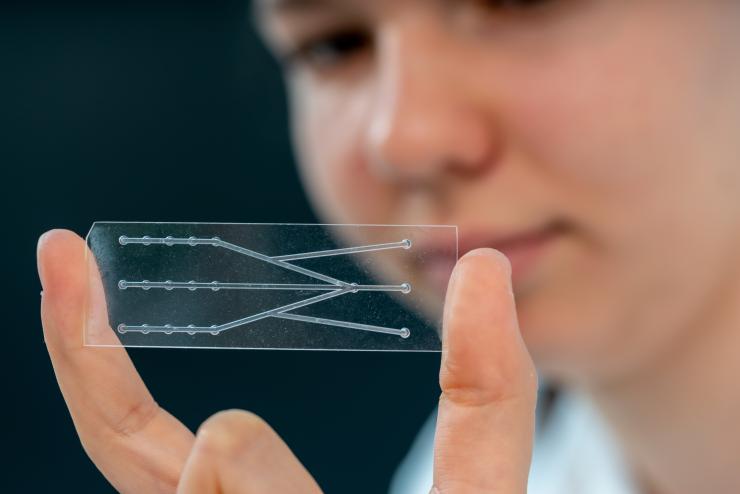
Tissue Chip

The current methods for studying the risks of human spaceflight in deep space rely on the International Space Station and ground-based analogs. These options require samples to be returned to Earth for hands-on analysis, and still provide an incomplete picture of the full range of risks that spaceflight beyond LEO poses to human health. By facilitating the development of MPS technology, also known as tissue chips or organs-on-a-chip, TRISH’s SENTINEL initiative bolsters not only our ability to realistically study the health impacts from deep space on human tissue, but also to test the medical treatments developed to address them without risking human health in the process.

The goal for SENTINEL’s tissue chips is to create automated and self-reporting tissue chips that can be built to represent single organs or systems of organs. In-line sensing capabilities will allow them to self-regulate and quickly provide data to researchers. This frees up crew time during missions and eliminates the need for sample returns, which are costly and potentially impossible on future long duration spaceflight missions. Constructing tissue chips from specific astronauts and flying them aboard the same mission will give researchers the opportunity to compare the effects of spaceflight on the whole human body to those on the tissue chip cultures, helping to validate the platform.  

The Future of Personalized Medicine in Space and on Earth

TRISH Tissue Chip

SENTINEL is revolutionizing the field of precision medicine and the advancements SENTINEL drives in tissue chip technology have applications that reach far beyond human spaceflight. Current tissue chip technologies are often artisan systems that do not easily transfer from laboratory to laboratory. SENTINEL prioritizes standardization of tissue chips which will help enable their usefulness in a clinical setting on Earth and in space. Using a subject’s cells to build personalized tissue chips enables researchers to test medications and other possible interventions without introducing further risk to the patient. The ability to predict how a person’s body reacts to the spaceflight environment can help fine-tune countermeasures based on that person’s genetic profile. Tissue chips can also be part of a connected multi-tissue system that simulates multiple organs and their interactions with one another, providing even further insight into a medication’s effects. The medical capabilities developed through SENTINEL will be instrumental in safeguarding the health of astronauts in space and in improving our healthcare systems here on Earth. 

Remote Biomarkers

In 2024, TRISH announced it was seeking advanced remote biomarker analysis proposals under the SENTINEL program. Selected projects will focus on technologies that can analyze a wide range of biomarkers without requiring sample return and doing so in a non-invasive way that allows for data collection over points in time separated by days or weeks. Selections for this program are expected to be made in summer 2025. 

Fram2
Fram2

EXPAND

TRISH’s EXPAND Program collects pre-, in-, and post-flight health and performance data from multiple commercial space flights.

Learn More
Data Earth

HERMES

TRISH’s HERMES facilitates the autonomous collection and monitoring of an astronaut’s biomedical and mission-related data on-orbit, allowing clinical and operations teams to access critical information at any time.

Learn more
Translational Research Institute for Space Health
  • What Is TRISH?
    • Consortium and Partners
    • TRISH Speaker Bureau
  • Our Team
  • Programs
  • Funding
  • Research
    • Commercial Spaceflight
    • HERMES
    • SENTINEL
    • Publications
  • Career Development
    • Academy of Bioastronautics
    • Blog: TRISH Postdoc Fellowship
  • Space Health Resources
    • How the Body Changes in Space
    • Launching Your Space Health Career
    • Red Risk School
  • News
  • Events
    • TRISH Orbit Rendezvous
    • Events Archive

Center for Space Medicine

Bioscience Research Collaborative
6500 Main St. Suite 908 Houston, TX 77030

Connect with us

Follow Us facebook twitter youtube linkedin instagram rss 

Footer Menu Healthcare

  • Healthcare
    • Specialties
    • MyChart Login
    • For Patients & Visitors
    • For Health Professionals
    • Clinical Trials
    • Find a Physician

Footer Menu Education

  • Education
    • Programs & Admissions
    • Student & Trainee Resources
    • Faculty Resources
    • School of Medicine
    • Graduate School of Biomedical Sciences
    • National School of Tropical Medicine
    • School of Health Professions
    • Tuition & Fees
    • Financial Aid

Footer Menu Research

  • Research
    • Our Research
    • Core Labs
    • Faculty Labs
    • Research Centers
    • Research Offices

Footer Menu Community

  • Community
    • Healthcare Outreach
    • Education Outreach
    • Global Programs
    • Community Events

Footer Menu About

  • About
    • Our Campus
    • Departments
    • Academic Centers
    • Administrative Offices
    • Affiliates
    • Leadership
    • Giving
    • Alumni

Footer Menu Resource Links

  • Resource Links
    • Contact Us
    • Find a Person
    • Careers
    • BCM Team Shop
    • News
    • Title IX Office
    • Compliance
    • Covid Response Site

©1998-2026 Baylor College of Medicine® | 1 Baylor Plaza, Houston, Texas 77030 | 713-798-4951
Have an edit or suggestion for this page?

  • Compliance
  • Privacy
  • Intranet