Home
  • Healthcare
    • Specialties
      • Cardiovascular Care
      • Oncology
      • Neurosurgery
      • Primary Care
      • View All Specialties >
    • For Health Professionals
      • Refer a Patient
      • Clinical Trials
      • Professional Development
      • View All >
    • For Patients & Visitors
      • MyChart Login
      • Accepted Insurance
      • Pay My Bill
      • Patient Information
      • View All >
    • Clinical Trials
      • Autism
      • Cancer
      • Obesity
      • Substance Abuse
      • View All Clinical Trials >
    • Find a Doctor
    • Make an Appointment

    General Inquiries

    Call today to schedule an appointment or fill out an online request form. If requested before 2 p.m. you will receive a response today.

    CALL

    713-798-1000

    Monday – Friday 8 a.m. – 5 p.m.


    ONLINE

    Request Now

    Request non-urgent appointments

    Request an appointment, learn about your rights as a patient, read about what to expect from your appointment, and more.

    As Houston's premier academic medical practice, Baylor Medicine delivers compassionate, innovative, evidence-based care.
    Find a Doctor

  • Education
    • Degree Programs & Admissions
      • M.D. Program
      • Ph.D. Programs
      • DNP Program (Nurse Anesthesia)
      • Genetic Counseling Program
      • P.A. Program
      • Orthotics & Prosthetics Program
      • Baccalaureate/M.D. Programs
      • Dual Degree Programs
      • View All Programs >
    • Financing Your Education
      • Tuition & Fees
      • Financial Aid
      • CARES ACT
    • Schools
      • School of Medicine
      • Graduate School of Biomedical Sciences
      • National School of Tropical Medicine
      • School of Health Professions
    • Advanced Training Programs
      • Residency Programs
      • Clinical Fellowships
      • Postdoctoral Research Positions
      • Continuing Professional Development
      • Diploma in Tropical Medicine
      • View All >
    • Resources
      • Departments
      • Academic Centers
      • Academic Calendars
      • Education Cores
      • View All >
    • Information For...
      • Students
      • Postdoctoral Researchers
      • Faculty
      • Alumni
    get-to-know-houston

    America's fourth-largest city is a great place to live, work, and play. Find out why.
    Get to Know Houston

  • Research
    • Research Offices
      • Advanced Technology Cores
      • Clinical Research
      • Institute for Clinical & Translational Research
      • Office of Research Leadership
      • Research IT
      • Sponsored Programs
    • Research at Baylor
      • Academic Centers
      • Departments
      • Faculty Labs
      • From the Labs
      • News
      • Our Research
      • Research Centers
      • Strategic Research Center
    • Additional Research Services
      • BCM Innovation Institute
      • Service Labs
      • VIICTR
    get-to-know-houston

    America's fourth-largest city is a great place to live, work, and play. Find out why.
    Get to Know Houston

  • Community
    • Healthcare Outreach
      • Community Programs
      • More >
    • Global Outreach
      • Global Health
      • Global Programs >
    • Educational Outreach
      • SMART Program
      • BioEd Online
      • More >
    • General Resources
      • Community Events
      • News
      • Blogs
      • Baylor in the Community
    get-to-know-houston

    America's fourth-largest city is a great place to live, work, and play. Find out why.
    Get to Know Houston

  • About
    • About Us
      • Academic Centers
      • Alumni
      • Careers
      • Departments
      • Giving
      • Leadership
      • Mission, Vision, Values
      • News
      • Our Affiliates
      • Fast Facts
      • Accreditation
    • Offices
      • President's Office
      • Office of Research
      • Ombuds Office
      • BCM Innovation Institute
      • View All >
    • Our Campus
      • Compliance
      • Safety and Security
      • Resource Stewardship & Sustainability
      • Team Shop
      • Find a Person
    get-to-know-houston

    America's fourth-largest city is a great place to live, work, and play. Find out why.
    Get to Know Houston

  • GIVE
  • CAREERS
  • INTRANET
  • Careers
  • Contact Us
  • News
Graduate School of Biomedical Sciences
  • Admissions
  • Degree Programs and Certificates
  • Research
  • Curriculum
  • Current Students
  • Postdoctoral Affairs
  • Faculty Mentoring Resources
  • Connect with GSBS
  • Graduate School Contacts
  • Career Paths
  • Student Life
  • Training Grants and Fellowships
  • Faculty & Staff
  • Admissions
  • Degree Programs and Certificates
  • Research
  • Curriculum
  • Current Students
  • Postdoctoral Affairs
  • Faculty Mentoring Resources
  • Connect with GSBS
  • Graduate School Contacts
  • Career Paths
  • Student Life
  • Training Grants and Fellowships
  • Faculty & Staff
  1. Baylor College of Medicine
  2. Education
  3. Graduate School of Biomedical Sciences
  4. Degree Programs and Certificates
  5. Immunology Microbiology
  • Research
    • Antibiotics, Antivirals & Drug Resistance
    • Autoimmune & Inflammatory Diseases
    • Host-Microbe Interactions and Pathogenesis
    • Immune System Development, Metabolism and Function
    • Immunotherapy, Gene Therapy & Vaccine Development
    • Mechanisms of Viral Replication
    • Microbial Macromolecular Structure and Function
    • Microbiome in Health and Disease
    • Molecular & Viral Carcinogenesis & Cancer Immunology
  • Faculty
  • Students

Immunology & Microbiology Graduate Program

Join us in investigating the importance of interactions between microbes, their hosts and the immune system in human health and disease.

Graduate Program Retreat

About the Program

As a student in the Immunology & Microbiology Graduate Program at Baylor College of Medicine, you will receive a personalized, inquiry-based education and actively acquire a sophisticated understanding of basic and translational immunology and microbiology problems and state-of-the-art techniques. We also emphasize the development of critical thinking, creativity, and problem-solving skills necessary for diverse scientific careers. Our interdisciplinary faculty members have diverse research interests that span many aspects of basic, translational, and clinical immunology and microbiology. This broad spectrum of topics provides rich opportunities for collaborative and interdisciplinary thesis projects at the cutting-edge of training in these fields.

Explore our research
Group photo from the 2016 Annual Retreat for the Graduate Program in Immunology.

Diverse Perspectives

Our program draws together faculty members with shared interests in immunology and microbiology to provide a diversity of scientific perspectives.

Find faculty whose interests match yours
Britton lab 070215

Where Will Your Ph.D. Take You?

Our graduates have gone on to build successful careers in academia, industry, law, consulting and more. Whatever your vision for your career entails, we will provide the training, resources and support to help you realize your ambition.

View alumni

Immunology & Microbiology News

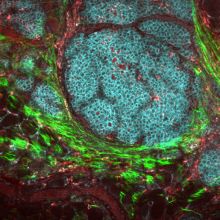
This image of a tumor mass shows cancer cells in teal color.  Macrophages in red and collagen fibers in green form part of the tumor microenvironment.

Taking a closer look into the tumor microenvironment with nano-radiomics

Research has shown that the tumor microenvironment (TME) can participate in the fight against cancer, but also can promote its growth and help the tumor evade the immune response. Assessing the effectiveness of new therapies on the TME is challenging. In a report published in Science Advances, BCM researchers describe a novel, noninvasive method they developed to assess the effect of a cellular immunotherapy treatment specifically directed at the TME.
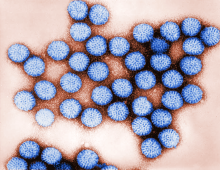
This 1981 digitally-colorized transmission electron microscopic (TEM) image revealed some of the ultrastructural morphology of a number of intact rotavirus, double-shelled particles.

Mystery Solved, rotavirus VP3 is a unique capping machine

After eluding researchers for more than 30 years, the VP3 protein of rotavirus has finally revealed its unique structure and function to a team led by labs at Baylor College of Medicine. The researchers knew that VP3 was necessary for capping messenger-RNA (mRNA), a process essential for the synthesis of viral proteins and for evading the host’s immune response, but while the structure and function of the other rotavirus proteins had progressively been unveiled, VP3 remained the last unsolved rotavirus mystery.
A pregnant woman holding her stomach.

Genetic signature may identify mothers at risk for preeclampsia

For years, researchers have looked for single gene mutations that could be strongly associated with risk of preeclampsia, but the results have not been encouraging. Previous work suggested that a genetic factor seemed to predispose to preeclampsia, but its identification has been elusive. BCM researchers discovered that a unique combination of variants of these three genes was associated with increased complement activation and preeclampsia.
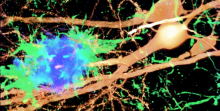
Microscopic images reveal that microglia become activated (green) in response to certain types of toxic amyloid plaques (blue) and damage neurons (gold), leading to defects in learning and memory.

Connecting interferon, neuroinflammation and synapse loss in Alzheimer’s disease

Inflammation in Alzheimer’s disease involves the activation of two types of cells in the brain: the resident immune cells called microglia, and astrocytes, star-shaped cells that support neuronal functions. In addition, there are elevated levels of cytokines, molecules that are produced by immune cells to promote inflammation. But the question remained, how does chronic inflammation in brains with Alzheimer’s disease lead to neuronal dysfunction and the consequent neurodegeneration and dementia? This study provides a major advance in the understanding of a process that leads to neuronal damage, by connecting IFN, complement and synapse loss: IFN controls the expression of multiple components of the complement cascade and mediates synapse elimination in a complement-dependent manner.
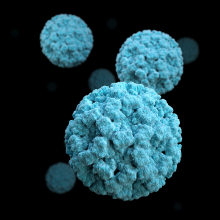
Norovirus

Come on in: Bile acids open the door to norovirus infection

Teams of researchers around the world have been working for more than four decades to find a way to grow this virus in the lab. Success came in 2016 from a BCM laboratory where they grew, for the first time, noroviruses in laboratory cultures of human intestinal epithelial cells. In this new study, investigators report the results of their continuing investigations to identify the bile components that are involved in promoting norovirus infection. 
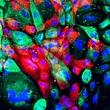
Prostate cancer model.

Making ‘sense’ of the ‘cart before the horse’

A fusion gene is a new gene made by joining parts of two different genes. It had been thought that fusion genes precede fusion RNA, but some have raised doubts that this is always the case. About 10 years ago scientists proposed the ‘cart-before-the-horse-hypothesis,’ which puts forward the idea that fusion RNA can form first and then guide the rearrangement of genes to form the corresponding fusion gene. Although this process had been found in simpler organisms, until this study, researchers had yet to come forward showing that this proposed RNA-mediate gene rearrangements also happen in mammalian cells.
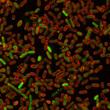
Green fluorescent spots form when DNA replication is stalled in membrane stained (red) E. coli cells. Stalling DNA replication is one way that DNA can be damaged by endogenous proteins in cells acting like carcinogens.

E. coli shows the way to cell-made protein carcinogens

Baylor researchers discovered a new major class of cancer-promoting genes by showing that many normal proteins made by our cells can act like carcinogens, damaged DNA and causing mutations. Former graduate student and current postdoctoral associate at Baylor, Dr. Jun Xia was one of the two co-first authors on this study.
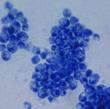
Yeast Candida Albicans

Yeast impairs memory in mice

An increasing number of clinical observations indicates that fungi are becoming a more common cause of upper airway allergic diseases such as asthma, as well as other conditions such as sepsis, a potentially life-threatening disease caused by the body’s response to an infection. Fungal infections causing airway allergic diseases and sepsis have been associated with increased risk for dementia later. This observation led Baylor researchers and colleagues to investigate the possibility that fungus might produce a brain infection and, if so, the consequences of having that kind of infection.
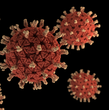
3D graphical representation of rotavirus virions.  Rotaviruses are nonenveloped, double-shelled viruses, making them quite stable in the environment.

Sugars in mother's milk influence neonatal rotavirus infection

Rotavirus infection causes diarrhea and vomiting primarily in children younger than 5, with the exception of babies younger than 28 days of age, who usually have no symptoms. However, in some places, infections in newborns are associated with severe gastrointestinal problems. What can lead to an asymptomatic or to a clear infection is not clearly understood. BCM researchers are identifying the factors mediating differences between newborns with and without symptoms.
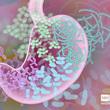
Good gut bacteria help keep a gut healthy.

Team work and balance can keep a gut healthy

A significant body of work currently is indicating that the microbiota helps shape the immune system and allows it to do its job. BCM researchers are investigating the role the microbiota plays in modulating the immune response in a way that reduces the damage inflammation can do to the gut.

From The Labs 2015

From the Labs

Subscribe to the From the Labs blog to keep up-to-date on all the latest research news from BCM.

Graduate School of Biomedical Sciences

The Immunology & Microbiology graduate program is part of the Baylor College of Medicine Graduate School of Biomedical Sciences. Visit the GSBS website for more information about our curriculum and admissions process as well as to find resources and services designed to support your success throughout graduate school and your future career.

Visit the Graduate School

Stipends and Benefits

At BCM we are focused on you and your training. If your vision for your future includes teaching, you may choose to gain experience as a teaching assistant. If you do not want to teach, you have the freedom to focus exclusively on your education and research as well as to work with your mentor to take advantage of other BCM resources that match your interests.

View stipends and benefits
Immunology & Microbiology Graduate Program
  • Research
    • Antibiotics, Antivirals & Drug Resistance
    • Autoimmune & Inflammatory Diseases
    • Host-Microbe Interactions and Pathogenesis
    • Immune System Development, Metabolism and Function
    • Immunotherapy, Gene Therapy & Vaccine Development
    • Mechanisms of Viral Replication
    • Microbial Macromolecular Structure and Function
    • Microbiome in Health and Disease
    • Molecular & Viral Carcinogenesis & Cancer Immunology
  • Faculty
  • Students

Contact Admissions

Phone 713–798–3859
Email gradappboss@bcm.edu

Contact Program

Emily Barrios
Graduate Program Administrator
emily.barrios@bcm.edu

Jason Kimata, Ph.D.
Graduate Program Director
(713) 798-4536
jkimata@bcm.edu

Graduate School Ph.D. Application

The Graduate School Ph.D. application for 2026 is now closed. The application for 2027 admission will open on Sept. 1. There is no application fee and no GRE required! Learn more. Learn more.

get-to-know-houston

America's fourth largest city is a great place to live, work and play. Find out why.
Get to Know Houston

Credit
Visit Houston

Connect with us

Follow Us facebook twitter youtube linkedin instagram rss 

Footer Menu Healthcare

  • Healthcare
    • Specialties
    • MyChart Login
    • For Patients & Visitors
    • For Health Professionals
    • Clinical Trials
    • Find a Physician

Footer Menu Education

  • Education
    • Programs & Admissions
    • Student & Trainee Resources
    • Faculty Resources
    • School of Medicine
    • Graduate School of Biomedical Sciences
    • National School of Tropical Medicine
    • School of Health Professions
    • Tuition & Fees
    • Financial Aid

Footer Menu Research

  • Research
    • Our Research
    • Core Labs
    • Faculty Labs
    • Research Centers
    • Research Offices

Footer Menu Community

  • Community
    • Healthcare Outreach
    • Education Outreach
    • Global Programs
    • Community Events

Footer Menu About

  • About
    • Our Campus
    • Departments
    • Academic Centers
    • Administrative Offices
    • Affiliates
    • Leadership
    • Giving
    • Alumni

Footer Menu Resource Links

  • Resource Links
    • Contact Us
    • Find a Person
    • Careers
    • BCM Team Shop
    • News
    • Title IX Office
    • Compliance
    • Covid Response Site

©1998-2026 Baylor College of Medicine® | 1 Baylor Plaza, Houston, Texas 77030 | 713-798-4951
Have an edit or suggestion for this page?

  • Compliance
  • Privacy
  • Intranet