Home
  • Healthcare
    • Specialties
      • Cardiovascular Care
      • Oncology
      • Neurosurgery
      • Primary Care
      • View All Specialties >
    • For Health Professionals
      • Refer a Patient
      • Clinical Trials
      • Professional Development
      • View All >
    • For Patients & Visitors
      • MyChart Login
      • Accepted Insurance
      • Pay My Bill
      • Patient Information
      • View All >
    • Clinical Trials
      • Autism
      • Cancer
      • Obesity
      • Substance Abuse
      • View All Clinical Trials >
    • Find a Doctor
    • Make an Appointment

    General Inquiries

    Call today to schedule an appointment or fill out an online request form. If requested before 2 p.m. you will receive a response today.

    CALL

    713-798-1000

    Monday – Friday 8 a.m. – 5 p.m.


    ONLINE

    Request Now

    Request non-urgent appointments

    Request an appointment, learn about your rights as a patient, read about what to expect from your appointment, and more.

    As Houston's premier academic medical practice, Baylor Medicine delivers compassionate, innovative, evidence-based care.
    Find a Doctor

  • Education
    • Degree Programs & Admissions
      • M.D. Program
      • Ph.D. Programs
      • DNP Program (Nurse Anesthesia)
      • Genetic Counseling Program
      • P.A. Program
      • Orthotics & Prosthetics Program
      • Baccalaureate/M.D. Programs
      • Dual Degree Programs
      • View All Programs >
    • Financing Your Education
      • Tuition & Fees
      • Financial Aid
      • CARES ACT
    • Schools
      • School of Medicine
      • Graduate School of Biomedical Sciences
      • National School of Tropical Medicine
      • School of Health Professions
    • Advanced Training Programs
      • Residency Programs
      • Clinical Fellowships
      • Postdoctoral Research Positions
      • Continuing Professional Development
      • Diploma in Tropical Medicine
      • View All >
    • Resources
      • Departments
      • Academic Centers
      • Academic Calendars
      • Education Cores
      • View All >
    • Information For...
      • Students
      • Postdoctoral Researchers
      • Faculty
      • Alumni
    get-to-know-houston

    America's fourth-largest city is a great place to live, work, and play. Find out why.
    Get to Know Houston

  • Research
    • Research Offices
      • Advanced Technology Cores
      • Clinical Research
      • Institute for Clinical & Translational Research
      • Office of Research Leadership
      • Research IT
      • Sponsored Programs
    • Research at Baylor
      • Academic Centers
      • Departments
      • Faculty Labs
      • From the Labs
      • News
      • Our Research
      • Research Centers
      • Strategic Research Center
    • Additional Research Services
      • BCM Innovation Institute
      • Service Labs
      • VIICTR
    get-to-know-houston

    America's fourth-largest city is a great place to live, work, and play. Find out why.
    Get to Know Houston

  • Community
    • Healthcare Outreach
      • Community Programs
      • More >
    • Global Outreach
      • Global Health
      • Global Programs >
    • Educational Outreach
      • SMART Program
      • BioEd Online
      • More >
    • General Resources
      • Community Events
      • News
      • Blogs
      • Baylor in the Community
    get-to-know-houston

    America's fourth-largest city is a great place to live, work, and play. Find out why.
    Get to Know Houston

  • About
    • About Us
      • Academic Centers
      • Alumni
      • Careers
      • Departments
      • Giving
      • Leadership
      • Mission, Vision, Values
      • News
      • Our Affiliates
      • Fast Facts
      • Accreditation
    • Offices
      • President's Office
      • Office of Research
      • Ombuds Office
      • BCM Innovation Institute
      • View All >
    • Our Campus
      • Compliance
      • Safety and Security
      • Resource Stewardship & Sustainability
      • Team Shop
      • Find a Person
    get-to-know-houston

    America's fourth-largest city is a great place to live, work, and play. Find out why.
    Get to Know Houston

  • GIVE
  • CAREERS
  • INTRANET
  • Careers
  • Contact Us
  • News
Healthcare: Neurosurgery
  • Specialties
  • Find a Physician
  • For Patients
  • For Physicians
  • Clinical Trials
  • Request an Appointment
  • MyChart
  • News
  • Specialties
  • Find a Physician
  • For Patients
  • For Physicians
  • Clinical Trials
  • Request an Appointment
  • MyChart
  • News
  1. Baylor College of Medicine
  2. Healthcare
  3. Specialties
  4. Neurosurgery
  5. Cerebrovascular and Stroke Surgery
  6. Acute Ischemic Stroke
  • Brain and Skull Base Tumor Surgery
  • Cerebrovascular and Stroke Surgery
    • Acute Ischemic Stroke
    • Brain Aneurysms
    • Brain Arteriovenous Malformations (AVMs)
    • Carotid Stenosis
    • Cavernous Malformations
    • Dural Arteriovenous Fistulas
    • Endovascular Neurosurgical Oncology
    • Moyamoya Disease
    • Spinal Vascular Malformations
    • Meet Our Team
  • Deep Brain Stimulation (DBS)
  • Epilepsy Surgery
    • Neurostimulation
  • Functional Neurosurgery
  • MR-Guided Focused Ultrasound
  • Pain Including Trigeminal Neuralgia
  • Pituitary Center
    • Cushing's Disease
    • Acromegaly
    • Prolactinoma
    • Minimally Invasive - Maximally Effective Pituitary Surgery
    • Physician Referral
    • Meet Our Team
  • Spine Surgery
  • Stereotactic Radiosurgery
  • For Patients
    • Neurosurgery FAQ
    • Neurosurgery Terms
    • Patient Resources
  • For Referring Physicians
  • Meet Our Team

Acute Ischemic Stroke

What You Need to Know About Stroke

Stroke is the leading cause of long-term disability and preventable disability in the United States. It is also the fifth leading cause of death, killing nearly 130,000 people in the U.S. each year. The cerebrovascular neurosurgeons and stroke neurologists at Baylor Medicine specialize in the diagnosis and treatment of brain blood vessel disorders, including acute ischemic strokes.

If you or someone you know is having symptoms of a stroke, seek medical attention and call 911 immediately!

What Is an Ischemic Stroke?
American Heart Association
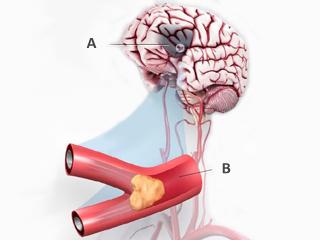
Figure 1. A blood clot breaks free, flows in the blood and lodges in a brain vessel. (A) Brain tissue affected by blockage. (B) Close-up of a clot inside an artery that provides blood flow to the brain.

The word “ischemia” means lack of blood flow to an organ of the body. Ischemic strokes happen when a blood vessel in the brain is suddenly blocked causing lack of blood flow to that area of the brain (Figure 1).

The disruption in blood flow deprives the brain of the crucial oxygen and nutrients it needs to survive. Within minutes, the parts of the brain supplied by that blood vessel begin to suffer and to stop working properly.

If the blocked vessel is not re-opened, irreversible brain tissue injury and damage will happen to that part of the brain.

Symptoms

People who are having a stroke can exhibit a variety of symptoms, which can vary greatly depending on what parts of the brain are affected by the stroke. People suffering a stroke might experience speech difficulties, numbness, weakness of the arm, leg or face, paralysis, problems with vision, confusion, and even coma.

Stroke specialists have distilled this information into a helpful mnemonic to help remember the signs of someone having a stroke (Figure 2).

In an emergency, just think "FAST" and do the following:

Face - Ask the person to smile. Does one side of the face droop or is it numb? Is the smile uneven?

Arms - Ask the person to raise both arms. Can one arm not be raised upward or does one arm drift downward?

Speech - Ask the person to repeat a simple phrase like "The sky is blue." Is their reply slurred or does it sound strange?

Time - If you observe any of these symptoms, even if they go away, call 911 immediately. Check the time so that you’ll know when the symptoms started.

If you notice any of these symptoms, even if they fluctuate or disappear, seek medical attention immediately and call 911!

National Stroke Association
Spot a stroke F.A.S.T.

Spot a Stroke F.A.S.T.

Figure 2. Face drooping. Arm weakness. Speech difficulty. Time to call 911.

Diagnosis

While you are at the hospital, there are a number of tests and scans that a physician might use to evaluate your condition and establish a treatment plan suited to your needs.

  • A CT (computed tomography) scan is an x-ray that doctors use to determine which part of the brain has been damaged and whether the stroke was caused by hemorrhage or artery blockage.
  • An MRI (magnetic resonance imaging) scan uses radio waves and magnets to produce a more detailed image of the blood vessels in the brain. It helps identify the damage done to the brain after stroke.
  • CT angiogram or MRI angiogram are able to obtain accurate pictures of the blood vessels in the neck and brain to look for blockages for causes of stroke.

Treatment

The primary goal in treating acute ischemic stroke is to preserve the healthy brain tissue that is at risk of dying due to the vessel blockage. Brain tissue can only survive a few hours without blood flow. Thus, to save the at-risk brain tissue during a stroke, the blood vessel blockage must be re-opened quickly in order to prevent permanent brain damage. There are two FDA approved tools that stroke doctors have to break up brain vessel blockage.

tPA (tissue Plasiminogen Activator)

tPA is a thrombolytic, or “clot-buster,” drug that is delivered through the patient’s vein and circulates in the blood stream to break up a blood clot that is blocking the brain vessel. Intravenous delivered tPA is approved by the FDA for the treatment of acute ischemic stroke. The drug can make a big difference, but only if it is given within a specified time frame (up to four and a half hours after symptoms begin). This is why thinking “FAST” is crucial in a stroke, or “brain attack.”

Mechanical Thrombectomy

Mechanical thrombectomy (mechanical blood clot removal) helps patients who have major brain blood vessel blockages and are at risk for the largest amount of brain injury and the worst strokes. Patients are candidates for this emergency procedure when they have a major brain blood vessel blocked and it has been less than six hours from the start of symptoms, and/or special brain scans show that no severe damage to the brain has already occurred.

The procedure is performed under light anesthesia by a specially trained neurointerventionalist. They place a lengthy catheter, or thin tube, into the femoral artery in the leg, and the catheter is guided up the artery into the brain’s blood vessels with x-ray guidance. An angiogram (x-ray image of blood vessels) is performed by injecting dye through the catheter and taking x-ray videos, which allow the doctor to find and visualize the blockage (Figure 3).

A special grasping device is placed from the catheter into the clot to grasp it and the device is used to then physically pull the blockage out of the brain restoring brain blood flow. If the vessel is opened in time, the brain can be saved from permanent damage. Stent retriever stroke procedures are safe and highly effective in selected patients even up to 24 hours after symptoms begin.

Figure 3. Stroke imaging

Figure 3. Images from a brain angiogram showing a large brain blood vessel blockage. Figure 3a: The blue arrows outline the internal carotid artery coursing from the neck to the brain and the red arrow show the blockage of the middle cerebral artery (MCA). Figure 3b: The same image with the skull eliminated and same red arrow showing the blockage. The blue shading shows the large area of brain not getting blood flow. Figure 3c: After opening the brain artery, the blood now flows normally. Figure 3d: The blood clots pulled out of the brain vessel (red) and the device (stentriever) used.

Recovery

Depending on the severity of your stroke, you may stay in the hospital for a few days to a few months to recover. You will likely either remain in the stroke unit or move to a rehabilitation ward. During this time, a team of healthcare professionals with specialized training manages your recovery. These individuals include:

  • Doctors
  • Nurses
  • Clinical nurse specialists and healthcare assistants
  • Therapists (physical, occupational, and speech/language)
  • Dietitians
  • Ophthalmologists
  • Clinical psychologists
  • Rehabilitation assistants
  • Social workers
  • Pharmacists

When it comes to recovering from a stroke, every person and each case is different. Some patients recover quickly needing with minimal assistance, while others are left with long-term disabilities. Some require different types of therapy, spending time practicing therapeutic exercises to regain skills that previously came easily to them. Others may have to learn how to work around their new limitations.

The rehabilitation process often requires patience and persistence, but our expert staff will be available to support you through it every step of the way. When it is time for you to be discharged from the hospital, your stroke team will work with you in order to determine what sort of support you will need at home. They will plan the necessary arrangements and help you ascertain any special services, aids, or equipment you might need.

Helpful Links

  • Ischemic Strokes (Clots) - American Heart Association | American Stroke Association
  • About Us - National Stroke Association
More information for patients

Patient Information

• For Patients
• Locations

  • Brain and Skull Base Tumor Surgery
  • Cerebrovascular and Stroke Surgery
    • Acute Ischemic Stroke
    • Brain Aneurysms
    • Brain Arteriovenous Malformations (AVMs)
    • Carotid Stenosis
    • Cavernous Malformations
    • Dural Arteriovenous Fistulas
    • Endovascular Neurosurgical Oncology
    • Moyamoya Disease
    • Spinal Vascular Malformations
    • Meet Our Team
  • Deep Brain Stimulation (DBS)
  • Epilepsy Surgery
    • Neurostimulation
  • Functional Neurosurgery
  • MR-Guided Focused Ultrasound
  • Pain Including Trigeminal Neuralgia
  • Pituitary Center
    • Cushing's Disease
    • Acromegaly
    • Prolactinoma
    • Minimally Invasive - Maximally Effective Pituitary Surgery
    • Physician Referral
    • Meet Our Team
  • Spine Surgery
  • Stereotactic Radiosurgery
  • For Patients
    • Neurosurgery FAQ
    • Neurosurgery Terms
    • Patient Resources
  • For Referring Physicians
  • Meet Our Team

Make an Appointment

Call today to schedule an appointment or fill out an online request form. If requested before 2 p.m. you will receive a response today.

Call 713–798–4696 Monday - Friday 8 a.m. - 5 p.m.
Fax 713–798–3739

ONLINE

Request Now

Request non-urgent appointments

Find a Physician
mychart

MyChart is a patient-accessible website that enables you to interact with your Baylor Medicine healthcare team.

Login

mobile-phone-image

Follow Us facebook twitter youtube linkedin instagram rss 

Footer Menu Healthcare

  • Healthcare
    • Specialties
    • MyChart Login
    • For Patients & Visitors
    • For Health Professionals
    • Clinical Trials
    • Find a Physician

Footer Menu Education

  • Education
    • Programs & Admissions
    • Student & Trainee Resources
    • Faculty Resources
    • School of Medicine
    • Graduate School of Biomedical Sciences
    • National School of Tropical Medicine
    • School of Health Professions
    • Tuition & Fees
    • Financial Aid

Footer Menu Research

  • Research
    • Our Research
    • Core Labs
    • Faculty Labs
    • Research Centers
    • Research Offices

Footer Menu Community

  • Community
    • Healthcare Outreach
    • Education Outreach
    • Global Programs
    • Community Events

Footer Menu About

  • About
    • Our Campus
    • Departments
    • Academic Centers
    • Administrative Offices
    • Affiliates
    • Leadership
    • Giving
    • Alumni

Footer Menu Resource Links

  • Resource Links
    • Contact Us
    • Find a Person
    • Careers
    • BCM Team Shop
    • News
    • Title IX Office
    • Compliance
    • Covid Response Site

©1998-2026 Baylor College of Medicine® | 1 Baylor Plaza, Houston, Texas 77030 | 713-798-4951
Have an edit or suggestion for this page?

  • Compliance
  • Privacy
  • Intranet