
Chagas Disease
Chagas disease is an infection with the parasite Trypanosoma cruzi. Animals and people normally get Chagas disease by contact with insect vectors found throughout the American continents (mainly, in rural areas of Latin America). It is estimated that as many as 8 million people in Mexico, Central America, and South America have Chagas disease, most of whom do not know they are infected. Chagas disease can cause very serious heart problems. If untreated, infection is lifelong and can be life threatening. Treatment is most effective in the early stages of disease. If you think you have Chagas disease, you should speak with your doctor about getting tested. We think that people in Texas, especially in Houston, might have exposures to the insect that causes Chagas disease. We are asking the Houston public to help us collect and test any “kissing bugs”, “chinches” or triatomine vectors from our fair city.
Current Projects
The goal of this study is to determine the prevalence of Chagas disease in patients presenting with dilated cardiomyopathy to three large acute care hospitals in Houston to assess the clinical impact of this infection and risk factors for acquiring the disease. This collaborative project is being done with our community partners at Michael E DeBakey Veterans Affairs Medical Center, St Luke’s Health, and Harris Health System. The public health impact of this study is considerable as it will critically impact the clinical understanding of Chagas disease on cardiovascular health in Texas, with an opportunity to identify high risk populations to target for prevention and intervention efforts.
If you or your doctor want to know more about the study please contact Dr. Melissa Garcia at mnolan@bcm.edu or (832) 824-1317.
If You See These "Kissing Bug" Insects Anywhere in Harris County, We Would Like to Hear From You!
The Laboratory for Zoonotic and Viral Diseases at Baylor College of Medicine, working with Harris County Public Health Mosquito & Vector Control, is currently doing a study aimed to identify areas in Houston with T. cruzi positive insect vectors. Further community outreach will allow education of potentially high-risk populations of their increased risk of contact with the vector for self-awareness and intervention, and a targeted vector control response.
Kissing bug specimens (dead or alive) can be placed in a Ziploc bag or a pill vial and mailed in a padded envelope to the address indicated on the submission form. Please fill out the collection information on the submission form include it the in envelope with the specimen. If you have more than one insect, each should be in their own bag and have their own submission form (please make copies if needed, or just write the information on a separate sheet of paper).
The feces of kissing bugs may contain the parasite, so please use caution when handling the insects. If you encounter a kissing bug or its nymph, do not use bare hands trying to catch it, but rather use gloves or an inverted plastic bag or Ziploc bag over your hand. For the same reason the surfaces the bug crawled on should be decontaminated with bleach or similar disinfectants.
The overall goal of this study is to understand the risk of Chagas disease in hunters, a potentially high-risk population. We hope to understand how many people are infected and how they are getting infected. We are offering free testing to any hunter in Texas. Specifically, we are targeting hunters at state conventions, wildlife management association meetings, and public hunting lands.
Researchers from the National School of Tropical Medicine are offering educational material and free screening for Chagas disease at hunting conventions and gatherings across Texas. If you are a hunter who has seen kissing bugs in areas where you hunt or stay overnight in shelters or cabins, please consider getting tested. And wear gloves when field dressing!
If your wildlife management association or hunter group would like to have us give a community education talk or has any specific questions, please contact Dr. Sarah Gunter at sarah.murphy@bcm.edu or (832) 824-0830.
TWRC Wildlife Center is partnering with the National School of Tropical Medicine at Baylor College of Medicine to learn more about the prevalence of Chagas disease in Houston. Chagas disease is an vector-borne parasitic infection which can produce heart failure in the late stages of infected animals and people. This infection can be present for months to years before animals and people develop any symptoms.
TWRC Wildlife Center and Baylor College of Medicine plan to test mammals brought to the wildlife center for care, as part of the routine examination given to all animals upon admission. In areas of Houston where animals test positive for Chagas disease, we will be able to target human populations for testing. Testing for both animals and people is a simple blood test.
The partnership between TWRC and Baylor College of Medicine is an important collaboration to better understand how many animals are infected in the Houston area. Together, we can improve the lives of both animals and people in Houston.
How Do People Get Chagas Disease?
People become infected by:
- Contact with infected insect vectors (more information below)
- Congenital transmission (a pregnant woman can give it to her baby)
- Blood transfusion
- Organ transplantation
- Consumption of uncooked drinks or food contaminated with feces from infected bugs
- Accidental laboratory exposure
Chagas disease is not transmitted from person-to-person like a cold or the flu or through casual contact with infected people or animals.
Kissing Bug
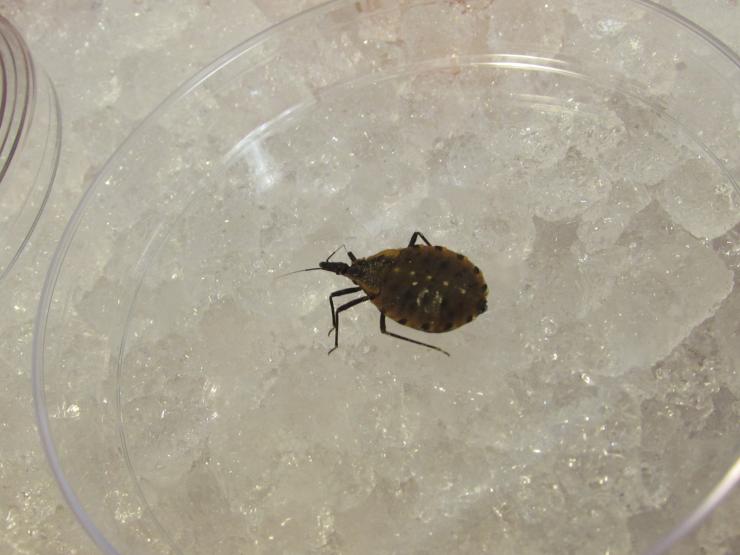
The insect vectors are called triatomine bugs or “kissing bugs” or “chinches”. If infected, these blood-sucking bugs pass T. cruzi parasites in their feces. During the night, when people are sleeping, the bugs come out of hiding. Because they tend to feed on people's faces, triatomine bugs are also known as "kissing bugs." But, these bugs can bite you on any part of your body. At the same time they are taking a blood meal, they defecate on your skin. People get infected when the T. cruzi-rich feces enters your body through breaks in the skin or mucous membranes. The unsuspecting, sleeping person may accidentally scratch or rub the feces into the bite wound, eyes, or mouth.
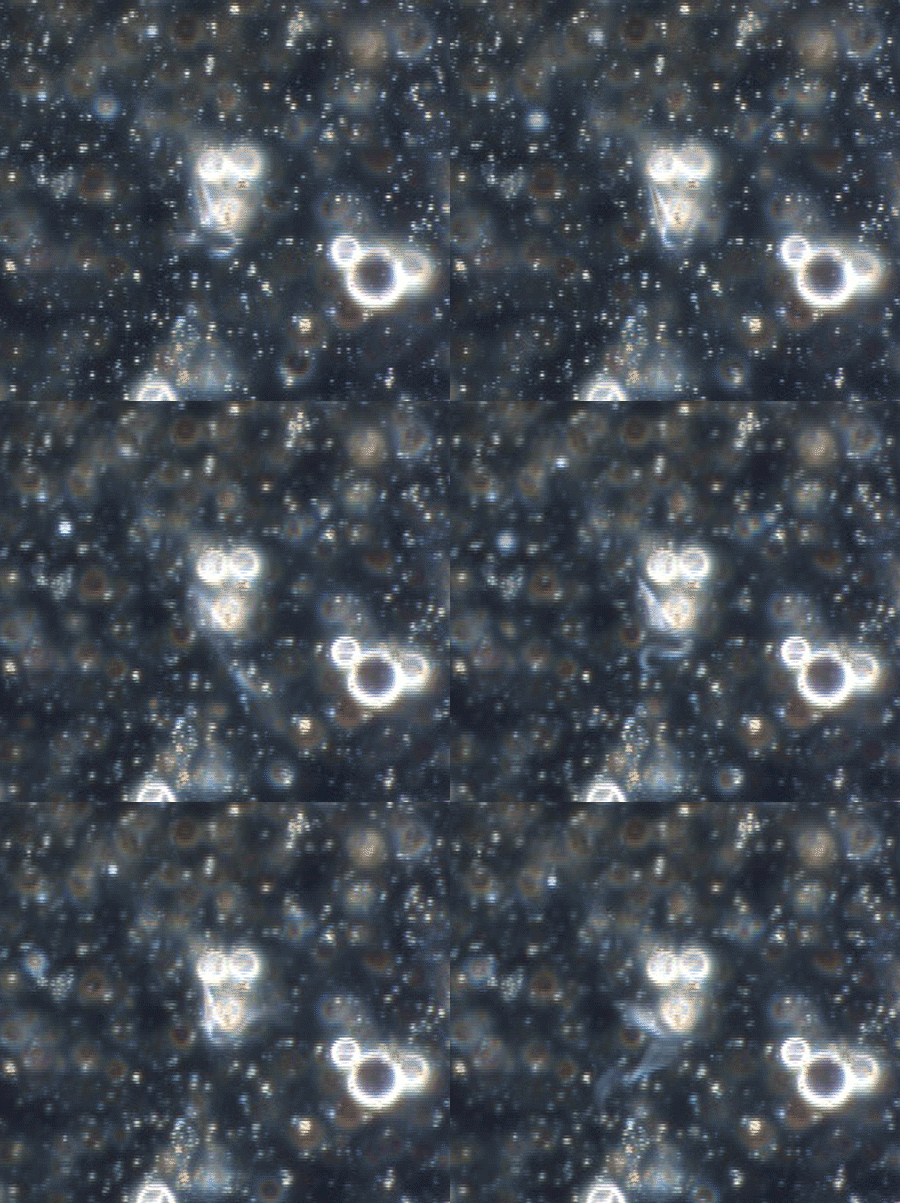
Trypanosoma cruzi
Trypanosoma cruzi parasite at trypomastigote stage seen in the gut contents of a kissing bug, Triatoma sanguisuga, using dark field microscopy. The kissing bug in this case was captured in Conroe, Texas.