Home
  • Healthcare
    • Specialties
      • Cardiovascular Care
      • Oncology
      • Neurosurgery
      • Primary Care
      • View All Specialties >
    • For Health Professionals
      • Refer a Patient
      • Clinical Trials
      • Professional Development
      • View All >
    • For Patients & Visitors
      • MyChart Login
      • Accepted Insurance
      • Pay My Bill
      • Patient Information
      • View All >
    • Clinical Trials
      • Autism
      • Cancer
      • Obesity
      • Substance Abuse
      • View All Clinical Trials >
    • Find a Doctor
    • Make an Appointment

    General Inquiries

    Call today to schedule an appointment or fill out an online request form. If requested before 2 p.m. you will receive a response today.

    CALL

    713-798-1000

    Monday – Friday 8 a.m. – 5 p.m.


    ONLINE

    Request Now

    Request non-urgent appointments

    Request an appointment, learn about your rights as a patient, read about what to expect from your appointment, and more.

    As Houston's premier academic medical practice, Baylor Medicine delivers compassionate, innovative, evidence-based care.
    Find a Doctor

  • Education
    • Degree Programs & Admissions
      • M.D. Program
      • Ph.D. Programs
      • DNP Program (Nurse Anesthesia)
      • Genetic Counseling Program
      • P.A. Program
      • Orthotics & Prosthetics Program
      • Baccalaureate/M.D. Programs
      • Dual Degree Programs
      • View All Programs >
    • Financing Your Education
      • Tuition & Fees
      • Financial Aid
      • CARES ACT
    • Schools
      • School of Medicine
      • Graduate School of Biomedical Sciences
      • National School of Tropical Medicine
      • School of Health Professions
    • Advanced Training Programs
      • Residency Programs
      • Clinical Fellowships
      • Postdoctoral Research Positions
      • Continuing Professional Development
      • Diploma in Tropical Medicine
      • View All >
    • Resources
      • Departments
      • Academic Centers
      • Academic Calendars
      • Education Cores
      • View All >
    • Information For...
      • Students
      • Postdoctoral Researchers
      • Faculty
      • Alumni
    get-to-know-houston

    America's fourth-largest city is a great place to live, work, and play. Find out why.
    Get to Know Houston

  • Research
    • Research Offices
      • Advanced Technology Cores
      • Clinical Research
      • Institute for Clinical & Translational Research
      • Office of Research Leadership
      • Research IT
      • Sponsored Programs
    • Research at Baylor
      • Academic Centers
      • Departments
      • Faculty Labs
      • From the Labs
      • News
      • Our Research
      • Research Centers
      • Strategic Research Center
    • Additional Research Services
      • BCM Innovation Institute
      • Service Labs
      • VIICTR
    get-to-know-houston

    America's fourth-largest city is a great place to live, work, and play. Find out why.
    Get to Know Houston

  • Community
    • Healthcare Outreach
      • Community Programs
      • More >
    • Global Outreach
      • Global Health
      • Global Programs >
    • Educational Outreach
      • SMART Program
      • BioEd Online
      • More >
    • General Resources
      • Community Events
      • News
      • Blogs
      • Baylor in the Community
    get-to-know-houston

    America's fourth-largest city is a great place to live, work, and play. Find out why.
    Get to Know Houston

  • About
    • About Us
      • Academic Centers
      • Alumni
      • Careers
      • Departments
      • Giving
      • Leadership
      • Mission, Vision, Values
      • News
      • Our Affiliates
      • Fast Facts
      • Accreditation
    • Offices
      • President's Office
      • Office of Research
      • Ombuds Office
      • BCM Innovation Institute
      • View All >
    • Our Campus
      • Compliance
      • Safety and Security
      • Resource Stewardship & Sustainability
      • Team Shop
      • Find a Person
    get-to-know-houston

    America's fourth-largest city is a great place to live, work, and play. Find out why.
    Get to Know Houston

  • GIVE
  • CAREERS
  • INTRANET
  • Careers
  • Contact Us
  • News
Department of Pediatrics
  • Meet Our Team
  • Divisions and Centers
  • Education
  • Research
  • Healthcare
  • News
  • Faculty Development
  • Meet Our Team
  • Divisions and Centers
  • Education
  • Research
  • Healthcare
  • News
  • Faculty Development
  1. Baylor College of Medicine
  2. Departments
  3. Pediatrics
  4. Divisions and Centers
  5. Cardiology
  6. Research
  7. Research Labs
  8. Pediatric Molecular Cardiology Lab
  9. Myocarditis
  • Faculty
  • Education
    • Pediatric Cardiology Fellowship
      • Admissions
      • Director's Message
      • Curriculum
        • Didactic
        • Research
        • Unique Educational Opportunities
      • Subspecialty Programs
      • Fellows
        • Fellow Life
        • Post-Graduate Outcomes
      • Stipend and Benefits
    • Pediatric Cardiology Electrophysiology Fellowship
  • Research
    • Research Labs
      • Pediatric Molecular Cardiology Lab
        • Arrhythmogenic Right Ventricular Dysplasia
        • Dilated Cardiomyopathy
        • Left Ventricular Non-Compaction
        • Myocarditis
  • Healthcare
  • Subspecialty Areas
    • Electrophysiology

Myocarditis

Myocarditis is an inflammatory disorder of the myocardium with necrosis of the myocytes and associated inflammatory infiltrate. It is usually caused by infection with a virus, particularly adenovirus or enterovirus (e.g., Coxsackievirus). These viruses typically cause other less serious diseases, such as gastrointestinal problems and the common cold. Although the utility of myocardial biopsy is debated, suspected myocarditis can be classified based on pathologic findings as defined in the Dallas or Marburg Criteria.

Investigations of the role of viruses in the development of myocarditis, DCM and ARVD/C are ongoing in the Phoebe Willingham Muzzy Pediatric Molecular Cardiology Laboratory, while viral diagnosis is provided by the John Welsh Cardiovascular Diagnostic Laboratory.

Dallas Classification (1987)

Initial Biopsy

  • Myocarditis: Myocardial necrosis, degeneration, or both, in the absence of significant coronary artery disease with adjacent inflammatory infiltrate with or without fibrosis
  • Borderline myocarditis: Inflammatory infiltrate too sparse or myocyte damage not apparent
  • No myocarditis

Subsequent Biopsies

  • Ongoing (persistent) myocarditis with or without fibrosis
  • Resolving (healing) myocarditis with or without fibrosis
  • Resolved (healed) myocarditis with or without fibrosis

WHO Marburg Criteria (1996)

First Biopsy

Acute (active) myocarditis: A clear-cut infiltrate (diffuse, focal or confluent) of >14 leukocytes/mm² (preferably activated T-cells). The amount of the infiltrate should be quantitated by immunohistochemistry. Necrosis or degeneration are compulsory, fibrosis may be absent or present and should be graded.

Chronic myocarditis: An infiltrate of >14 leukocytes/mm² (diffuse, focal or confluent, preferably activated T-cells). Quantification should be made by immunohistochemistry. Necrosis or degeneration are usually not evident, fibrosis may be absent or present and should be graded.

No myocarditis: No infiltrating cells or <14 leukocytes/mm².

Subsequent Biopsies

  • Ongoing (persistent) myocarditis: Criteria as in 1 or 2 (features of an acute or chronic myocarditis).
  • Resolving (healing) myocarditis: Criteria as in 1 or 2 but the immunological process is sparser than in the first biopsy.
  • Resolved (healed) myocarditis: Corresponds to the Dallas classification.

Frequency of Myocarditis
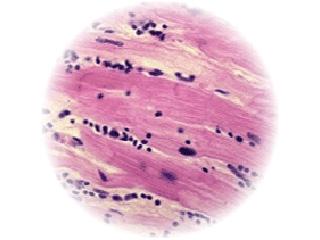
Histological assessment of heart tissue from a patient with myocarditis

Myocarditis is a rare disease. The World Health Organization reports that incidence of cardiovascular involvement after enteroviral infection is 1-4 percent, depending on the causative organism. Incidence varies greatly among countries and is related to hygiene and socioeconomic conditions. Availability of medical services and immunizations also affect incidence. Occasional epidemics of viral infections have been reported with an associated higher incidence of myocarditis. Studies give a wide spectrum of mortality and morbidity statistics. With suspected Coxsackievirus B, the mortality rate is higher in newborns (75 percent) than in older infants and children (10-25 percent). Complete recovery of ventricular function has been reported in as many as 50 percent of patients. Some patients develop chronic myocarditis (ongoing or resolving) and/or dilated cardiomyopathy and may eventually require cardiac transplantation.

Causes of Myocarditis

Most cases of myocarditis are believed to be caused by virus infection, either directly, due to virus replication, or indirectly, due to autoimmune disease. Occasionally, myocarditis may be due to drug hypersensitivity or toxicity.

Viral Infection
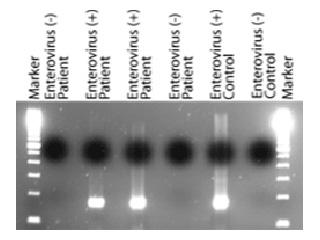
PCR amplification of enterovirus

A number of viruses have been identified in the hearts of patients with myocarditis. In 1986 a virus called Coxsackievirus B was identified in the hearts of patients with either myocarditis or DCM. Subsequent work performed by Dr. Jeffrey Towbin and the Muzzy lab has shown that another virus, called adenovirus, is also commonly a cause of these conditions. It has been suggested that when the virus infects the heart it causes the body to react against the virus, much as the body's own defense system (immune system) normally attacks a virus infection, and this causes inflammation in the heart (myocarditis). Usually the virus will be eliminated, however in some patients the immune system may not totally eliminate the virus and in these patients the heart muscle continues to be damaged, leading to DCM. In some people, the body's immune system may attack and damage the heart even though the virus has been eliminated: this is termed auto immune disease.

Auto-Immune Disease

The body's own immune system is responsible for defending it against all foreign invaders for example viruses and bacteria. However, sometimes, this system malfunctions, and starts to attack the body's own tissues - this results in a so-called auto-immune disease. It is thought that this process occurs in some cases of myocarditis.

Other Agents

Myocarditis also can be caused by alcohol, radiation, chemicals (hydrocarbons and arsenic), and drugs.

  • Faculty
  • Education
    • Pediatric Cardiology Fellowship
      • Admissions
      • Director's Message
      • Curriculum
        • Didactic
        • Research
        • Unique Educational Opportunities
      • Subspecialty Programs
      • Fellows
        • Fellow Life
        • Post-Graduate Outcomes
      • Stipend and Benefits
    • Pediatric Cardiology Electrophysiology Fellowship
  • Research
    • Research Labs
      • Pediatric Molecular Cardiology Lab
        • Arrhythmogenic Right Ventricular Dysplasia
        • Dilated Cardiomyopathy
        • Left Ventricular Non-Compaction
        • Myocarditis
  • Healthcare
  • Subspecialty Areas
    • Electrophysiology

Contact

Contact 832–826–5048
Contact 832–826–5715
Fax 832–826–4297

Division of Cardiology

Texas Children's Hospital
6651 Main St. Suite E1920 Houston, TX 77030

Related Links

Department of Pediatrics

Follow Us facebook twitter youtube linkedin instagram rss 

Footer Menu Healthcare

  • Healthcare
    • Specialties
    • MyChart Login
    • For Patients & Visitors
    • For Health Professionals
    • Clinical Trials
    • Find a Physician

Footer Menu Education

  • Education
    • Programs & Admissions
    • Student & Trainee Resources
    • Faculty Resources
    • School of Medicine
    • Graduate School of Biomedical Sciences
    • National School of Tropical Medicine
    • School of Health Professions
    • Tuition & Fees
    • Financial Aid

Footer Menu Research

  • Research
    • Our Research
    • Core Labs
    • Faculty Labs
    • Research Centers
    • Research Offices

Footer Menu Community

  • Community
    • Healthcare Outreach
    • Education Outreach
    • Global Programs
    • Community Events

Footer Menu About

  • About
    • Our Campus
    • Departments
    • Academic Centers
    • Administrative Offices
    • Affiliates
    • Leadership
    • Giving
    • Alumni

Footer Menu Resource Links

  • Resource Links
    • Contact Us
    • Find a Person
    • Careers
    • BCM Team Shop
    • News
    • Title IX Office
    • Compliance
    • Covid Response Site

©1998-2026 Baylor College of Medicine® | 1 Baylor Plaza, Houston, Texas 77030 | 713-798-4951
Have an edit or suggestion for this page?

  • Compliance
  • Privacy
  • Intranet