Home
  • Healthcare
    • Specialties
      • Cardiovascular Care
      • Oncology
      • Neurosurgery
      • Primary Care
      • View All Specialties >
    • For Health Professionals
      • Refer a Patient
      • Clinical Trials
      • Professional Development
      • View All >
    • For Patients & Visitors
      • MyChart Login
      • Accepted Insurance
      • Pay My Bill
      • Patient Information
      • View All >
    • Clinical Trials
      • Autism
      • Cancer
      • Obesity
      • Substance Abuse
      • View All Clinical Trials >
    • Find a Doctor
    • Make an Appointment

    General Inquiries

    Call today to schedule an appointment or fill out an online request form. If requested before 2 p.m. you will receive a response today.

    CALL

    713-798-1000

    Monday – Friday 8 a.m. – 5 p.m.


    ONLINE

    Request Now

    Request non-urgent appointments

    Request an appointment, learn about your rights as a patient, read about what to expect from your appointment, and more.

    As Houston's premier academic medical practice, Baylor Medicine delivers compassionate, innovative, evidence-based care.
    Find a Doctor

  • Education
    • Degree Programs & Admissions
      • M.D. Program
      • Ph.D. Programs
      • DNP Program (Nurse Anesthesia)
      • Genetic Counseling Program
      • P.A. Program
      • Orthotics & Prosthetics Program
      • Baccalaureate/M.D. Programs
      • Dual Degree Programs
      • View All Programs >
    • Financing Your Education
      • Tuition & Fees
      • Financial Aid
      • CARES ACT
    • Schools
      • School of Medicine
      • Graduate School of Biomedical Sciences
      • National School of Tropical Medicine
      • School of Health Professions
    • Advanced Training Programs
      • Residency Programs
      • Clinical Fellowships
      • Postdoctoral Research Positions
      • Continuing Professional Development
      • Diploma in Tropical Medicine
      • View All >
    • Resources
      • Departments
      • Academic Centers
      • Academic Calendars
      • Education Cores
      • View All >
    • Information For...
      • Students
      • Postdoctoral Researchers
      • Faculty
      • Alumni
    get-to-know-houston

    America's fourth-largest city is a great place to live, work, and play. Find out why.
    Get to Know Houston

  • Research
    • Research Offices
      • Advanced Technology Cores
      • Clinical Research
      • Institute for Clinical & Translational Research
      • Office of Research Leadership
      • Research IT
      • Sponsored Programs
    • Research at Baylor
      • Academic Centers
      • Departments
      • Faculty Labs
      • From the Labs
      • News
      • Our Research
      • Research Centers
      • Strategic Research Center
    • Additional Research Services
      • BCM Innovation Institute
      • Service Labs
      • VIICTR
    get-to-know-houston

    America's fourth-largest city is a great place to live, work, and play. Find out why.
    Get to Know Houston

  • Community
    • Healthcare Outreach
      • Community Programs
      • More >
    • Global Outreach
      • Global Health
      • Global Programs >
    • Educational Outreach
      • SMART Program
      • BioEd Online
      • More >
    • General Resources
      • Community Events
      • News
      • Blogs
      • Baylor in the Community
    get-to-know-houston

    America's fourth-largest city is a great place to live, work, and play. Find out why.
    Get to Know Houston

  • About
    • About Us
      • Academic Centers
      • Alumni
      • Careers
      • Departments
      • Giving
      • Leadership
      • Mission, Vision, Values
      • News
      • Our Affiliates
      • Fast Facts
      • Accreditation
    • Offices
      • President's Office
      • Office of Research
      • Ombuds Office
      • BCM Innovation Institute
      • View All >
    • Our Campus
      • Compliance
      • Safety and Security
      • Resource Stewardship & Sustainability
      • Team Shop
      • Find a Person
    get-to-know-houston

    America's fourth-largest city is a great place to live, work, and play. Find out why.
    Get to Know Houston

  • GIVE
  • CAREERS
  • INTRANET
  • Careers
  • Contact Us
  • News
Zheng Zhou Lab
  • Lab Members
  • Research Areas
  • Publicatations
  • Lab Members
  • Research Areas
  • Publicatations
  1. Baylor College of Medicine
  2. Research
  3. Faculty Labs
  4. Zheng Zhou Lab
  5. Research Areas
  • Lab Members
  • Research Areas
  • Publicatations

Zheng Zhou Lab Research Areas

Zheng Zhou Lab

Research Questions

Recognition of Dying Cells

  • What is the molecular nature of the "eat me" signal(s) presented on the surface of apoptotic and necrotic cells?
  • What is the molecular mechanism that leads to the presentation of an “eat me” signal to the surface of apoptotic cells?
  • How do cytoplasmic Ca2+induces necrotic cells to expose phosphatidylserine (PS), the “eat me” signal that attracts engulfing cells?
  • How does the phagocytic receptor CED-1 recognize dying cells?  Besides CED-1, is there another phagocytic receptor that recognizes dying cells?
     

Engulfment of Dying Dells

  • How is CED-1 activated by its association with apoptotic cells?
  • What are the signaling pathways that trigger and regulate the polarized extension of engulfing cell surfaces that embrace the apoptotic cells?
  • How are the plasma membrane and the actin cytoskeleton underneath it rearranged during cell-surface extension?
  • How is membrane trafficking involved in the engulfment of apoptotic cells?
     

Degradation of Dying Cells

  • What are the molecular events, in particular membrane trafficking events, that are involved in the degradation of apoptotic cells?  Organelles in the endocytic pathway, such as early endosomes and lysosomes, are known to fuse with phagosomes and deliver digestive enzymes to phagosomal lumen.  Are there other kinds of intracellular organelles that fuse to phagosomes and promote phagosomal degradation?
  • How does the autophagy pathway interact with the phagocytosis pathway?
  • What are the signaling molecules that trigger the recruitment and fusion of intracellular organelles to phagosomes?  What are the effectors of these signaling molecules?  How do the effectors work on the molecular level?
  • How are the nutrients from degraded dying cells recycled inside host cells?
     

Clearance of Apoptotic Cells and Environmental Stresses

  • How do engulfing cells cope with environmental stresses during the clearance of dying cells?
  • What is the molecular mechanism behind the function of RAB-35, which is a robustness factor that functions to stabilize the apoptotic cell-clearance machinery under high temperature?
  • What are the identities of the members of the RAB-35 pathway?

Research to Answer These Questions

To answer these questions, we have established effective experimental systems that include forward genetics screens for mutants defective in each one of the three steps of dying cell removal, genetic and molecular analyses of gene functions, and many cell biological tools, in particular the time-lapse fluorescence microscopy technique, which allows us to visualize many subcellular events that occur during the process of dying cell removal in developing C. elegans embryos in real time.  The combination of genetic, cell biological, and molecular biological tools has enabled us to discover an “eat me” signal presented on the surface of both apoptotic and necrotic cells for attracting engulfing cells, and multiple proteins that are essential for the engulfment of dying cells.  Furthermore, we successfully used these methods to identify multiple signaling molecules and their effectors that drive phagosome maturation through a signaling pathway initiated by the activation of CED-1 on nascent phagosomes and mediated by the large GTPase dynamin.

In summary, the recognition, engulfment, and degradation of apoptotic cells are three integral steps in the process of apoptotic-cell removal.  C. elegans is a particular good system for studying the molecular mechanisms behind each step due to the existence of powerful tools for genetic and cell biological analyses.  Continuing our research using C. elegans as a model organism will allow us to discover the molecular mechanisms that control each cellular event related to the removal of dying cells, and will further provide clues for us to expand our research into the phagocytic removal of other targets, such as invading pathogens.

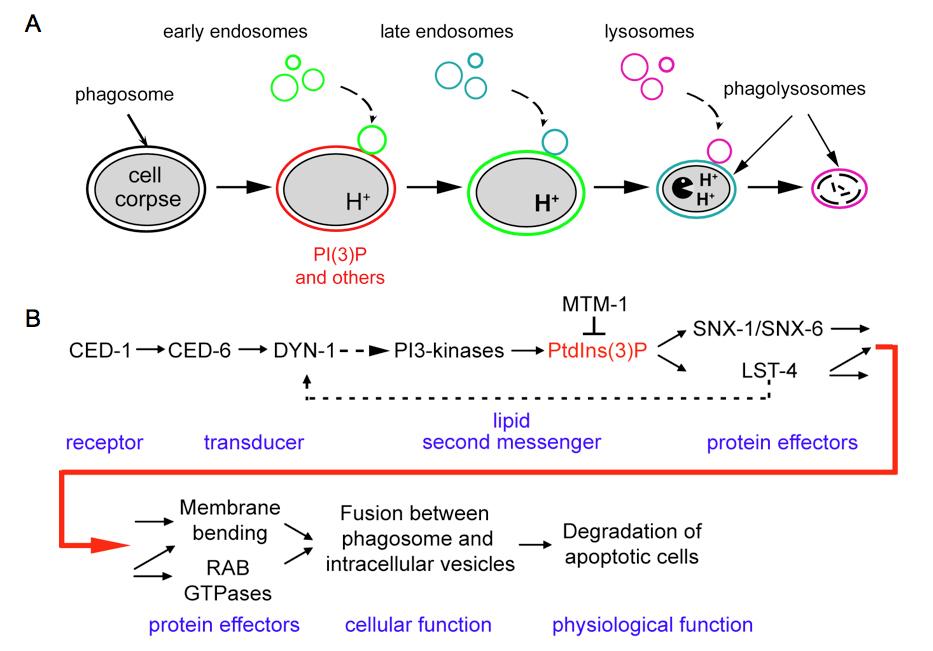
Figure 2: Zhou Lab
Figure 2. Cellular events activated by the phagocytic receptor for apoptotic cells and the genetic pathways regulating cell-corpse engulfment. Names in the parentheses are the names of the corresponding mammalian homologs.
Figure 3: Zhou Lab
Figure 3: The degradation of dying cells inside phagosomes. (A) The sequential incorporation of early endosomes, late endosomes, and lysosomes to phagosomes drives phagosome maturation. (B) A signal pathway that controls phagosome maturation.
  • Lab Members
  • Research Areas
  • Publicatations

Contact Us

Email zhengz@bcm.edu
Phone 713–798–6489

Zheng Zhou Lab

Verna and Marrs McLean Department of Biochemistry and Molecular Biology
One Baylor Plaza Rm 322B Houston, TX 77030

Follow Us facebook twitter youtube linkedin instagram rss 

Footer Menu Healthcare

  • Healthcare
    • Specialties
    • MyChart Login
    • For Patients & Visitors
    • For Health Professionals
    • Clinical Trials
    • Find a Physician

Footer Menu Education

  • Education
    • Programs & Admissions
    • Student & Trainee Resources
    • Faculty Resources
    • School of Medicine
    • Graduate School of Biomedical Sciences
    • National School of Tropical Medicine
    • School of Health Professions
    • Tuition & Fees
    • Financial Aid

Footer Menu Research

  • Research
    • Our Research
    • Core Labs
    • Faculty Labs
    • Research Centers
    • Research Offices

Footer Menu Community

  • Community
    • Healthcare Outreach
    • Education Outreach
    • Global Programs
    • Community Events

Footer Menu About

  • About
    • Our Campus
    • Departments
    • Academic Centers
    • Administrative Offices
    • Affiliates
    • Leadership
    • Giving
    • Alumni

Footer Menu Resource Links

  • Resource Links
    • Contact Us
    • Find a Person
    • Careers
    • BCM Team Shop
    • News
    • Title IX Office
    • Compliance
    • Covid Response Site

©1998-2026 Baylor College of Medicine® | 1 Baylor Plaza, Houston, Texas 77030 | 713-798-4951
Have an edit or suggestion for this page?

  • Compliance
  • Privacy
  • Intranet