Home
  • Healthcare
    • Specialties
      • Cardiovascular Care
      • Oncology
      • Neurosurgery
      • Primary Care
      • View All Specialties >
    • For Health Professionals
      • Refer a Patient
      • Clinical Trials
      • Professional Development
      • View All >
    • For Patients & Visitors
      • MyChart Login
      • Accepted Insurance
      • Pay My Bill
      • Patient Information
      • View All >
    • Clinical Trials
      • Autism
      • Cancer
      • Obesity
      • Substance Abuse
      • View All Clinical Trials >
    • Find a Doctor
    • Make an Appointment

    General Inquiries

    Call today to schedule an appointment or fill out an online request form. If requested before 2 p.m. you will receive a response today.

    CALL

    713-798-1000

    Monday – Friday 8 a.m. – 5 p.m.


    ONLINE

    Request Now

    Request non-urgent appointments

    Request an appointment, learn about your rights as a patient, read about what to expect from your appointment, and more.

    As Houston's premier academic medical practice, Baylor Medicine delivers compassionate, innovative, evidence-based care.
    Find a Doctor

  • Education
    • Degree Programs & Admissions
      • M.D. Program
      • Ph.D. Programs
      • DNP Program (Nurse Anesthesia)
      • Genetic Counseling Program
      • P.A. Program
      • Orthotics & Prosthetics Program
      • Baccalaureate/M.D. Programs
      • Dual Degree Programs
      • View All Programs >
    • Financing Your Education
      • Tuition & Fees
      • Financial Aid
      • CARES ACT
    • Schools
      • School of Medicine
      • Graduate School of Biomedical Sciences
      • National School of Tropical Medicine
      • School of Health Professions
    • Advanced Training Programs
      • Residency Programs
      • Clinical Fellowships
      • Postdoctoral Research Positions
      • Continuing Professional Development
      • Diploma in Tropical Medicine
      • View All >
    • Resources
      • Departments
      • Academic Centers
      • Academic Calendars
      • Education Cores
      • View All >
    • Information For...
      • Students
      • Postdoctoral Researchers
      • Faculty
      • Alumni
    get-to-know-houston

    America's fourth-largest city is a great place to live, work, and play. Find out why.
    Get to Know Houston

  • Research
    • Research Offices
      • Advanced Technology Cores
      • Clinical Research
      • Institute for Clinical & Translational Research
      • Office of Research Leadership
      • Research IT
      • Sponsored Programs
    • Research at Baylor
      • Academic Centers
      • Departments
      • Faculty Labs
      • From the Labs
      • News
      • Our Research
      • Research Centers
      • Strategic Research Center
    • Additional Research Services
      • BCM Innovation Institute
      • Service Labs
      • VIICTR
    get-to-know-houston

    America's fourth-largest city is a great place to live, work, and play. Find out why.
    Get to Know Houston

  • Community
    • Healthcare Outreach
      • Community Programs
      • More >
    • Global Outreach
      • Global Health
      • Global Programs >
    • Educational Outreach
      • SMART Program
      • BioEd Online
      • More >
    • General Resources
      • Community Events
      • News
      • Blogs
      • Baylor in the Community
    get-to-know-houston

    America's fourth-largest city is a great place to live, work, and play. Find out why.
    Get to Know Houston

  • About
    • About Us
      • Academic Centers
      • Alumni
      • Careers
      • Departments
      • Giving
      • Leadership
      • Mission, Vision, Values
      • News
      • Our Affiliates
      • Fast Facts
      • Accreditation
    • Offices
      • President's Office
      • Office of Research
      • Ombuds Office
      • BCM Innovation Institute
      • View All >
    • Our Campus
      • Compliance
      • Safety and Security
      • Resource Stewardship & Sustainability
      • Team Shop
      • Find a Person
    get-to-know-houston

    America's fourth-largest city is a great place to live, work, and play. Find out why.
    Get to Know Houston

  • GIVE
  • CAREERS
  • INTRANET
  • Careers
  • Contact Us
  • News
Research
  • Lab Members
  • Projects
  • Lab Members
  • Projects
  1. Baylor College of Medicine
  2. Research
  3. Faculty Labs
  4. Marta Fiorotto Lab
  5. Projects
  • Lab Members
  • Projects

Marta Fiorotto Projects

Regulation of skeletal muscle satellite cell function by protein intake during the postnatal period​
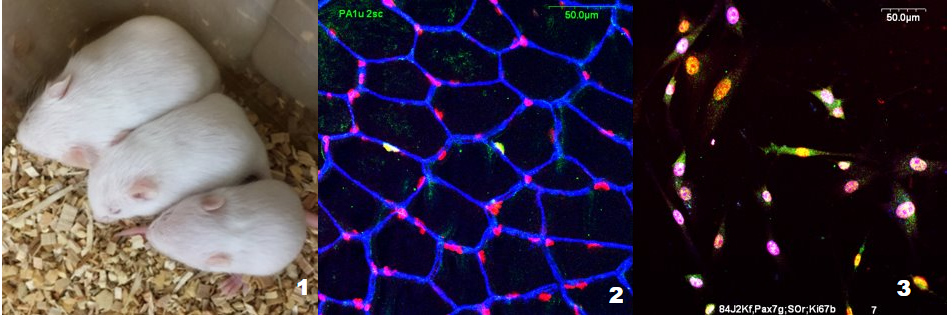
Under- or overnutrition in early postnatal life (1) have lifelong repercussions for skeletal muscle. We study how protein intake influences muscle growth (2) focusing primarily on protein turnover and satellite cell function

Regulation of skeletal muscle satellite cell function by protein intake during the postnatal period

When animals are undernourished in the newborn period, skeletal muscle growth is significantly compromised. Nutritional rehabilitation after weaning does not recover muscle mass. We have been undertaking a series of experiments to understand why this is so. Such information is necessary to design interventions that have a chance of successfully restoring muscle mass. Our goals are: (a) to assess the contribution of programmed alterations in protein turnover and satellite cell proliferation to the impaired growth; (b) to understand the mechanisms that result in these defects in cellular function and; (c) to identify the specific dietary nutrient deficit(s) that are responsible for the occurrence of the impairments.

  
These studies are primarily performed in mice in which we cross-foster pups at various developmental ages between dams fed a control or a reduced protein diet (to reduce milk production). Alternatively, we alter litter size to decrease or increase the amount of milk available to individual pups. We use: tracers to measure protein turnover and satellite cell proliferation in vivo; a variety of biochemical and molecular techniques to assess the activity of cellular signaling pathways, gene expression, enzyme activities, protein expression and hormone and metabolite levels; histological methods to characterize muscle phenotype; isolation of muscle progenitor cells for in vitro studies to identify inherent functional deficits resulting from the in vivo nutritional experiences of the organism. 
Evaluation of chronic dietary supplementation on muscle growth and body composition in the newborn piglet​
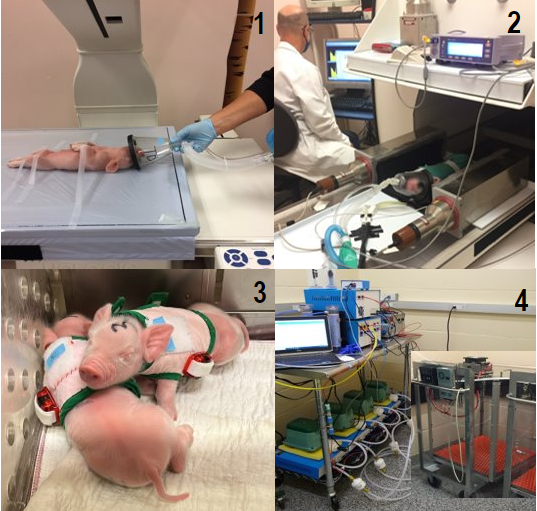
Total lean, fat, and bone mineral are quantified using dual x-ray absorptiometry (1) and total body potassium (2) measurements. Accelerometers (3) and indirect calorimetry (4) are used to assess components of energy expenditure.

Evaluation of chronic dietary supplementation with leucine or β-hydroxy β-methyl butyrate on muscle growth and body composition

Short-term supplementation of diets of newborn animals with leucine or its metabolite, β-hydroxy-β-methylbutyrate (HMB), stimulates muscle protein synthesis and satellite cell proliferation. We are conducting studies to determine if these anabolic effects are sustained and promote greater muscle protein accretion when the supplements are fed long-term. We are also assessing the effect of differences in lean mass on the partitioning of dietary energy intake to better understand its influence on energy balance and fat deposition in the neonate.

These studies are performed in full-term newborn pigs that are fed artificial formulas that mimic sow’s milk. We use many of the same techniques listed for our mouse studies.  In addition, we perform longitudinal measurements of:  total body potassium and dual x-ray absorptiometry to quantify changes in fat, lean, bone, and cellular masses; activity by accelerometry; energy intake and whole body energy expenditure by indirect calorimetry to determine energy balance.
Interventions to mitigate long-term cardiac dysfunction resulting from early life undernutrition 
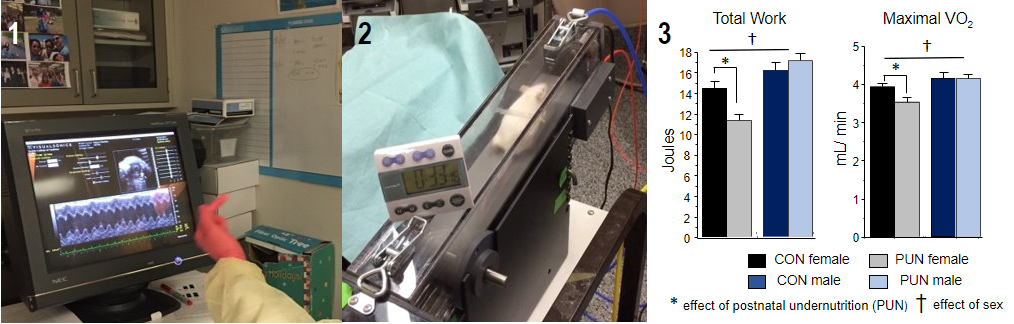
Following recovery from early postnatal undernutrition, heart structure and function (1) are compromised in adult female but not males. This is evidenced at the whole-body level with a stress test (2). Females, but not males, have reduced capacity for work and maximal aerobic capacity (3).

Interventions to mitigate long-term cardiac dysfunction resulting from early life undernutrition

Impaired growth during fetal life can reprogram heart development and increase the risk for long-term cardiovascular dysfunction. We found that, compared to males, young adult females that had been undernourished in early postnatal life and then nutritionally rehabilitated had disproportionately smaller and dysfunctional hearts with compromised maximal exercise capacity.  With progressive aging, many of the functional risks that develop are similar to those that predispose to heart failure with preserved ejection fraction, a condition that is most prevalent in women.   Thus, there appears to be a developmental window during which the heart is undergoing terminal maturation when it is vulnerable to reprogramming by inadequacies in nutrient intake. Our long-term goal is to reveal the mechanistic basis for the cardiac anomalies that develop as nutritionally compromised infants age and to identify preventive strategies to mitigate disease progression. 

These studies are primarily performed in mice using the cross-fostering and protein-restricted diet model  to induce undernutrition and rehabilitation. In vivo assessment of cardiac function and size are performed in collaboration with the DeBakey Heart Center Murine Non-Invasive Cardiovascular Function Laboratory. Exercise testing (VO2 peak, endurance, strength, voluntary activity), body composition, and measurements of energy expenditure and substrate utilization are performed in the Mouse Metabolic Research Unit at the CNRC.
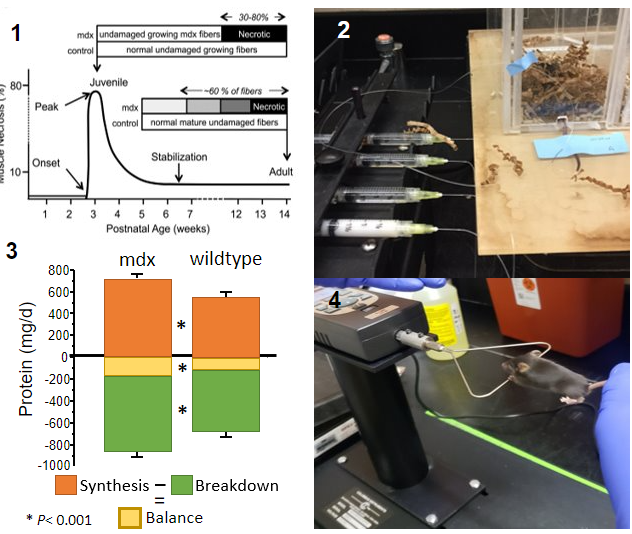
In the  mdx mouse model of Duchenne’s muscular dystrophy, the onset  and peak of muscle necrosis occurs at  weaning
In the mdx mouse model of Duchenne’s muscular dystrophy, the onset and peak of muscle necrosis occurs at weaning (1). We use amino acid tracers (2) to determine how these processes affect protein and amino acid metabolism (3). Effects of dietary interventions on the onset and severity of disease pathology are assessed using histological, functional, and molecular methods (4).

Dietary protein requirements and citrulline supplementation to support growing dystrophic muscle​

Little is known about protein requirements in patients with neuromuscular diseases. Current recommendations are that protein intake should meet the normal recommendations for age as there is little evidence to suggest otherwise.  Our research on the regulation of muscle and protein metabolism in highly anabolic conditions would indicate that this may not be so.  Additionally, the genetic defects are likely to incur alterations in the metabolism of specific amino acids and, hence, their nutritional requirements.  We are using a mouse model of Duchenne muscular dystrophy to define the contribution of skeletal muscle protein turnover to whole body protein turnover, how this affects dietary protein requirement, and the impact of variations in the dietary protein:energy ratio on the severity of muscle pathology. Citrulline is a precursor for arginine that serves as a substrate for the synthesis of many critical molecules, in addition to protein.  During growth, and other anabolic or inflammatory conditions arginine needs are increased. We are conducting studies in the dystrophic mouse model to assess if supplementation with citrulline confers any benefits in mitigating the progression of the disease.

Our studies are conducted in the mdx mouse model of muscular dystrophy. They are performed when the disease process is most severe, that is from the preweaning period, when muscle damage is first observed, through to adolescence.  We use stable isotope amino acid tracers to assess protein turnover in vivo; a wide variety of histological, molecular, and biochemical assays to assess disease severity; an array of in vivo measurements to assess muscle function; measurements of body composition, food intake, and indirect calorimetry to evaluate the efficiency of dietary protein and energy utilization.
 

  • Lab Members
  • Projects
USDA/ARS Children's Nutrition Research Center Holcombe View

USDA/ARS Children's Nutrition Research Center

The Hirschi Lab is part of the USDA/ARS Children's Nutrition Research Center which houses laboratories, state-of-the-art equipment, a greenhouse, observation labs, research volunteer accommodations, a metabolic kitchen, and an elite group of research scientists.

Visit the CNRC

Follow Us facebook twitter youtube linkedin instagram rss 

Footer Menu Healthcare

  • Healthcare
    • Specialties
    • MyChart Login
    • For Patients & Visitors
    • For Health Professionals
    • Clinical Trials
    • Find a Physician

Footer Menu Education

  • Education
    • Programs & Admissions
    • Student & Trainee Resources
    • Faculty Resources
    • School of Medicine
    • Graduate School of Biomedical Sciences
    • National School of Tropical Medicine
    • School of Health Professions
    • Tuition & Fees
    • Financial Aid

Footer Menu Research

  • Research
    • Our Research
    • Core Labs
    • Faculty Labs
    • Research Centers
    • Research Offices

Footer Menu Community

  • Community
    • Healthcare Outreach
    • Education Outreach
    • Global Programs
    • Community Events

Footer Menu About

  • About
    • Our Campus
    • Departments
    • Academic Centers
    • Administrative Offices
    • Affiliates
    • Leadership
    • Giving
    • Alumni

Footer Menu Resource Links

  • Resource Links
    • Contact Us
    • Find a Person
    • Careers
    • BCM Team Shop
    • News
    • Title IX Office
    • Compliance
    • Covid Response Site

©1998-2026 Baylor College of Medicine® | 1 Baylor Plaza, Houston, Texas 77030 | 713-798-4951
Have an edit or suggestion for this page?

  • Compliance
  • Privacy
  • Intranet