
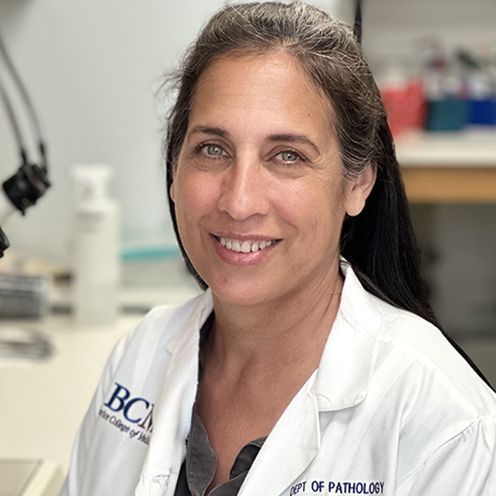
Positions
- Professor
-
Pathology
Baylor College of Medicine
Houston, TX
- James R. Davis Chair
-
Baylor College of Medicine
- Co-Director
-
Cancer & Cell Biology Graduate Program
Baylor College of Medicine
- Director
-
Comprehensive Mechanisms in Reproductive Sciences T32
Baylor College of Medicine
Education
- Post-Doctoral Fellowship at Baylor College Of Medicine
- 01/2007 - Houston, Texas, United States
- Reproductive Biology
- PhD from Northwestern University
- 04/2002 - Evanston, Illinois, United States
- Neurobiology and Physiology
- MS from Northwestern University
- 06/1995 - Evanston, Illinois, United States
- Biochemistry, Molecular Biology, and Cell Biology
- BA from Kent State University
- 06/1990 - Kent, Ohio, United States
- Anthropology and Sociology
Professional Interests
- Reproductive Biology
- Reproductive Cancers
Professional Statement
Our laboratory investigates the molecular mechanisms that regulate ovary development, and folliculogenesis, oocyte quality, female fertility, and reproductive aging, and how disruptions in these pathways contribute to reproductive diseases and gynecologic cancers.
We integrate genetically engineered mouse models with human genetics, transcriptomics, proteomics, and advanced imaging. Current research focuses on cell-signaling, post-translational modifications, mitochondrial function, and gene regulatory mechanisms that control oocyte development.
Our research is supported by the National Institutes of Health, including the Eunice K. Shriver National Institute of Child Health and Human Development (NICHD).
We integrate genetically engineered mouse models with human genetics, transcriptomics, proteomics, and advanced imaging. Current research focuses on cell-signaling, post-translational modifications, mitochondrial function, and gene regulatory mechanisms that control oocyte development.
Our research is supported by the National Institutes of Health, including the Eunice K. Shriver National Institute of Child Health and Human Development (NICHD).
Selected Publications
-
Rodriguez A, Briley SM, Patton BK, Tripurani SK, Rajapakshe K, Coarfa C, Rajkovic A, Andrieux A, Dejean A, Pangas SA. " Loss of the E2 SUMO-conjugating enzyme Ube2i in oocytes during ovarian folliculogenesis causes infertility in mice " Development. 2019 Dec 2; 146 (23)
Pubmed PMID: 31704792. -
Richards JS, Pangas SA. " The ovary: basic biology and clinical implications. " J. Clin. Invest.. 2010 Apr 1; 120 (4) : 963-72.
Pubmed PMID: 20364094. -
Middlebrook BS, Eldin K, Li X, Shivasankaran S, Pangas SA. " Smad1-Smad5 ovarian conditional knockout mice develop a disease profile similar to the juvenile form of human granulosa cell tumors. " Endocrinology. 2009 Dec ; 150 (12) : 5208-17.
Pubmed PMID: 19819941. -
Myers M, Middlebrook BS, Matzuk MM, Pangas SA. " Loss of inhibin alpha uncouples oocyte-granulosa cell dynamics and disrupts postnatal folliculogenesis. " Dev. Biol.. 2009 Oct 15; 334 (2) : 458-67.
Pubmed PMID: 19666016.
Log In to edit your profile