Home
  • Healthcare
    • Specialties
      • Cardiovascular Care
      • Oncology
      • Neurosurgery
      • Primary Care
      • View All Specialties >
    • For Health Professionals
      • Refer a Patient
      • Clinical Trials
      • Professional Development
      • View All >
    • For Patients & Visitors
      • MyChart Login
      • Accepted Insurance
      • Pay My Bill
      • Patient Information
      • View All >
    • Clinical Trials
      • Autism
      • Cancer
      • Obesity
      • Substance Abuse
      • View All Clinical Trials >
    • Find a Doctor
    • Make an Appointment

    General Inquiries

    Call today to schedule an appointment or fill out an online request form. If requested before 2 p.m. you will receive a response today.

    CALL

    713-798-1000

    Monday – Friday 8 a.m. – 5 p.m.


    ONLINE

    Request Now

    Request non-urgent appointments

    Request an appointment, learn about your rights as a patient, read about what to expect from your appointment, and more.

    As Houston's premier academic medical practice, Baylor Medicine delivers compassionate, innovative, evidence-based care.
    Find a Doctor

  • Education
    • Degree Programs & Admissions
      • M.D. Program
      • Ph.D. Programs
      • DNP Program (Nurse Anesthesia)
      • Genetic Counseling Program
      • P.A. Program
      • Orthotics & Prosthetics Program
      • Baccalaureate/M.D. Programs
      • Dual Degree Programs
      • View All Programs >
    • Financing Your Education
      • Tuition & Fees
      • Financial Aid
      • CARES ACT
    • Schools
      • School of Medicine
      • Graduate School of Biomedical Sciences
      • National School of Tropical Medicine
      • School of Health Professions
    • Advanced Training Programs
      • Residency Programs
      • Clinical Fellowships
      • Postdoctoral Research Positions
      • Continuing Professional Development
      • Diploma in Tropical Medicine
      • View All >
    • Resources
      • Departments
      • Academic Centers
      • Academic Calendars
      • Education Cores
      • View All >
    • Information For...
      • Students
      • Postdoctoral Researchers
      • Faculty
      • Alumni
    get-to-know-houston

    America's fourth-largest city is a great place to live, work, and play. Find out why.
    Get to Know Houston

  • Research
    • Research Offices
      • Advanced Technology Cores
      • Clinical Research
      • Institute for Clinical & Translational Research
      • Office of Research Leadership
      • Research IT
      • Sponsored Programs
    • Research at Baylor
      • Academic Centers
      • Departments
      • Faculty Labs
      • From the Labs
      • News
      • Our Research
      • Research Centers
      • Strategic Research Center
    • Additional Research Services
      • BCM Innovation Institute
      • Service Labs
      • VIICTR
    get-to-know-houston

    America's fourth-largest city is a great place to live, work, and play. Find out why.
    Get to Know Houston

  • Community
    • Healthcare Outreach
      • Community Programs
      • More >
    • Global Outreach
      • Global Health
      • Global Programs >
    • Educational Outreach
      • SMART Program
      • BioEd Online
      • More >
    • General Resources
      • Community Events
      • News
      • Blogs
      • Baylor in the Community
    get-to-know-houston

    America's fourth-largest city is a great place to live, work, and play. Find out why.
    Get to Know Houston

  • About
    • About Us
      • Academic Centers
      • Alumni
      • Careers
      • Departments
      • Giving
      • Leadership
      • Mission, Vision, Values
      • News
      • Our Affiliates
      • Fast Facts
      • Accreditation
    • Offices
      • President's Office
      • Office of Research
      • Ombuds Office
      • BCM Innovation Institute
      • View All >
    • Our Campus
      • Compliance
      • Safety and Security
      • Resource Stewardship & Sustainability
      • Team Shop
      • Find a Person
    get-to-know-houston

    America's fourth-largest city is a great place to live, work, and play. Find out why.
    Get to Know Houston

  • GIVE
  • CAREERS
  • INTRANET
  • Careers
  • Contact Us
  • News
Healthcare: Ear, Nose and Throat (Otolaryngology)
  • Specialties
  • Find a Physician
  • For Patients
  • For Physicians
  • Clinical Trials
  • Request an Appointment
  • MyChart
  • News
  • Specialties
  • Find a Physician
  • For Patients
  • For Physicians
  • Clinical Trials
  • Request an Appointment
  • MyChart
  • News
  1. Baylor College of Medicine
  2. Healthcare
  3. Specialties
  4. Ear, Nose and Throat
  5. For Patients
  6. Sound
  • Head and Neck Surgery
  • Center for Airway, Voice and Swallowing
    • Speech-Language Pathology
  • Hearing and Balance
    • Cochlear Implants
    • Audiology Services
    • Program for Lateral Skull Base Surgery
    • Balance Testing (Vestibular Diagnostics)
    • Balance Therapy (Vestibular Rehabilitation)
  • Nose and Sinus
  • For Patients
  • Meet Our Team

Sound

Sound - Mechanical Vibrations - Pressure Waves
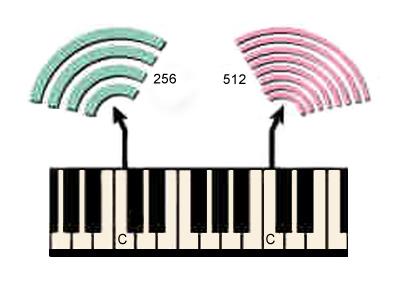
The pressure waves of sound are represented by the advancing concentric lines radiating away from the vibrating source. Middle C has a frequency of 256 cycles per second, while upper C has a frequency of 512 cycles per second.

The sensory organs of the eye, ear, tongue and skin are each sensitive to specific forms of energy. The nose and tongue detect chemical energy, the eye detects light energy, the skin detects heat and mechanical energy. Sound is a form of mechanical energy. Mechanical forces can be steady, like the weight of this journal in your hand, or they can vibrate, like your car when it goes over speed bumps. Sound is generated by mechanical vibrations (such as a vibrating piano string). This sets up small oscillations of air molecules that in turn cause adjacent molecules to oscillate as the sound propagates away from its source. Sound is called a pressure wave because when the molecules of air come closer together the pressure increases (compression) as they mover further apart the pressure decreases (rarefaction). Since a pressure wave consists of a molecular disturbance, sound waves cannot travel through a vacuum. The velocity of sound in air is around 1,100 ft/sec which is why dividing the seconds between seeing lightning and hearing thunder by 5 gives a rough measure in miles of how far the lightning is from you. Sound waves travel fastest in solids, slower in liquids and slowest in air. Sound vibrations extend from a few cycles per second to millions of cycles per second. Human hearing is limited to a range of between 20 to 20,000 cycles per second. Sound at a vibration rate of greater than 20,000 cycles per second is called ultrasound. Other mammals can hear ultrasound, some such as whales approach 100,000 cycles per second. Physicians now use imaging techniques based on ultrasound (mechanical vibrations at millions of cycles per second) to examine the unborn child.

A sound is characterized by its frequency and intensity. The frequency of a sound contributes to its pitch and is measured by counting the number of cycles per second in the vibration. Intensity is a measure of loudness. If you have ever played a piano, you know where middle C is on the keyboard (see Figure 1). If the piano is properly tuned, middle C has a frequency of 256 cycles per second, high C (7 white keys to the right) has a frequency of 512 cycles per second. People with normal hearing can tell the difference between two sounds that differ by less than 0.5 percent. In order to appreciate how small a difference in frequency this is you need only realize that middle C differs from C sharp (the black piano key immediately to its right of C) by more than 5 percent.

The intensity of a sound is a measure of its loudness and reflects how tightly packed the molecules of air become during the compression phase of a sound wave. The ear can detect sounds where the vibration of the air at the ear drum is less than the diameter of a hydrogen molecule. The ear has the ability to discriminate intensities over a 100,000 fold difference in energy. Still louder sounds can cause pain and damage the structures of the inner ear.

The task of all hearing organs is to analyze environmental sounds and transmit the results of that analysis to the brain. The brain interprets the ear’s analysis. All sensory organs have specialized sensory cells that convert an environmental signal into electrical energy. The change in electrical energy is then converted to a type a digital code that is transmitted to the brain. The human auditory system performs an analysis of sound entering the ear prior to the conversion to the neural code. The inner ear first determines how much energy is contained at the different frequencies that make up a specific sound. The cochlea is designed so that it is most sensitive to a specific frequency (say middle C) at one location and most sensitive to another frequency (say high C) at another. These different locations then transmit information to the brain. If the brain receives an increase in activity from the middle C location it then knows that the original sound contained energy at that frequency. This "mapping" of frequency information is just one of several strategies that the ear uses to code incoming information. The frequency analysis of environmental sounds begins in the external ear.

Next chapter: Getting Sound to the Inner Ear - The Analysis of Sound Begins

Return to the table of contents of How the Ear Works

  • Head and Neck Surgery
  • Center for Airway, Voice and Swallowing
    • Speech-Language Pathology
  • Hearing and Balance
    • Cochlear Implants
    • Audiology Services
    • Program for Lateral Skull Base Surgery
    • Balance Testing (Vestibular Diagnostics)
    • Balance Therapy (Vestibular Rehabilitation)
  • Nose and Sinus
  • For Patients
  • Meet Our Team

Make an Appointment

CALL 713–798–6336 Monday-Friday 7 a.m.-5 p.m.

ONLINE

Request Now

Request non-urgent appointments

Find a Physician
mychart

MyChart is a patient-accessible website that enables you to interact with your Baylor Medicine healthcare team.

Login

mobile-phone-image

Follow Us facebook twitter youtube linkedin instagram rss 

Footer Menu Healthcare

  • Healthcare
    • Specialties
    • MyChart Login
    • For Patients & Visitors
    • For Health Professionals
    • Clinical Trials
    • Find a Physician

Footer Menu Education

  • Education
    • Programs & Admissions
    • Student & Trainee Resources
    • Faculty Resources
    • School of Medicine
    • Graduate School of Biomedical Sciences
    • National School of Tropical Medicine
    • School of Health Professions
    • Tuition & Fees
    • Financial Aid

Footer Menu Research

  • Research
    • Our Research
    • Core Labs
    • Faculty Labs
    • Research Centers
    • Research Offices

Footer Menu Community

  • Community
    • Healthcare Outreach
    • Education Outreach
    • Global Programs
    • Community Events

Footer Menu About

  • About
    • Our Campus
    • Departments
    • Academic Centers
    • Administrative Offices
    • Affiliates
    • Leadership
    • Giving
    • Alumni

Footer Menu Resource Links

  • Resource Links
    • Contact Us
    • Find a Person
    • Careers
    • BCM Team Shop
    • News
    • Title IX Office
    • Compliance
    • Covid Response Site

©1998-2026 Baylor College of Medicine® | 1 Baylor Plaza, Houston, Texas 77030 | 713-798-4951
Have an edit or suggestion for this page?

  • Compliance
  • Privacy
  • Intranet