Home
  • Healthcare
    • Specialties
      • Cardiovascular Care
      • Oncology
      • Neurosurgery
      • Primary Care
      • View All Specialties >
    • For Health Professionals
      • Refer a Patient
      • Clinical Trials
      • Professional Development
      • View All >
    • For Patients & Visitors
      • MyChart Login
      • Accepted Insurance
      • Pay My Bill
      • Patient Information
      • View All >
    • Clinical Trials
      • Autism
      • Cancer
      • Obesity
      • Substance Abuse
      • View All Clinical Trials >
    • Find a Doctor
    • Make an Appointment

    General Inquiries

    Call today to schedule an appointment or fill out an online request form. If requested before 2 p.m. you will receive a response today.

    CALL

    713-798-1000

    Monday – Friday 8 a.m. – 5 p.m.


    ONLINE

    Request Now

    Request non-urgent appointments

    Request an appointment, learn about your rights as a patient, read about what to expect from your appointment, and more.

    As Houston's premier academic medical practice, Baylor Medicine delivers compassionate, innovative, evidence-based care.
    Find a Doctor

  • Education
    • Degree Programs & Admissions
      • M.D. Program
      • Ph.D. Programs
      • DNP Program (Nurse Anesthesia)
      • Genetic Counseling Program
      • P.A. Program
      • Orthotics & Prosthetics Program
      • Baccalaureate/M.D. Programs
      • Dual Degree Programs
      • View All Programs >
    • Financing Your Education
      • Tuition & Fees
      • Financial Aid
      • CARES ACT
    • Schools
      • School of Medicine
      • Graduate School of Biomedical Sciences
      • National School of Tropical Medicine
      • School of Health Professions
    • Advanced Training Programs
      • Residency Programs
      • Clinical Fellowships
      • Postdoctoral Research Positions
      • Continuing Professional Development
      • Diploma in Tropical Medicine
      • View All >
    • Resources
      • Departments
      • Academic Centers
      • Academic Calendars
      • Education Cores
      • View All >
    • Information For...
      • Students
      • Postdoctoral Researchers
      • Faculty
      • Alumni
    get-to-know-houston

    America's fourth-largest city is a great place to live, work, and play. Find out why.
    Get to Know Houston

  • Research
    • Research Offices
      • Advanced Technology Cores
      • Clinical Research
      • Institute for Clinical & Translational Research
      • Office of Research Leadership
      • Research IT
      • Sponsored Programs
    • Research at Baylor
      • Academic Centers
      • Departments
      • Faculty Labs
      • From the Labs
      • News
      • Our Research
      • Research Centers
      • Strategic Research Center
    • Additional Research Services
      • BCM Innovation Institute
      • Service Labs
      • VIICTR
    get-to-know-houston

    America's fourth-largest city is a great place to live, work, and play. Find out why.
    Get to Know Houston

  • Community
    • Healthcare Outreach
      • Community Programs
      • More >
    • Global Outreach
      • Global Health
      • Global Programs >
    • Educational Outreach
      • SMART Program
      • BioEd Online
      • More >
    • General Resources
      • Community Events
      • News
      • Blogs
      • Baylor in the Community
    get-to-know-houston

    America's fourth-largest city is a great place to live, work, and play. Find out why.
    Get to Know Houston

  • About
    • About Us
      • Academic Centers
      • Alumni
      • Careers
      • Departments
      • Giving
      • Leadership
      • Mission, Vision, Values
      • News
      • Our Affiliates
      • Fast Facts
      • Accreditation
    • Offices
      • President's Office
      • Office of Research
      • Ombuds Office
      • BCM Innovation Institute
      • View All >
    • Our Campus
      • Compliance
      • Safety and Security
      • Resource Stewardship & Sustainability
      • Team Shop
      • Find a Person
    get-to-know-houston

    America's fourth-largest city is a great place to live, work, and play. Find out why.
    Get to Know Houston

  • GIVE
  • CAREERS
  • INTRANET
  • Careers
  • Contact Us
  • News
Healthcare: Ear, Nose and Throat (Otolaryngology)
  • Specialties
  • Find a Physician
  • For Patients
  • For Physicians
  • Clinical Trials
  • Request an Appointment
  • MyChart
  • News
  • Specialties
  • Find a Physician
  • For Patients
  • For Physicians
  • Clinical Trials
  • Request an Appointment
  • MyChart
  • News
  1. Baylor College of Medicine
  2. Healthcare
  3. Specialties
  4. Ear, Nose and Throat
  5. For Patients
  6. Getting Sound Inner Ear
  • Head and Neck Surgery
  • Center for Airway, Voice and Swallowing
    • Speech-Language Pathology
  • Hearing and Balance
    • Cochlear Implants
    • Audiology Services
    • Program for Lateral Skull Base Surgery
    • Balance Testing (Vestibular Diagnostics)
    • Balance Therapy (Vestibular Rehabilitation)
  • Nose and Sinus
  • For Patients
  • Meet Our Team

Getting Sound to the Inner Ear

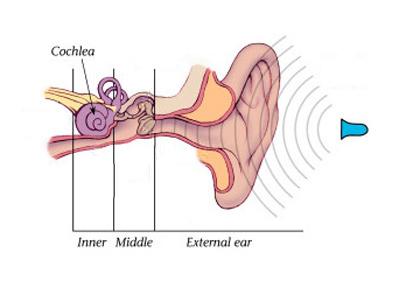
Figure 2. Pressure waves from the speaker pass through the air to the external ear which collects the sound and passes it to the ear drum.

Millions of years ago marine animals had hearing organs that allowed them to detect sounds in the water. When land dwelling animals evolved they now had to detect environmental sounds that traveled through the air. This created a special challenge because their inner ears continued to be fluid filled. When sound passes from one media to another (as, in this example, from air to water) some energy is reflected by the surface and does not pass to the new media. In order to reduce these reflections and maximize the transfer of sound energy from the air filled environment to the fluid filled inner ear, land animals evolved external ears as sound collectors and middle ears as mechanical force amplifiers. It is fascinating that the tiny bones in the middle ear appear to have evolved from gills that were no longer needed.

Figure 2 shows the path that sound waves follow from the sound source where they are generated to the inner ear. The middle ear consists of the ear drum, the middle ear bones, and the membrane over the oval window at the entrance to the inner ear. The cochlea of the inner ear is named with the Greek word for "snail" because of its spiral shape. Did you know that the left cochlea spirals to the left and the right cochlea spirals to the right?

The outer portion of the external ear reflects sound towards the ear canal. Once in the ear canal, the pressure waves are aligned so they strike the ear drum at right angles. The reflection of sounds of different frequency is not the same and as a result the relative amplitude of some frequencies is greater than others. The result is that the relative amplitude of different frequencies at the ear drum differs, even if sound begins at the same intensity for all frequencies. Modification of the original sound by the external ear is a type of analysis that your brain learns to interpret. The frequency composition of familiar sounds aids your auditory system in determining where a sound is coming from. You can perform a simple experiment to appreciate the "frequency analysis" performed by the external ear. Cupping your hands over your ears and bending the top of your ears down changes the energy of different frequencies at your ear drum. Ask a friend to snap their fingers or clap their hands behind you before and after bending your ears. The sound will appear to come from different locations, particularly if the sound is coming from above or below your head, because your brain attempts to analyze the ear’s input to the brain based on the normal frequency pattern.

The middle ear bones conduct sound from the ear drum to the fluids of the inner ear. The ear drum is bigger than the oval window. The decrease in the area of these two membranes leads to an increase in pressure (pressure is equal to force divided by area and as the area gets smaller the pressure increases). The middle ear bones act as mechanical levers and further increase the pressure of the sound at the entrance to the cochlea. All of this is necessary to maximize the sound energy that gets to the fluids of the inner ear. There is a tube (called the Eustachian tube) that connects the middle ear to the nose. Its purpose is to allow the air pressure in middle ear to be equal to the air pressure in the environment. The pressure balance allows the ear drum to vibrate freely. Sometimes when you have a cold the tube is blocked and the middle ear pressure can not be balanced. You may have experienced the discomfort and even pain that can result if you are rapidly changing altitude (as when an airplane is landing). The freedom of movement of the middle ear bones can be reduced by certain diseases which leads to hearing loss. Any problem in the outer or middle ear that leads to a reduction of the sound energy entering the inner ear leads to what is called a conductive hearing loss. Many of these problems can be corrected either though medicine or surgery and contrast with the long term hearing problems that arise from damage to the structures in the inner ear.

Next chapter: The Inner Ear - A Closed Shop With a Division of Labor

Return to the table of contents of How the Ear Works

  • Head and Neck Surgery
  • Center for Airway, Voice and Swallowing
    • Speech-Language Pathology
  • Hearing and Balance
    • Cochlear Implants
    • Audiology Services
    • Program for Lateral Skull Base Surgery
    • Balance Testing (Vestibular Diagnostics)
    • Balance Therapy (Vestibular Rehabilitation)
  • Nose and Sinus
  • For Patients
  • Meet Our Team

Make an Appointment

CALL 713–798–6336 Monday-Friday 7 a.m.-5 p.m.

ONLINE

Request Now

Request non-urgent appointments

Find a Physician
mychart

MyChart is a patient-accessible website that enables you to interact with your Baylor Medicine healthcare team.

Login

mobile-phone-image

Follow Us facebook twitter youtube linkedin instagram rss 

Footer Menu Healthcare

  • Healthcare
    • Specialties
    • MyChart Login
    • For Patients & Visitors
    • For Health Professionals
    • Clinical Trials
    • Find a Physician

Footer Menu Education

  • Education
    • Programs & Admissions
    • Student & Trainee Resources
    • Faculty Resources
    • School of Medicine
    • Graduate School of Biomedical Sciences
    • National School of Tropical Medicine
    • School of Health Professions
    • Tuition & Fees
    • Financial Aid

Footer Menu Research

  • Research
    • Our Research
    • Core Labs
    • Faculty Labs
    • Research Centers
    • Research Offices

Footer Menu Community

  • Community
    • Healthcare Outreach
    • Education Outreach
    • Global Programs
    • Community Events

Footer Menu About

  • About
    • Our Campus
    • Departments
    • Academic Centers
    • Administrative Offices
    • Affiliates
    • Leadership
    • Giving
    • Alumni

Footer Menu Resource Links

  • Resource Links
    • Contact Us
    • Find a Person
    • Careers
    • BCM Team Shop
    • News
    • Title IX Office
    • Compliance
    • Covid Response Site

©1998-2026 Baylor College of Medicine® | 1 Baylor Plaza, Houston, Texas 77030 | 713-798-4951
Have an edit or suggestion for this page?

  • Compliance
  • Privacy
  • Intranet