

Baylor Research
The extensive research conducted at Baylor College of Medicine and its affiliated hospitals is a strong feature of the residency program. Our committed faculty members provide robust support for residents actively pursuing research projects.
Baylor College of Medicine among the very top in the nation for funds received for pediatric research from the National Institutes of Health.
Texas Children’s Hospital has three distinct research facilities that offer specific areas of focus to expand learning opportunities. The Feigin Center houses state-of-the-art laboratories including a GMP cell and vector processing facility; an animal imaging facility, and SIM center for educational training. The Jan and Dan Duncan Neurological Research Institute offers collaboration with different clinical departments to research developmental disorders and other inherited pediatric neurological diseases. The Children’s Nutrition Research Center, the largest and most comprehensive center of its kind, is dedicated to the study of childhood nutrition.
In addition, Texas Children’s Hospital strongly supports educational research and innovation via the Center for Research Innovation and Scholarship (CRIS) in medical education as well as our Simulation Center.
Research Highlights
- Residents have the opportunity to interact, pursue, and receive mentorship from all faculty, including subspecialties.
- Residents gain insight into future subspecialty career options during Fellow’s Research Day.
- Baylor College of Medicine’s reputation and scholarly research pursuits attract high acceptance rates of residents interested in fellowship opportunities at other prestigious institutions.
- The Texas Medical Center provides avenues for collaboration with other institutions of higher learning and patient care such as The University of Texas School of Public Health, MD Anderson and Rice University.
Resident Scholarship Program
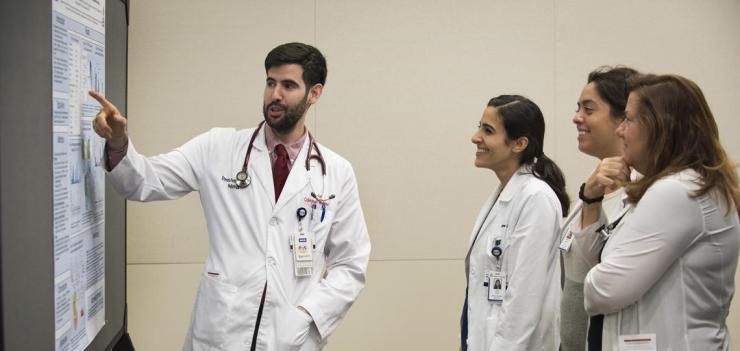
Medicine is rapidly changing. Increasingly, pediatricians are no longer just clinical practitioners. In many settings, pediatricians are expected to participate in a range of scholarship activities including clinical studies, basic science research, advocacy, education, quality improvement, patient safety, and simulation. Reflecting this trend, the Accreditation Council of Graduate Medical Education now requires that all pediatric residents engage in scholarship. The aim of the Resident Scholarship Program is to provide knowledge, skill, and supervised experience in designing, conducting, and reporting a scholarly project.
The Resident Scholarship Program consists of several components:
- Core lecture series
- Scholarly Project rotation to work on your scholarly project
- Participate in Resident Scholarship day and present your project to the wider Baylor College of Medicine community
The possibilities for what your scholarly project might entail are vast. Our hope is that you find an area of interest, capitalize on all components of RSP and begin your career with an eye toward scholarship. Scholarship can be in any of the following fields: research, clinical (case reports, chart reviews, patient information), advocacy, teaching, or quality improvement.
Current Resident Scholarly Activity
Our most recent Resident Scholarship Day was held on May 29, 2026.
| Presenter | Title |
|---|---|
| Avery J. Allen, M.D. | Mitral Annular Disjunction: A Novel Congenital Finding in Tricuspid Atresia with Associated Arrythmia |
| Shayan Bhathena, M.D. | PrEP School: Improving Resident Proficiency at Prescribing HIV Pre-Exposure Prophylaxis |
| Erin Bolte, M.D., Ph.D. | Isolated CNS Small Vessel Vasculitis Associated with Neuropsychiatric Systemic Lupus Erythematous: A Pediatric Case Report |
| Diana Bueso-Mendoza, M.D., MBA | Incidence and Outcomes of Acute Kidney Injury Following Extracorporeal Membrane Oxygenation as a Bridge to Lung Transplantation in the Pediatric Population: Retrospective Review |
| Busra Dalgic, M.D. | Demographics and Clinical Features of Deficiency of Adenosine Deaminase 2 (DADA2): A Large Quaternary Single Center Experience |
| Busra Dalgic, M.D. | Utilization and Safety of Live Attenuated Vaccines in Patients with Fontan-Associated Protein-Losing Enteropathy |
| Busra Dalgic, M.D. | Early Recognition of Hepatic Veno-Occlusive Disease Using Pediatric EBMT Criteria in the Non-Transplant Oncology Setting |
| Kali Deans-Fielder, M.D., Ph.D. | Expanding the Phenotypic Spectrum of SLCO2A1 Deficiency: Chronic Enteropathy with Hypertrophic Osteoarthropathy and Myelofibrosis |
| Kiely Fagundes, M.D. | Short Term Effects of Low Dose Dexamethasone in Very Low Birth Weight Infants |
| Jessy Feng, M.D. | Iron Deficiency is Common in Congenital Heart Disease |
| Sravya Gurivireddygari, M.D. and Tahmina Mohiuddin, M.D. | Addressing Secondary Traumatic Stress Among Educators in Trauma-Exposed School Communities at YES Prep THRIVE |
| Sammie James, M.D. | Peri-operative Neurologic Complications in Children Supported on VAD |
| Amrit Kannan, M.D. | Acute Rheumatic Fever Presenting with Syncope, Atrial Flutter, and Multivalvular Regurgitation: A Case Report |
| Tiffany King, M.D., Ph.D. | Modeling Acute Chest Syndrome in Humanized Mouse Model for Sickle Cell Disease Using Products of Hemolysis |
| Tiffany King, M.D., Ph.D. | Association of Pulmonary Function Changes with Acute Chest Syndrome Severity in Children with Sickle Cell Disease |
| Blake Meyer, M.D. | Improving Bowel Management in Pediatric Patients with Spina Bifida |
| Megan N. Murphy, D.O., M.S. | The Use of Intravenous Ferric Carboxymaltose for Iron Replacement in Infants with Intestinal Failure in the Neonatal Intensive Care Unit – A Case Series |
| J. Quin Neilson, M.D. | Tailored Tales: Generative AI Storybooks for Pediatric Perioperative Anxiety Reduction |
| Heerali Patel, M.D. | A Comparison of Outcomes in Human Milk-Fed Premature Infants with a Human Milk-Derived Fortifier versus Bovine Milk-Derived Fortifier |
| Marisa Pinson, M.D., Ph.D. | The Impact of Prenatal Co-Exposure to Alcohol and Cannabinoids on Neurogenesis |
| Emma Reford, M.D. | Comparison of Respiratory Adjuncts on Pediatric Drowning Outcomes |
| Maheen Sheikh, M.D. | Dolichocolon in Pediatric Constipation: Expanding Prevalence, Age-Dependent Clinical Significance, and a Developmental Biomechanical Framework |
| Sarah Stockum, M.D. | “We need to get rid of the fog” – A Teenager with Autism and Progressive Vision Loss |
| Hailey Tinsley, M.D. | High Early Platelet Transfusion Burden Flags Endothelial Risk but Not aGVHD After Matched Sibling HSCT for Pediatric Sickle Cell Disease |
| Christopher Wong, M.D., M.Sc. | Socioeconomic and Insurance Determinants of Biologics Access for Severe Persistent Asthma |