Home
  • Healthcare
    • Specialties
      • Cardiovascular Care
      • Oncology
      • Neurosurgery
      • Primary Care
      • View All Specialties >
    • For Health Professionals
      • Refer a Patient
      • Clinical Trials
      • Professional Development
      • View All >
    • For Patients & Visitors
      • MyChart Login
      • Accepted Insurance
      • Pay My Bill
      • Patient Information
      • View All >
    • Clinical Trials
      • Autism
      • Cancer
      • Obesity
      • Substance Abuse
      • View All Clinical Trials >
    • Find a Doctor
    • Make an Appointment

    General Inquiries

    Call today to schedule an appointment or fill out an online request form. If requested before 2 p.m. you will receive a response today.

    CALL

    713-798-1000

    Monday – Friday 8 a.m. – 5 p.m.


    ONLINE

    Request Now

    Request non-urgent appointments

    Request an appointment, learn about your rights as a patient, read about what to expect from your appointment, and more.

    As Houston's premier academic medical practice, Baylor Medicine delivers compassionate, innovative, evidence-based care.
    Find a Doctor

  • Education
    • Degree Programs & Admissions
      • M.D. Program
      • Ph.D. Programs
      • DNP Program (Nurse Anesthesia)
      • Genetic Counseling Program
      • P.A. Program
      • Orthotics & Prosthetics Program
      • Baccalaureate/M.D. Programs
      • Dual Degree Programs
      • View All Programs >
    • Financing Your Education
      • Tuition & Fees
      • Financial Aid
      • CARES ACT
    • Schools
      • School of Medicine
      • Graduate School of Biomedical Sciences
      • National School of Tropical Medicine
      • School of Health Professions
    • Advanced Training Programs
      • Residency Programs
      • Clinical Fellowships
      • Postdoctoral Research Positions
      • Continuing Professional Development
      • Diploma in Tropical Medicine
      • View All >
    • Resources
      • Departments
      • Academic Centers
      • Academic Calendars
      • Education Cores
      • View All >
    • Information For...
      • Students
      • Postdoctoral Researchers
      • Faculty
      • Alumni
    get-to-know-houston

    America's fourth-largest city is a great place to live, work, and play. Find out why.
    Get to Know Houston

  • Research
    • Research Offices
      • Advanced Technology Cores
      • Clinical Research
      • Institute for Clinical & Translational Research
      • Office of Research Leadership
      • Research IT
      • Sponsored Programs
    • Research at Baylor
      • Academic Centers
      • Departments
      • Faculty Labs
      • From the Labs
      • News
      • Our Research
      • Research Centers
      • Strategic Research Center
    • Additional Research Services
      • BCM Innovation Institute
      • Service Labs
      • VIICTR
    get-to-know-houston

    America's fourth-largest city is a great place to live, work, and play. Find out why.
    Get to Know Houston

  • Community
    • Healthcare Outreach
      • Community Programs
      • More >
    • Global Outreach
      • Global Health
      • Global Programs >
    • Educational Outreach
      • SMART Program
      • BioEd Online
      • More >
    • General Resources
      • Community Events
      • News
      • Blogs
      • Baylor in the Community
    get-to-know-houston

    America's fourth-largest city is a great place to live, work, and play. Find out why.
    Get to Know Houston

  • About
    • About Us
      • Academic Centers
      • Alumni
      • Careers
      • Departments
      • Giving
      • Leadership
      • Mission, Vision, Values
      • News
      • Our Affiliates
      • Fast Facts
      • Accreditation
    • Offices
      • President's Office
      • Office of Research
      • Ombuds Office
      • BCM Innovation Institute
      • View All >
    • Our Campus
      • Compliance
      • Safety and Security
      • Resource Stewardship & Sustainability
      • Team Shop
      • Find a Person
    get-to-know-houston

    America's fourth-largest city is a great place to live, work, and play. Find out why.
    Get to Know Houston

  • GIVE
  • CAREERS
  • INTRANET
  • Careers
  • Contact Us
  • News
Dan L Duncan Comprehensive Cancer Center
  • Leadership
  • Education
  • Research
  • Healthcare
  • New Funding Opportunities
  • Community Outreach and Engagement
  • Membership
  • News and Events
  • Leadership
  • Education
  • Research
  • Healthcare
  • New Funding Opportunities
  • Community Outreach and Engagement
  • Membership
  • News and Events
  1. Baylor College of Medicine
  2. Academic Centers
  3. Dan L Duncan Comprehensive Cancer Center
  4. Community Outreach and Engagement
  5. Community Engagement Resources
  6. Clinical Trials Support
  • Meet our Team
  • Service Area
  • Our Partners
  • Community Engagement Resources
    • Online Health Library
    • Theater Outreach Program
      • Monologues and Plays
      • Talent Production Partners
    • Outreach Programs and Educational Resources
    • Cancer Prevention Programs
    • Community-Engaged Research
    • Clinical Trials Support
    • BodyGuards Volunteer Program

Clinical Trials Support

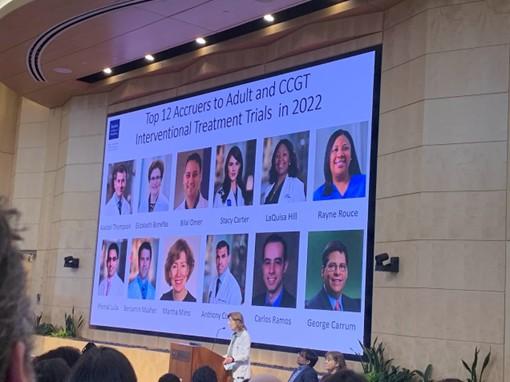
person speaking in front of a large powerpoint presentation screen


Clinical Trials for cancer are research studies that test the safety and effectiveness of new treatments or medical products, like medicines and devices, in healthy volunteers or patients. These studies may show which medical approaches work best for certain malignancies or patient populations. Certain demographic groups are less frequently enrolled in clinical research, posing a challenge for outcome interpretation as people of different ages, races, and ethnicities may respond differently to different cancer interventions.

Local Cancer Burden: Key Insights

In our catchment area, the four most common cancers mirror national trends: breast (17%), prostate (15%), lung and bronchus (12%), and colorectal (10%). While Black women have a lower overall rate of breast cancer compared to White women, they are twice as likely to be diagnosed with triple-negative breast cancer, a more aggressive subtype. Additionally, Black individuals experience higher incidence and mortality rates for both prostate and colorectal cancers.

Liver cancer rates in our area are higher than the national average (10 vs. 8 per 100,000 people), with even higher rates among Black and Hispanic communities. In our catchment area, cervical cancer is also more common and more deadly, with about 20% more cases and 30% higher mortality compared to the U.S. overall.

Compared to the rest of the country, fewer children are diagnosed with cancer in our area. However, childhood cancer mortality is about 23% higher. This increase in mortality is likely due to the higher proportion of Hispanic children in the region, who often experience worse outcomes in certain cancers, like leukemia. 

Therefore, it is important to include all patients in our catchment area in cancer research. As we study new and better ways to treat cancer, we must ensure that everyone who could benefit has the chance to take part in clinical trials, access investigational therapies, and be included in efforts to understand treatment outcomes.

Expanding Access to Clinical Trials through Community Collaboration

The DLDCCC COE is dedicated to enhancing clinical trial support across communities within and beyond our catchment area, acknowledging the many barriers that have hindered research participation for different groups. Some of these barriers include a lack of awareness, medical mistrust, and logistical or financial challenges, which contribute to different rates of healthcare uptake and clinical trial enrollment.

To address these common concerns, the COE uses a multi-level, multi-step approach that involves ongoing communication among staff from the COE and the Office of Outreach and Health Disparities (OOHD), the Community and Patient Advisory Board (CAB/PCAB), local community groups, and DLDCCC members. Through these interactions, the CAB/PCAB communicate outreach-related priorities directly to COE and DLDCCC leadership (Figure 1). COE conducts quarterly needs assessments with the CAB/PCAB, community partners, and community members at outreach events to better understand community cancer education and research priorities, identify key needs, and ensure the DLDCCC strategic goals align with community needs. 

Key priorities identified for 2024-2025 include:

  1. Increase community awareness of lifestyle, genetics, and environmental cancer risk factors.
  2. Increase cancer prevention, screening, and uptake for breast, CRC, liver, and HPV-associated cancers.
  3. Provide education on biological determinants of cancer disparities.
  4. Develop, test, and disseminate interventions to increase physical activity and reduce child obesity.
  5. Increase participation in clinical trials through community education.

COE Facilitated Bidirectional Engagement Examples:

  1. Community members identified the need for culturally and linguistically tailored educational materials about cell therapy clinical trials. Program leadership noted challenges in simplifying the complex information and addressing common concerns. In response, CAB/PCAB in coordination with COE, led the development of culturally and linguistically appropriate trial materials. In addition, they also provided training for providers on best practices for enrolling and retaining diverse populations, using CRTEC lay-language.
  2. Community members reported limited health literacy and difficulty navigating clinical trials logistics and insurance barriers. Program data showed lower trial enrollment among uninsured, publicly insured, and out-of-network patients. In response, COE in collaboration with CPPS and the CAB/PCAB, launched a community-based clinical trial insurance navigation and health literacy program. They also developed an educational curriculum to train Community Cancer Research Ambassadors. 

COE efforts to boost clinical trial recruitment and retention presentation:

  1. Review study materials – Ensure that study protocols and informed consent forms are easy to understand, address common misconceptions and concerns, and are reflective of the feedback from the CAB/PCAB and community members, culturally.
  2. Offer Proposal and Protocol Feedback – Participate in the DLDCCC’s Protocol Review and Monitoring Committee (PRMC) meetings to provide feedback on how proposals align with catchment area priorities.
  3. Lead Healthcare Provider Training – Collaborate with our CAB/PCAB to offer interactive training workshops for DLDCCC members, clinical researchers, and clinical trials that train on best practices for recruitment, retention, and engagement with broad patient populations and community partners.  
  4. Address Barriers – Provide clinical trial and clinical research consultations, working with investigators and study teams to identify and troubleshoot study-specific barriers.

In coordination with our Theater Outreach Program, we have produced two videos that cover common misconceptions about clinical trials and research participation, which we showcase both within DLDCCC and in the broader community.

A Win-Win for Everyone - a short reel about the importance of participating in clinical trials in the African American community (English ~6 minutes).

Todos Ganamos - a short reel about the importance of participating in clinical trials in the Hispanic Community (Spanish with English subtitles ~6 minutes).

COE has also developed a number of educational videos on the importance of representation in clinical trials. These videos can be viewed on our Online Health Library under the Monologues – Quick Reels tab.  

Learn more about clinical trial opportunities at Baylor College of Medicine.

  • Meet our Team
  • Service Area
  • Our Partners
  • Community Engagement Resources
    • Online Health Library
    • Theater Outreach Program
      • Monologues and Plays
      • Talent Production Partners
    • Outreach Programs and Educational Resources
    • Cancer Prevention Programs
    • Community-Engaged Research
    • Clinical Trials Support
    • BodyGuards Volunteer Program

Contact Us

Phone 713–798–6643
Email dldccc-coe@bcm.edu

Community Outreach and Engagement

Dan L Duncan Comprehensive Cancer Center
One Baylor Plaza MS: BCM305 Houston, TX 77030

Connect with us

Follow Us facebook twitter youtube linkedin instagram rss 

Footer Menu Healthcare

  • Healthcare
    • Specialties
    • MyChart Login
    • For Patients & Visitors
    • For Health Professionals
    • Clinical Trials
    • Find a Physician

Footer Menu Education

  • Education
    • Programs & Admissions
    • Student & Trainee Resources
    • Faculty Resources
    • School of Medicine
    • Graduate School of Biomedical Sciences
    • National School of Tropical Medicine
    • School of Health Professions
    • Tuition & Fees
    • Financial Aid

Footer Menu Research

  • Research
    • Our Research
    • Core Labs
    • Faculty Labs
    • Research Centers
    • Research Offices

Footer Menu Community

  • Community
    • Healthcare Outreach
    • Education Outreach
    • Global Programs
    • Community Events

Footer Menu About

  • About
    • Our Campus
    • Departments
    • Academic Centers
    • Administrative Offices
    • Affiliates
    • Leadership
    • Giving
    • Alumni

Footer Menu Resource Links

  • Resource Links
    • Contact Us
    • Find a Person
    • Careers
    • BCM Team Shop
    • News
    • Title IX Office
    • Compliance
    • Covid Response Site

©1998-2026 Baylor College of Medicine® | 1 Baylor Plaza, Houston, Texas 77030 | 713-798-4951
Have an edit or suggestion for this page?

  • Compliance
  • Privacy
  • Intranet