
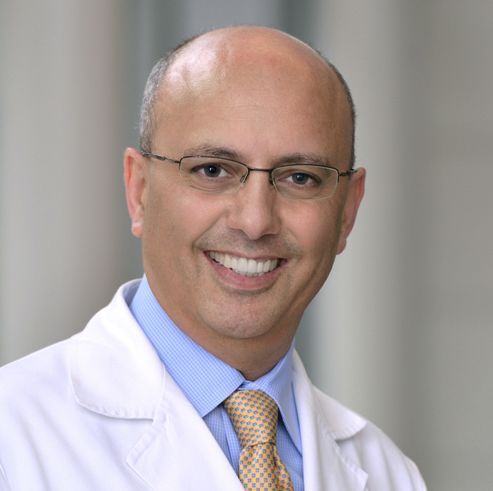
Positions
- Professor of Surgery
-
Division of Surgical Oncology
Baylor College of Medicine
- Medical Director, Neuroendocrine Tumor Program
-
Baylor St. Luke's Medical Center
Addresses
- Dan L Duncan Comprehensive Cancer Center (Clinic)
-
Elkins Pancreas Center
O’Quinn Medical Tower at Baylor St. Luke’s Medical Center’s McNair Campus
Houston, TX, 77054
United States
Phone: (832) 957-6500
Fax: (713) 610-4597
MAP IT
Education
- Residency at Medical College of Pennsylvania
- Philadelphia
- General Surgery
- Fellowship at State University of New York
- Buffalo
- Cardiovascular Surgery Research
- Clinical Fellowship at Texas Heart Institute
- Houston
- Heart Transplantation and Mechanical assist devices
- Clinical Fellowship at The University of Texas Medical School at Houston
- Houston
- Transplant Surgery
- Residency at Aleppo University Hospital
- Aleppo
- MD from Aleppo University Medical School
- Aleppo
Certifications
- Royal College of Surgeon (Ed), UK
Professional Interests
- Liver and pancreas surgery
- Upper gastrointestinal surgery
- Neuroendocrine tumors
- Gastrointestinal tumors
- Minimally Invasive Surgery
Professional Statement
Omar Barakat, M.D. is a general surgeon with more than twenty years of experience in diagnosing and treating benign and malignant diseases of the liver, bile duct, gallbladder, and pancreas. After completing his general surgery residency in the Medical College of Pennsylvania, Episcopal Hospital in Philadelphia in 1992, he pursued a liver transplantation fellowship at The University of Texas Health Science Center in Houston.
Dr. Barakat continued his practice in liver and pancreatic surgery in England, where in 1998 he joined the Freeman Hospital in Newcastle Upon-Tyne, UK. For the next five years he gained extensive experience in treating complex and rare tumors of the liver, bile duct, and pancreas.
Dr. Barakat returned to Houston in 2003 and has been applying his special expertise to treat malignant hepatobiliary and pancreatic diseases, gastrointestinal stromal tumors (GIST), and neuroendocrine tumors (NET). Currently, he serves as the medical director of the newly established neuroendocrine program at Baylor St. Luke’s Medical Center. The program includes a multidisciplinary group of gastroenterologists, medical oncologists, radiologists, pathologists, and radiation oncologists.
Dr. Barakat has developed new surgical techniques to minimize the complication rate and blood loss following pancreatic and liver surgeries. He utilizes image-guided therapies, such as radiofrequency ablation, microwave ablation, irreversible electroporation (NanoKnife system), trans-arterial chemotherapy, and selective internal radiotherapy (SIRT) with Yttrium-90 microspheres, to treat liver tumors while minimizing trauma to the patients.
Dr. Barakat's clinical and basic science research interests also include the study of neuroendocrine tumors and the development of off-the-shelf bio-artificial liver organs that can be suitable for liver transplantation in patients with end-stage liver disease.
Dr. Barakat continued his practice in liver and pancreatic surgery in England, where in 1998 he joined the Freeman Hospital in Newcastle Upon-Tyne, UK. For the next five years he gained extensive experience in treating complex and rare tumors of the liver, bile duct, and pancreas.
Dr. Barakat returned to Houston in 2003 and has been applying his special expertise to treat malignant hepatobiliary and pancreatic diseases, gastrointestinal stromal tumors (GIST), and neuroendocrine tumors (NET). Currently, he serves as the medical director of the newly established neuroendocrine program at Baylor St. Luke’s Medical Center. The program includes a multidisciplinary group of gastroenterologists, medical oncologists, radiologists, pathologists, and radiation oncologists.
Dr. Barakat has developed new surgical techniques to minimize the complication rate and blood loss following pancreatic and liver surgeries. He utilizes image-guided therapies, such as radiofrequency ablation, microwave ablation, irreversible electroporation (NanoKnife system), trans-arterial chemotherapy, and selective internal radiotherapy (SIRT) with Yttrium-90 microspheres, to treat liver tumors while minimizing trauma to the patients.
Dr. Barakat's clinical and basic science research interests also include the study of neuroendocrine tumors and the development of off-the-shelf bio-artificial liver organs that can be suitable for liver transplantation in patients with end-stage liver disease.
Selected Publications
-
Barakat O, Cagigas MN, Bozorgui S, Ozaki CF, Wood RP.. " Proximal Roux-en-y Gastrojejunal Anastomosis with Pyloric Ring Resection Improves Gastric Emptying After Pancreaticoduodenectomy " J Gastrointest Surg. ;
Pubmed PMID: 26850262. -
George Van Buren, MD, Omar Barakat, MD, Sally E. Hodges, and William E. Fisher, MD. et al.. " Randomized Prospective Multicenter Trial of Pancreaticoduodenectomy with and without Routine Intraperitoneal Drainage. " ;
-
Delpassand ES, Samarghandi A, Mourtada JS, Zamanian S, Espenan GD, Sharif R, Barakat O, Mackenzie S, Kosari K, Seng JE, Antony L.. " Long-Term Survival, Toxicity Profile, and role of F-18 FDG PET/CT scan in Patients with Progressive Neuroendocrine Tumors Following Peptide Receptor Radionuclide Therapy with High Activity In-111 Pentetreotide. " Theranostics. ;
-
Barakat O, Ozaki CF, Wood RP. " Topically applied 2-octyl cyanoacrylate (Dermabond) for prevention of postoperative pancreatic fistula after pancreaticoduodenectomy. " ;
Memberships
- Royal College of Surgeons
- Fellow
Intellectual Property
- Compositions and methods related to organ or tissue decellularization
- Method Patent #US9962410B2 (Approved)
- Embodiments include methods for decellularizing an organ or tissue comprising conditioning the organ or tissue to be decellularized by exposing the organ or tissue to electricity, as well as methods of using such decellularized organs or tissues.
- Co Inventors: Jesus Rios
Log In to edit your profile