
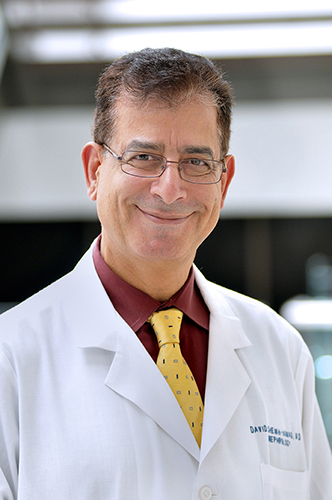
Positions
- Professor
-
Medicine-Nephrology
Baylor College of Medicine
Houston, TX, US
Education
- B.Sc. from Hebrew University Of Jerusalem
- 01/1976 - Jerusalem, Israel
- M.D. from Hadassah Medical School
- 01/1981 - Jerusalem, Israel
- Advanced Training from University Of California, Los Angeles
- 01/1984 - Los Angeles, CA, United States
- Advanced Training from National Institutes Of Health
- 01/1991 - Bethesda, MD, United States
Certifications
- ABIM-Medicine
- #115454
- ABIM
- Valid indefinitely
- ABIM-Nephrology
- #115454
- ABIM
- Re-certified 2002
Honors & Awards
- Fulbright & Jaworski L. L. P. Faculty Excellence Award
- Recipient of Baylor College of Medicine Fulbright & Jaworski L. L. P. Faculty Excellence Award for Teaching and Evaluation (8/2007).
- Baylor College of Medicine (08/2007)
- Faculty of the Year
- Recognized by the nephrology fellows, Baylor College of Medicine, for outstanding contributions to the educational mission of the Division of Nephrology, Selzman Institute for Kidney Health, May 2019 and May 2022.
- Baylor College of Medicine (05/2019 - 05/2022)
- Elected Member, Leadership Committee of KCVD
- Member at-Large (Elected): Leadership Committee of the Council on the Kidney in Cardiovascular Disease (KCVD); AHA, 7/2005 - 2010.
- AHA (07/2005)
- Member, Nominating Committee, KCVD
- Member: Nominating Committee of the AHA Council on Kidney in Cardiovascular Disease (KCVVD), 2004-2010.
- AHA (07/2004 - 06/2010)
- Member of the Academy of Distinguished Educators
- Member of the Academy of Distinguished Educators, Baylor College of Medicine (8/2007)
- BCM (07/2007)
Professional Interests
- Riverside Clinic
- Kidney Protection via Metabolic Sensors
Websites
Publications
Publications on PubMed
Professional Development
- Renal Grand Rounds
- Conference (Organizer, 2009)
- Sponsor: BCM/Methodist Hospital
- Weekly conference presented by national and international nephrology leaders, and features state-of-the-art lectures and new advances in nephrology.
Selected Publications
-
http://www-ncbi-nlm-nih-gov.ezproxyhost.library.tmc.edu/pubmed/?term=sheikh-hamad. " ;
-
Morduchowicz GA, Sheikh-Hamad D, Dwyer BE, Stern N, Jo OD, Yanagawa N. " Angiotensin II directly increases rabbit renal brush-border membrane sodium transport: presence of local signal transduction system. " J. Membr. Biol.. 1991 May ; 122 (1) : 43-53.
Pubmed PMID: 1652030. -
Huang L, Garcia G, Lou Y, Zhou Q, Truong LD, DiMattia G, Lan XR, Lan HY, Wang Y, Sheikh-Hamad D. " Anti-inflammatory and renal protective actions of stanniocalcin-1 in a model of anti-glomerular basement membrane glomerulonephritis. " Am. J. Pathol.. 2009 Apr ; 174 (4) : 1368-78.
Pubmed PMID: 19246645. -
Sheikh-Hamad D, Ayus CJ. " Antidiuretic hormone and renal clearance of uric acid. " Am. J. Kidney Dis.. 1998 Oct ; 32 (4) : 692-3; discussi.
Pubmed PMID: 9774136.
Funding
-
Megalin, and transition from AKI to CKDon and anti-inflammation
#I01BX002006 - $620,000.00 (04/01/2014 - 09/30/2027)
- Grant funding from Veteran Administration
- The prevalence of chronic kidney disease (CKD) in the US is rising concomitant with aging of the general population and coexistence of comorbidities such as hypertension and diabetes mellitus. Cardiovascular outcomes, sudden death and overall mortality are worse with advancing CKD. Ischemic kidney injury may exacerbate other disease processes and accelerate the progression to ESKD. The underlying pathways and contributing factors to the development and progression from AKI to CKD are poorly understood. Abnormalities in mitochondrial function play critical roles in many disease processes. We have recently shown megalin is present in the mitochondria, where it associates with stanniocalcin-1 (STC1) and SIRT3; two proteins that promote anti-oxidant defenses. Internalization into the cell and shuttling of the intracrines angiotensin II, STC1 and TGF- from the cell surface to the mitochondria are megalin-dependent; deletion of megalin is associated with impaired mitochondrial respiration and glycolysis. Megalin is found in clathrin-coated pits and provides endocytic receptor-mediated ligand uptake. Here, we show tubular epithelium-specific KO of megalin aggravates AKI after ischemia/reperfusion (I/R) and is associated with severe and sustained kidney inflammation, upregulation of TGF-β1 and fibrosis, cell cycle arrest, mitochondrial stress, dysregulated lysosomal function and rapid progression to CKD. Additionally, we show TGF-is degraded by the mitochondrial caseinolytic protein proteases. We hypothesize that megalin is a guardian of kidney health; megalin downregulates pathways of cellular injury (inflammation, TGF-β1, fibrosis) and preserves recovery pathways (mitochondrial function, lysosomal biogenesis); upregulation of megalin may be a therapeutic target to slow CKD progression. In the current proposal, we will characterize the role of megalin in the transition from AKI to CKD and identify potential therapeutic targets - to prevent CKD after AKI. Aim 1A will examine kidney injury, TGF-β signaling, fibrosis and progression to CKD in mice with tubular epithelium-specific overexpression of megalin using post-I/R model. Aim 1B will examine the role of mitochondrial caseinolytic protein proteases in the termination of TGF- signaling. Aim 1C will examine the expression of cell cycle regulators and TGF-β1 signaling after I/R in mice with combined conditional tubular epithelium specific overexpression of megalin and deletion of SMAD3. Aim 2 will examine the expression of signaling molecules involved in autophagy and lysosomal biogenesis (mTOR, PGC1, TFEB, ERK2 and calcineurin) and characterize lysosomal morphology following hypoxia/reoxygenation in sgScramble and sgLrp2 BUMPT cells; this proposal will examine new paradigms for megalin-mediated kidney protection and identify therapeutic targets to prevent CKD progression after AKI.
Languages
Hebrew, Arabic
Log In to edit your profile